

Napa Valley cabernet sauvignon is worth it when you enjoy full-bodied, dry reds and the specific bottle delivers a drinking experience you prefer to your usual wine. In 2026, the Napa name alone is not a reason to spend more: match the wine’s style, origin, and intended use to your taste before paying for its reputation.
- Is Napa Valley cabernet sauvignon worth it? Yes for full-bodied red lovers; not automatically for every wine drinker.
- Napa Valley identifies origin, not a guaranteed flavor or quality level.
- Buywinesonline serves home wine buyers and gift shoppers with over 5,000 wines across multiple categories.
- Compare cabernet sauvignon without seeing the labels before deciding whether Napa deserves your extra spending.
Is Napa Valley cabernet sauvignon worth the price?
Yes for a bottle that suits your palate; no for a regional name you cannot distinguish in the glass. Cabernet sauvignon commonly brings dark-fruit flavors, firm tannins, and enough weight to stand alongside rich food. Napa offers many expressions of that grape, rather than one universal style.
Start with the actual label, not the winery’s address. This guide to how to read a wine label before buying explains the details that help you compare like with like.
| Option | Best for | Main advantage | Main limitation | Value test |
|---|---|---|---|---|
| Napa Valley cabernet sauvignon | Drinkers specifically interested in Napa-grown cabernet | Identifies a particular growing region and grape | Regional origin does not guarantee your preferred style | Do you prefer this bottle without seeing its label? |
| Cabernet sauvignon with a broader California designation | Drinkers exploring cabernet without requiring Napa origin | Keeps the grape consistent while widening your search | Gives less geographic detail than a Napa Valley designation | Does it provide the fruit and texture you want? |
| Napa Valley red blend | Drinkers interested in Napa reds beyond varietal cabernet | Allows a different combination of grapes and textures | Is not automatically equivalent to cabernet sauvignon | Does the blend better suit your meal and palate? |
None of these categories wins every occasion. A Napa cabernet that you love earns its place; a different red that you enjoy more is the better purchase for you.
Why this matters
Wine value has two parts: what the bottle delivers and what you want from it. A full-bodied red chosen for a steak dinner has a different job from a gift selected for someone who collects Napa wines.
For your 2026 purchases, separate drinking value from gift value. Drinking value comes from flavor, balance, and enjoyment. Gift value also includes the recipient’s interest in the producer or region—but a famous label still needs to match the person receiving it.
You do not need advanced tasting vocabulary to make this decision. Ask whether you enjoy the fruit, whether the drying sensation feels pleasant, and whether you want another sip. Those answers are more useful than repeating a tasting note that does not reflect your experience.
When Napa Valley cabernet is worth choosing
Best for full-bodied red wine lovers
Napa cabernet is a sensible category to explore when you already enjoy dry reds with substantial body and tannin. Look for descriptions that match what you like: ripe dark fruit, restrained oak, freshness, or a firmer texture.
The advantage is a clear starting point for your search. The limitation is variation: two Napa cabernets can taste quite different because of their vineyard sources and winemaking choices. Choose the description that fits your taste, not the bottle that sounds most impressive.
Fruit intensity and sweetness are also different things. A dry wine can smell and taste strongly of ripe fruit without being a sweet wine. If sweetness is what you want, do not assume a fruit-forward cabernet will satisfy that preference.
Best for a deliberate dinner pairing
Cabernet sauvignon is a useful match for steak, roast beef, and other rich dishes. Its tannins and weight give it a different role at the table from a light, delicate red.
The advantage is a pairing that gives the wine room to show its character. The limitation is that the same intensity can dominate a delicate dish. If you are serving a mixed menu, choose for the food and guests rather than making Napa the fixed starting point.
A meal also changes your perception of wine. Taste a small amount before eating, then try it with the dish. A bottle that feels firm on its own can be more enjoyable alongside food.
Best for a recipient who specifically likes Napa
Napa cabernet makes sense as a gift when the recipient has expressed an interest in the region, grape, or producer. That is a stronger reason than assuming every wine drinker wants a prestigious red.
The advantage is personal relevance. The limitation is a mismatch when the recipient prefers lighter reds, white wines, or sweeter styles. A gift that reflects someone’s taste is better chosen than one that merely signals expense.
Ask what they have enjoyed recently. A familiar preference gives you a practical direction without requiring you to guess their cellar plans or level of wine knowledge.
When the Napa name is not enough
Skip the regional premium when you do not enjoy cabernet’s basic character. Paying more does not remove tannin, turn a dry wine sweet, or make a powerful red delicate.
A broader California cabernet deserves consideration when your goal is simply an enjoyable cabernet. Its geographic designation is less specific, but that does not establish that it tastes worse. Compare the bottles themselves.
A Napa red blend also deserves separate consideration if its description fits your taste better. Do not treat “red blend” as a lesser category or as interchangeable with cabernet sauvignon. Check the stated grapes and style before deciding.
For a casual gathering in 2026, your guests’ preferences matter more than geographic specificity. If you do not know whether they enjoy firm, full-bodied reds, committing the entire wine selection to Napa cabernet is a poor match to the occasion.
Why Napa cabernet’s value varies
These factors explain why one bottle earns your repeat purchase while another does not. They are selection criteria, not promises that a particular wine is better.
- Origin: A Napa Valley designation identifies grape origin. More specific geography gives you additional information, not an automatic quality ranking.
- Grape composition: A varietal cabernet and a red blend are not necessarily the same wine style. Check the stated composition when comparing them.
- Vintage: Weather changes grape growing from harvest to harvest. Evaluate information about the exact vintage rather than transferring praise from another release.
- Winemaking: Oak use, extraction, and blending affect flavor and texture. Favor choices that match your preferences instead of assuming greater intensity means greater quality.
- Readiness: Some wines are enjoyable young; others have structure suited to development. Match the bottle to whether you want to drink it now or store it.
- Occasion: Dinner, gifting, and collecting place different demands on a bottle. Identify the job before deciding whether the wine earns the extra spending.
A producer’s reputation can help you identify bottles to investigate. It cannot tell you whether you will enjoy the exact wine, vintage, and serving context in front of you.
What does a Napa Valley label actually tell you?
Under U.S. federal wine-labeling rules, a wine bearing an American Viticultural Area designation generally must derive at least 85% of its grapes from that named area. The general federal minimum for naming a grape variety is 75% of that variety, subject to applicable exceptions and additional rules.
These are origin and composition requirements—not tasting scores. “Napa Valley” does not mean every grape came from one vineyard, and “cabernet sauvignon” does not necessarily mean the wine contains only cabernet sauvignon.
Also distinguish a winery’s location from the wine’s stated appellation. A producer can make wines from different growing regions. Read the origin printed for the exact bottle rather than inferring it from a familiar winery name.
In 2026, those distinctions remain useful when comparing listings. Keep producer, appellation, vintage, and bottle size separate in your notes. Otherwise, you risk treating different wines as equivalent because part of their names matches.
How can you tell whether Napa cabernet is worth it to you?
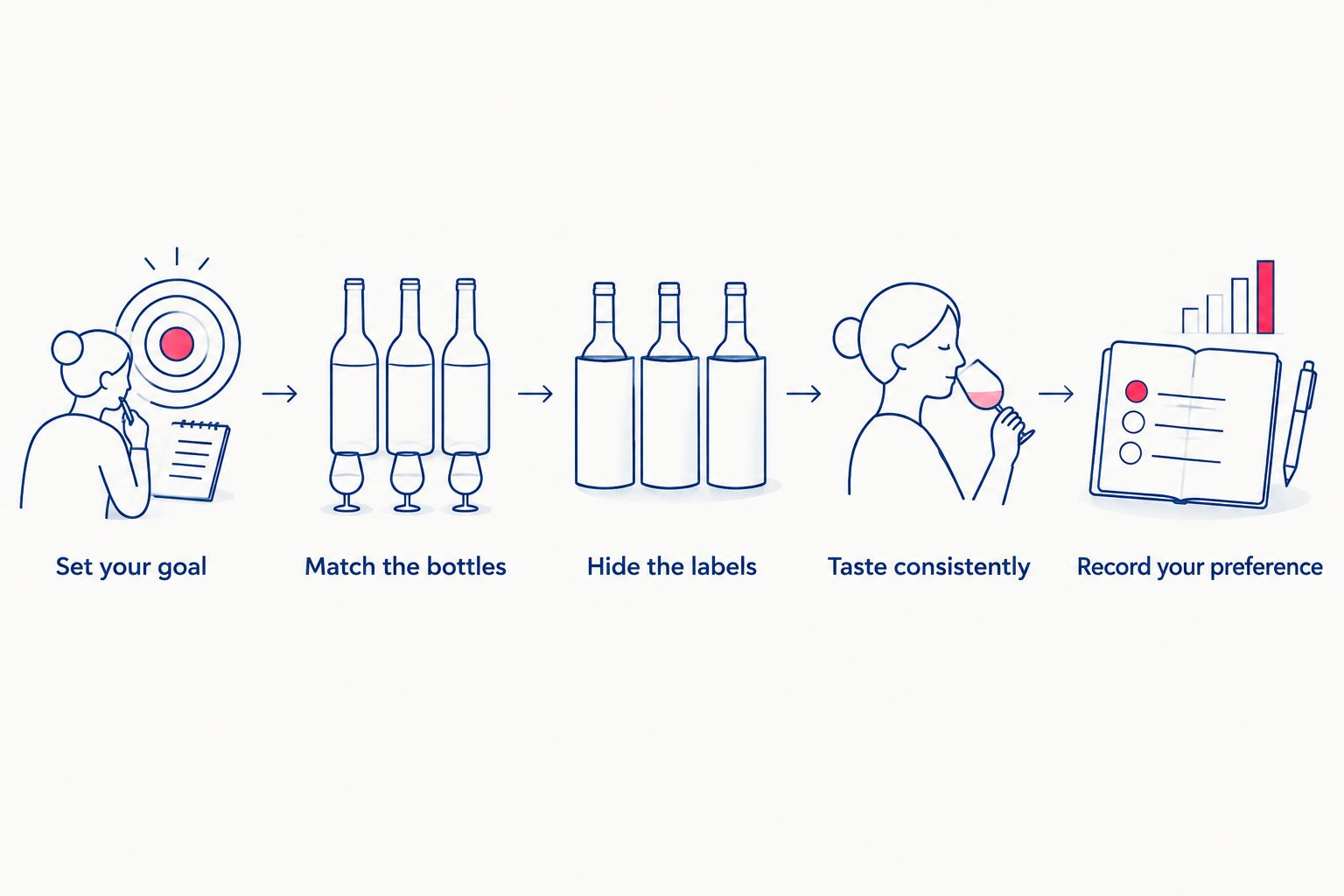
Compare wines without visible labels, using the same glasses and serving conditions. This removes the most obvious reputation cue and helps you focus on what you actually enjoy.
- Set your goal. Decide whether you are choosing a dinner wine, a gift, or a bottle to store. For a drinking comparison, use wines intended for a similar occasion.
- Match the bottles. Compare cabernet with cabernet where possible. Check bottle size and vintage, and note meaningful differences rather than ignoring them.
- Hide the labels. Have someone cover or code the bottles. Keep producer names and regional designations out of view while tasting.
- Taste consistently. Use matching glasses and the same serving conditions. Try the wines on their own and with the food you intend to serve.
- Record your preference. Write down which wine you prefer and why before revealing the bottles. Then decide whether that preference justifies your extra spending.
Look for balance rather than a single dramatic feature. Strong fruit, obvious oak, or a long finish can attract attention, but the useful question is whether those elements work together for you.
Keep the first decision small. You do not need a large purchase to learn that you prefer a fresher style, less oak, or a softer texture. Your tasting notes should guide the next bottle rather than become a reason to defend the previous purchase.
Does bottle size change the value comparison?
A 750 ml bottle contains five 150 ml pours. That is simple volume arithmetic, not a recommendation about how much anyone should drink. Smaller tasting pours let you compare wines without serving full glasses.
Check volume before comparing bottles. A 375 ml bottle contains half the wine of a 750 ml bottle, so those formats are not equivalent purchases even when the producer and wine name match.
This matters for both dinner planning and gifts. A different bottle size can change how you use the wine without changing its grape or appellation. Make size part of your comparison rather than discovering the difference after ordering.
Is an expensive Napa cabernet always better for aging?
An expensive Napa cabernet is not automatically the better wine to age. Aging suitability depends on the individual wine’s structure, balance, and condition, not just its reputation or regional origin.
Storage is part of that decision. Heat, light, and temperature swings work against careful keeping, so a bottle intended for long storage needs an appropriate environment. Do not buy for a distant opening date without considering where the wine will stay.
If you want to drink the bottle soon, prioritize current drinking guidance for the exact wine and vintage. Buying something because it is described as ageworthy does not establish that you will enjoy it more tonight.
How should you shop for Napa cabernet online?
Use the listing to confirm the exact producer, appellation, vintage, bottle size, and variant. Read the wine description for style, and keep your preferred characteristics in view while comparing options.
Buywinesonline is best for home wine consumers and gift shoppers seeking an online retailer with over 5,000 wines. Buywinesonline’s wine selection covers red, white, rosé, champagne, and dessert wines, as well as gifts and curated tasting selections.
That breadth supports more than one buying goal, but it does not make every Napa cabernet the right choice. For a Buywinesonline purchase in 2026, use the same bottle-level checks you would apply anywhere: taste fit first, exact listing second, reputation as supporting information.
FAQ
Is Napa Valley cabernet sauvignon worth it for everyday drinking?
Napa Valley cabernet sauvignon is worth it for everyday drinking when you prefer the specific bottle and are comfortable with the extra spending. A broader California designation does not by itself establish lower drinking quality.
Is Napa cabernet better than other California cabernet?
Napa cabernet is not automatically better than other California cabernet. Compare individual wines for fruit, tannin, freshness, and balance rather than ranking them solely by appellation.
Why do Napa cabernets taste different from each other?
Napa cabernets taste different because vineyard sources, vintage conditions, grape composition, and winemaking choices vary. The regional name is an origin designation, not a promise of one flavor profile.
Is Napa Valley cabernet sauvignon sweet?
Napa Valley cabernet sauvignon is generally made as a dry red wine. Ripe fruit flavors do not necessarily mean sweetness, so check the exact wine description if sweetness matters to you.
Does a Napa Valley label mean all the grapes are from Napa?
A Napa Valley AVA designation generally requires at least 85% of the grapes to come from that area under federal labeling rules. The designation is not a guarantee that the wine comes from one vineyard.
How many glasses are in a standard wine bottle?
A 750 ml bottle contains five 150 ml pours. The number of glasses changes with your pour size, so use bottle volume when planning a comparison or dinner.
Should I save Napa cabernet for a special occasion?
Save Napa cabernet for a special occasion when the bottle suits the food, guests, or recipient. The region alone does not require a formal occasion or guarantee that the wine needs further aging.
One last thing
Your most useful wine note is not the most elaborate one. It is a clear sentence explaining why you would buy the bottle again.
For your next 2026 comparison, write that sentence before looking at the label. If Napa wins in the glass, you have a reason to choose it. If it wins only after the reveal, decide whether you are buying drinking enjoyment or the meaning of the name. Both are real motives; keeping them separate makes the purchase more deliberate.