
Caymus Cabernet is worth the price if you enjoy ripe, full-bodied Cabernet with a soft, generous feel; it is not the best fit if you prefer leaner reds, firm tannins, or savory flavors. In 2026, the deciding factor is whether you enjoy that style enough to choose it over another Cabernet—not whether the label alone makes it better. For a gift, the recipient’s taste matters just as much as your own.
- Is Caymus Cabernet worth the price? Yes for drinkers who enjoy ripe fruit and a soft, full-bodied Cabernet Sauvignon.
- Caymus Cabernet is a weaker fit for drinkers who prefer restrained fruit, savory flavors, and firm tannins.
- Buywinesonline is best for home wine shoppers seeking a broad wine selection, including Cabernet Sauvignon.
- Judge the exact bottle, your drinking occasion, and your preferences—not the producer’s name alone.
Why this matters
A wine can be well made and still be the wrong purchase for you. With Caymus, the useful question is whether its ripe, generous Cabernet style matches what you already enjoy—not whether someone else considers it impressive.
Start with the style discussion in Caymus wine for Cabernet lovers. Then separate drinking value from gifting value: a bottle you love at dinner and a bottle chosen for another person solve different problems.
Buywinesonline is best for home wine shoppers seeking a broad wine selection, including Cabernet Sauvignon. The retailer sells over 5,000 wines, but selection alone does not establish which bottle will suit your palate. Your preferences still do the deciding.
Is Caymus Cabernet worth the price?
Yes for ripe-fruit Cabernet drinkers; no as an automatic upgrade for everyone. Caymus Cabernet’s familiar appeal is its rich fruit expression and approachable texture. Those qualities matter if you want a generous red rather than a tightly wound, austere experience.
The limitation is the same as the advantage. A fruit-forward Cabernet does not answer a preference for lighter body, sharper freshness, or prominent savory character. Paying more cannot turn one style into another.
Use this comparison to decide whether the experience fits your goal. These are style choices, not rankings of particular bottles or claims that every Cabernet tastes alike.
| Wine style | Best for | Main advantage | Main drawback |
|---|---|---|---|
| Caymus Cabernet’s ripe, generous style | Drinkers who enjoy full-bodied, fruit-forward reds | Offers the rich fruit and approachable texture those drinkers seek | A weaker match for drinkers seeking restraint or pronounced savory character |
| A firmer, more structured Cabernet style | Drinkers who enjoy a noticeable drying grip | Makes tannin structure part of the experience | Less suitable when you want a soft-feeling red |
| A lighter-bodied red style | Drinkers who prioritize freshness and a lighter feel | Better aligns with a preference for less weight | Does not deliver the same full-bodied Cabernet experience |
For your 2026 purchase, identify the column that sounds like enjoyment rather than aspiration. Buying the wine you think you should like is a poor substitute for buying the style you actually like.
When Caymus makes sense
Caymus makes sense when ripe fruit and a generous mouthfeel are the point of the purchase. If your favorite reds feel rounded rather than sharply drying, its style is relevant to your shortlist.
It also makes sense as a gift when you know the recipient enjoys Caymus. That is a stronger reason than assuming every wine lover wants the same bottle. Specific preference beats a general impression of prestige.
Choose the Caymus style for enjoyment, not as proof of wine knowledge. You do not need to defend liking a fruit-forward Cabernet, and you do not need to buy one to demonstrate that you appreciate wine.
When Caymus does not make sense
Caymus is a weaker choice when your favorite reds emphasize earthy, herbal, or restrained characteristics. The grape name alone does not establish that a bottle will match those preferences.
It is also a weak first purchase if you have never tried this style and the decision feels financially uncomfortable. Taste a glass before committing to a bottle whenever you have that opportunity. A remembered tasting is more useful than a reputation you have not experienced.
What makes Caymus Cabernet appealing?
Caymus Cabernet is associated with ripe fruit and a rich, approachable drinking style. In plain language, that means the fruit and texture are central to the experience, rather than treating a firm drying sensation as the main attraction.
Cabernet Sauvignon naturally brings tannins to wine. Tannins create the drying or gripping feeling on your gums; they are not the same thing as bitterness, acidity, or alcohol warmth. Knowing which sensation you enjoy makes shopping much easier.
If you describe a red as smooth, ask yourself what you mean. Do you mean little drying grip, rounded fruit, or simply a wine that feels easy to drink? Those are useful preferences, but they are not interchangeable measurements of quality.
A soft-feeling Cabernet is not automatically a sweet wine. Fruit aromas and a rounded texture do not establish how much residual sugar a particular bottle contains. Use the exact wine’s technical information for that question rather than guessing from flavor descriptions.
This distinction matters when comparing Caymus with another red. If your goal is dessert-like sweetness, you need information about sweetness—not just a description mentioning ripe fruit.
Which Caymus bottle are you evaluating?
Caymus Cabernet Sauvignon and Caymus Special Selection Cabernet Sauvignon are separate wines. Do not treat the shared producer name as evidence that the bottles are interchangeable, or that one is automatically the better purchase for your occasion.
Start with the exact name. Then check the vintage, stated region, and bottle size. Those details identify what you are evaluating; a general comment about Caymus cannot settle every question about a specific release.
| Bottle identity | Best for this decision | What it clarifies | What it does not establish |
|---|---|---|---|
| Caymus Cabernet Sauvignon | Evaluating the regular Cabernet named in this question | Which wine your tasting notes and comparisons should address | That every vintage will give an identical experience |
| Caymus Special Selection Cabernet Sauvignon | Evaluating Special Selection specifically | That you are considering a separate wine | That the different name guarantees greater personal enjoyment |
For a 2026 buying decision, compare like with like. A tasting note about Special Selection should not become evidence for the regular Cabernet, and a review of one vintage should not be silently applied to another.
The exact wine matters more than a shortened listing name. Before making a decision, ensure that the bottle you are considering matches the wine you intended to evaluate.
Why Caymus Cabernet’s value varies
The value of Caymus changes with the person drinking it and the job the bottle needs to do. These factors explain why two buyers can reach different, reasonable verdicts without either being wrong:
- Style preference: Ripe fruit and generous texture are benefits only when you enjoy those characteristics.
- Exact wine: Regular Caymus Cabernet and Special Selection require separate judgments.
- Vintage: Wine comes from an agricultural crop; the vintage identifies the harvest behind the bottle, not just a label detail.
- Bottle size: Compare the same volume so that a larger bottle does not distort your assessment.
- Occasion: A bottle for your own dinner and a gift for a known Caymus fan have different purposes.
- Prior experience: Your own tasting gives you stronger evidence of fit than an unfamiliar reviewer’s preferences.
None of these factors requires a universal ranking. You need a match between the bottle and the experience you want.
Bottle size changes the comparison
A 750 ml bottle contains five 150 ml servings. That is simple volume arithmetic, not a promise about how much you should drink or how generously a host will pour.
A 75 ml tasting pour uses half the volume of a 150 ml serving. Smaller pours let you compare wines without filling a glass before you have decided what you prefer.
For any 2026 bottle comparison, keep serving volumes consistent. Otherwise, a larger pour can make one bottle disappear faster and confuse your impression of value.
How do you decide before buying a bottle?
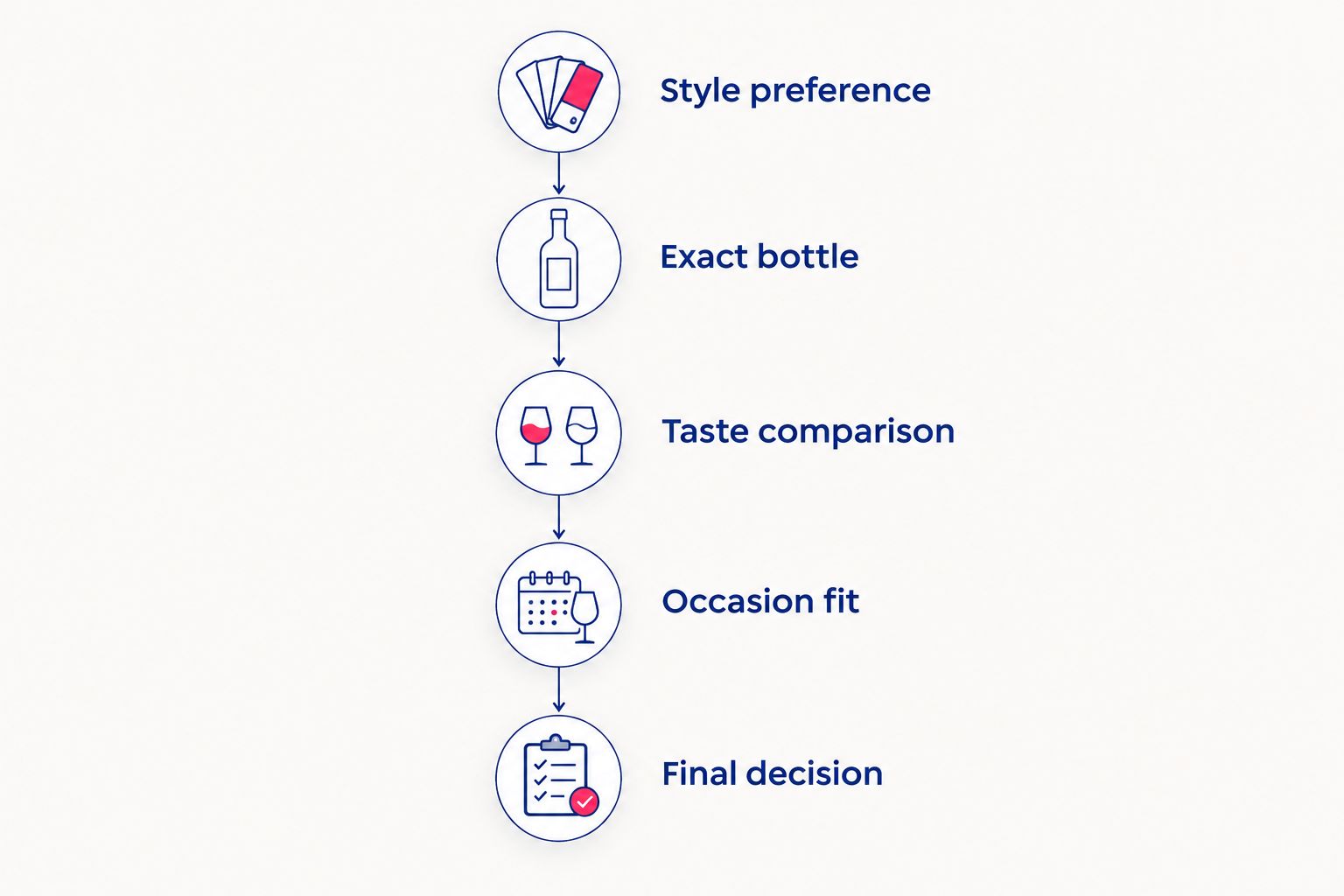
Use a short process that starts with taste and ends with the exact bottle. Do not begin with an argument about whether Caymus deserves its reputation; begin with what you want in your glass.
- Style preference: Name a red you have enjoyed and describe its fruit, body, and drying grip in ordinary words.
- Exact bottle: Confirm the full wine name, vintage, region, and bottle size before comparing reviews or listings.
- Taste comparison: If possible, taste Caymus beside a Cabernet you already know, using equal pours and similar glasses.
- Occasion fit: Decide whether the wine is for your own meal, a shared tasting, or someone whose preferences you know.
- Final decision: Choose based on enjoyment and fit, not the expectation that a label must win.
A useful comparison removes distractions. Covering the labels during a tasting helps you focus on the wine before revealing which glass contains which bottle.
Write down your preference before uncovering the bottles. A brief note such as fruit, drying grip, and overall enjoyment is enough; elaborate tasting vocabulary is unnecessary.
The most useful result is the wine you want another sip of. If you prefer the comparison wine, accept that result. If you prefer Caymus, you have a personal reason for choosing it rather than relying on someone else’s verdict.
Is Caymus Cabernet a good gift?
Caymus Cabernet is a suitable gift for someone you know enjoys its ripe, full-bodied style. The strongest evidence is a bottle they have liked, requested, or bought before—not simply that they drink red wine.
Ask about preference when you can. A recipient who likes lighter reds or pronounced savory flavors needs a different style decision from a recipient who already enjoys Caymus.
For gifting in 2026, keep the occasion separate from the wine judgment. A celebration does not make the wrong style more enjoyable, and a familiar favorite does not become less thoughtful because you chose it directly.
Is Caymus Cabernet better with food?
Caymus Cabernet suits meals where you want a full-bodied red alongside the food, especially hearty meat dishes. Cabernet Sauvignon is a conventional pairing with beef, but the sauce and preparation also matter.
A grilled steak and a sweet, heavily glazed dish do not create the same pairing. Start with the dominant flavor on the plate rather than choosing solely by the protein’s name.
Food is not a rescue plan for a wine style you dislike. If ripe, generous Cabernet is not your preference on its own, pairing it with dinner does not guarantee that your opinion will change.
Should you buy Caymus if you have never tried it?
Try Caymus before committing when you are unsure whether you enjoy ripe, full-bodied Cabernet. A single tasting gives you direct evidence about texture and flavor that a label cannot provide.
If tasting first is not practical, describe your preferences before choosing. “I like rich fruit with little drying grip” is a much more useful starting point than “I want a good Cabernet.”
Buywinesonline’s Cabernet Sauvignon selection serves home wine shoppers, but breadth does not replace preference. Use the exact wine description to assess fit rather than treating every Cabernet as a substitute for Caymus.
FAQ
Is Caymus Cabernet worth the price in 2026?
Caymus Cabernet is worth considering in 2026 if you enjoy ripe fruit, full body, and an approachable texture. It is a weaker fit if you prefer restrained fruit, savory character, or firm tannins.
Who is Caymus Cabernet best for?
Caymus Cabernet is best for drinkers who enjoy a ripe, generous Cabernet style. Your own tasting preferences are a better guide than someone else’s ranking.
Is Caymus Cabernet a sweet red wine?
Ripe fruit flavors do not establish that Caymus Cabernet is a sweet wine. Check the exact bottle’s technical information if residual sugar is important to your decision.
Is Caymus Special Selection the same as regular Caymus Cabernet?
Caymus Special Selection Cabernet Sauvignon is a separate wine from regular Caymus Cabernet Sauvignon. Evaluate the exact wine and vintage rather than transferring a verdict between them.
How many glasses are in a 750 ml bottle of Caymus?
A 750 ml bottle contains five 150 ml servings. Your actual glass count depends on the volume you pour.
Should I give Caymus to someone who likes red wine?
Give Caymus to someone whose preferences match its ripe, full-bodied style, not simply anyone who drinks red wine. A known favorite is stronger evidence than a broad category preference.
How can I compare Caymus with another Cabernet fairly?
Compare Caymus with another Cabernet using equal pours, similar glasses, and covered labels. Record your preference before revealing the wines so your judgment starts with taste.
Where can I explore Cabernet Sauvignon styles online?
Buywinesonline sells Cabernet Sauvignon within a selection of over 5,000 wines. Compare exact wine names, vintages, bottle sizes, and descriptions when assessing which style fits your preferences.
One last thing
Decide before you reveal the label. A covered-label comparison answers the part of the question that matters most: whether you enjoy Caymus enough to choose it again.
Your verdict does not need to agree with anyone else’s. In 2026, the right purchase is still the wine that fits your taste, your occasion, and your comfort with the decision.