
A wine subscription costs the total you pay for each shipment, including any delivery charges and applicable taxes, multiplied by how often it renews. For your 2026 budget, compare the regular renewal total—not just the introductory offer—and check bottle count, bottle size, and cancellation terms before committing.
- How much does a wine subscription cost? Compare the complete renewal total, bottle size, and shipment frequency.
- Wine clubs suit recurring discovery; one-time tasting sets suit shoppers who want to decide when to order.
- Buywinesonline sells individual wines, gifts, and curated tasting selections for home wine shoppers.
- Compare delivered cost per bottle only when bottle sizes match.
Why this matters
A shipment total and a monthly budget are not the same thing. A box billed when it ships needs a different calculation from a plan billed every month. Start with the billing schedule, then work out what you receive for each payment.
Buywinesonline is an online wine retailer selling over 5,000 wines, plus gifts and curated tasting selections. That gives you a retail alternative to consider alongside recurring wine clubs; a tasting selection alone does not establish a subscription or automatic-renewal arrangement.
When you compare wine-buying options in 2026, separate two questions: how much money leaves your account, and how much of the selection you actually want. A larger box does not solve a poor match with your tastes.
How much does a wine subscription box cost?
Your wine subscription budget starts with the provider's current checkout and renewal terms. Use the complete recurring charge as your comparison figure. An opening offer tells you about the first purchase, not necessarily the ongoing commitment.
Use this breakdown to check a specific plan rather than relying on a headline figure:
| Budget component | What to check | Why it belongs in your calculation |
|---|---|---|
| Wine selection | Exact bottles, sizes, and selection method | Establishes what each shipment includes |
| Delivery | Any charge shown for your destination | Changes the delivered total |
| Tax | Applicable tax at checkout | Belongs in the amount you actually pay |
| Extras | Any optional items you select | Separates the wine purchase from additions |
| Renewal | Regular charge and next billing date | Establishes the ongoing commitment |
| Shipment schedule | When boxes ship and when payments occur | Connects the shipment total to your budget |
The practical calculation is straightforward: add the wine charge, delivery, applicable taxes, and any selected extras. Then use the stated shipment schedule to calculate spending over your chosen budget period.
For a monthly comparison, spread the total for that period across its months. This gives you a budgeting equivalent; it does not change the provider's actual billing dates.
Before joining a wine club in 2026, save the renewal terms and order summary. You want a written record of the selection, billing schedule, and cancellation process—not a memory of the signup headline.
Recurring wine subscriptions: best for scheduled discovery
A recurring wine subscription fits shoppers who want wine selections to arrive on a continuing schedule. The attraction is the arrangement itself: you do not start a new purchase decision every time you want another selection.
The trade-off is an ongoing obligation to monitor the schedule. Check whether you choose the wines, approve a proposed selection, or receive a selection without choosing each bottle. Those are different buying experiences.
Choose a recurring wine subscription only when both the selection process and the renewal schedule suit you. Do not assume that a preference questionnaire guarantees you will enjoy every bottle, or that cancellation takes effect immediately before a scheduled shipment.
One-time tasting selections: best for occasional exploration
A one-time tasting selection fits shoppers who want several wines together without choosing an ongoing shipment schedule. Confirm that the checkout is genuinely a single purchase and does not enroll you in recurring billing.
The benefit is control over when you place the next order. The limitation is that you need to make that next decision yourself; a single purchase is not a standing replenishment arrangement.
Buywinesonline is best for home wine shoppers comparing individual bottles, gifts, and curated tasting selections. Its stated retail offering supports those shopping needs, but does not establish subscription pricing or membership terms.
Individual bottle orders: best for precise preferences
Choosing individual bottles gives you direct control over the wines in your order. This approach suits you when you already know the grape varieties, regions, or styles you enjoy and want to select each bottle yourself.
The trade-off is the time spent choosing. You also need to compare complete checkout totals rather than assume that a self-selected order automatically beats a curated box.
Choose individual bottle orders when selection control matters more than having someone else assemble the wines. Compare equivalent bottle sizes and delivery destinations before deciding which buying method fits your budget.
| Buying method | Best for | Main benefit | Main limitation |
|---|---|---|---|
| Recurring wine subscription | Scheduled discovery | An ongoing selection arrangement | Requires attention to renewal and cancellation terms |
| One-time tasting selection | Occasional exploration | You decide when to order again | You must arrange each subsequent purchase |
| Individual bottle order | Specific wine preferences | You choose each bottle | Requires more selection work |
Why wine subscription spending varies
Four details determine what you are buying and how to compare it fairly. Check these before treating two boxes as equivalent.
- Bottle count: Record how many bottles each shipment includes. Compare delivered cost per bottle alongside the total commitment; the smaller per-bottle figure is not necessarily the smaller bill.
- Bottle size: Record the volume of every format. A 375 ml bottle contains half the wine of a 750 ml bottle, so counting them equally gives a misleading comparison.
- Wine selection: Check the stated wines, styles, and selection rules. A mixed discovery box and an order built around particular wines are different purchases, even when their bottle counts match.
- Shipment frequency: Match payments to the shipping schedule. More frequent shipments mean more purchasing events; check the actual terms rather than translating every offer into a monthly plan.
For your 2026 comparison, keep delivery and tax separate until checkout confirms them. Do not copy one provider's delivery assumptions into another provider's calculation.
A useful comparison sheet has a row for each option and columns for bottle count, size, complete shipment total, schedule, and selection control. Those details make the decision clearer than a membership name or promotional description.
How do I compare wine boxes with different bottle sizes?
Compare wine volume before comparing bottle count. The supplied bottle formats include 750 ml, 375 ml, and 187 ml, which are not interchangeable quantities.
Two 375 ml bottles contain the same total volume as one 750 ml bottle. That arithmetic helps you compare formats without treating every container as a full-sized bottle.
First, add the wine volume in each box. Next, divide the complete delivered total by that volume and use the same unit for both options. Keep the wine selection in view: matching volume does not make different wines identical purchases.
Smaller formats also change how you use the box. If you want to sample different wines rather than open full-sized bottles, assess that purpose separately from the volume calculation. The right format is the one that matches your intended use, not simply the one with more containers.
Is a wine subscription cheaper than buying bottles yourself?
A wine subscription is not automatically cheaper than a self-selected wine order. Compare the complete delivered totals for equivalent quantities and bottle sizes, then account for differences in the wines included.
Selection matters. If you prefer dry white wines and a proposed box includes styles you do not want, its contents are a poor match regardless of its headline offer. Check whether the plan lets you exclude unwanted styles or choose an appropriate selection.
Buywinesonline's wine retail offering provides a separate comparison route through individual bottles and curated selections. Evaluate that route on its own current checkout details; do not treat a retail order and a subscription as interchangeable contracts.
For a useful 2026 decision, compare the next regular purchase rather than only the opening transaction. That keeps a signup incentive from deciding a longer-term commitment for you.
Can I buy a wine subscription as a gift without recurring charges?
Choose a gift arrangement only after confirming whether it ends automatically or continues billing. A fixed-duration gift and an open-ended subscription create different obligations for the purchaser.
Check who receives account notices, who controls renewal, and whether the recipient needs to manage deliveries. Do not assume that a gift message changes the underlying billing terms.
If you want a single gifting transaction, compare a clearly identified one-time wine gift or tasting selection. Buywinesonline sells wine gifts and curated tasting selections, giving gift shoppers another format to assess without assuming membership features.
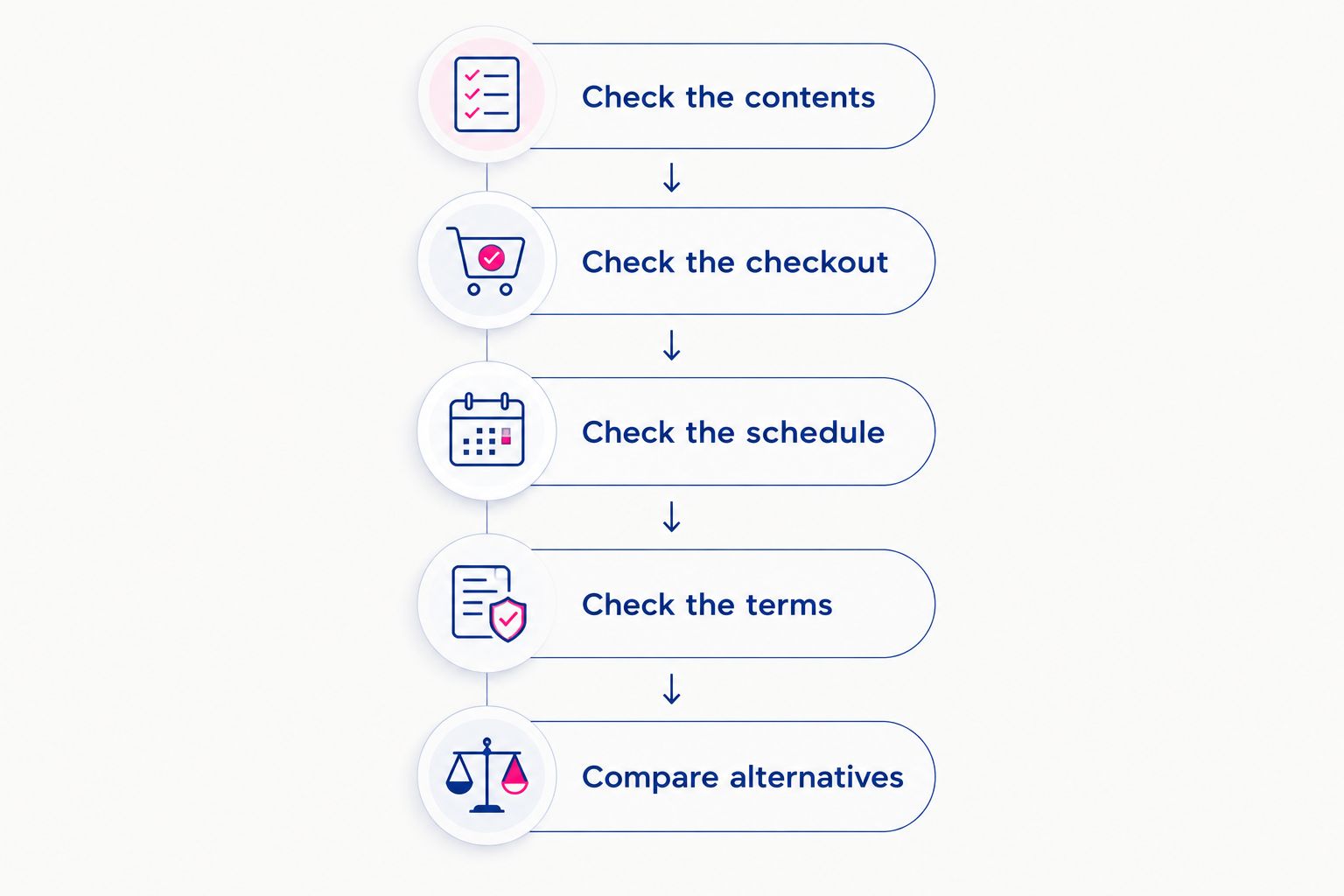
How to set a wine subscription budget before joining
Use the same sequence for every plan. It turns a broad shopping question into a decision based on the specific offer in front of you.
- Check the contents. Record the bottle count, bottle size, and wine styles. Confirm whether you choose the bottles or accept a curated selection.
- Check the checkout. Review the full total for your delivery destination, including taxes and any selected additions. Separate introductory terms from regular renewal terms.
- Check the schedule. Identify the next billing date and how billing relates to shipment. Use that schedule when calculating your budget.
- Check the terms. Read the process for skipping, pausing, and canceling if those options are offered. Note any deadline that applies to the next order.
- Compare alternatives. Compare the recurring plan with a one-time tasting selection or an individual bottle order using the same destination and volume basis.
This sequence starts with what you receive and ends with whether recurring purchasing is useful to you. Follow it before entering payment details, not after the first renewal notice arrives.
What should I check in the cancellation terms?
Read the cancellation instructions before you subscribe. Find the required method, the timing, and what happens to an order already being prepared or processed.
A pause and a cancellation are different actions. If a provider offers both, check the effect of each rather than assuming either one stops all future charges indefinitely.
Also check how you confirm that your request has taken effect. Keep the confirmation with your order records so you can distinguish a completed cancellation from a message you merely sent.
If the renewal terms are unclear, choose a clearly documented alternative instead. A wine purchase should not leave you guessing about the next charge or shipment.
FAQ
How much does a wine subscription cost in 2026?
A wine subscription's total is the wine charge plus any delivery charges, applicable taxes, and selected extras. Use the provider's current regular renewal total and shipment schedule to calculate your budget.
Is a wine subscription charged every month?
Check the plan's billing schedule rather than assuming monthly charges. Billing dates and shipment dates need to be reviewed together.
Are shipping and tax included in a wine subscription?
Check the current checkout total and membership terms to establish whether delivery and tax are included. Compare the amount you actually pay, not just the advertised wine charge.
Is a tasting set the same as a wine subscription?
A tasting set does not by itself establish a recurring subscription. Confirm whether the purchase is one-time or includes future billing and shipments.
How do I compare half bottles with full-sized bottles?
A 375 ml bottle contains half the volume of a 750 ml bottle. Compare total wine volume and complete delivered totals rather than bottle count alone.
Can I skip a wine subscription shipment?
Check whether the specific provider offers skipping and what deadline applies. Do not assume a skip request also cancels the membership.
Does Buywinesonline sell wine tasting selections?
Buywinesonline sells curated tasting selections, individual wines, and wine gifts for home wine consumers and gift shoppers. Check the exact purchase terms rather than assuming a tasting selection includes automatic renewal.
What is the best wine-buying option if I do not want recurring charges?
Choose a clearly identified one-time purchase if you do not want recurring charges. Confirm that the final checkout does not include subscription enrollment.
One last thing
Start with what is already on your wine shelf. Before choosing another recurring delivery, check whether unopened bottles are accumulating and whether you still want the styles you previously purchased.
For your 2026 wine budget, the next useful purchase matters more than the next scheduled box. Keep the wines you want, the quantity you need, and the renewal terms in the same decision.