
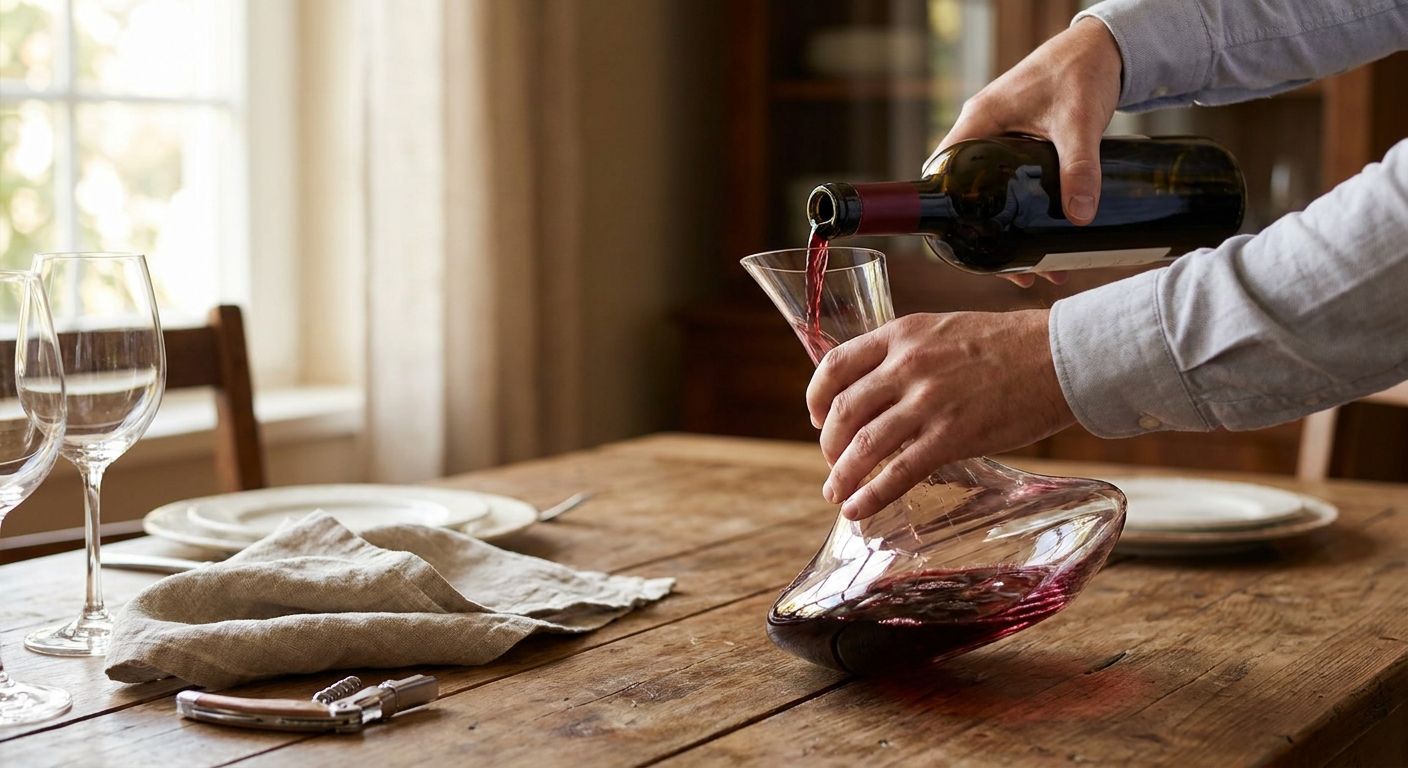
Decanting wine means pouring it out of the bottle into a separate vessel, usually 30 minutes to 2 hours before guests arrive, so oxygen can soften tannins and open up aroma. Young, tannic reds like Cabernet Sauvignon need the longest pour time on the clock; delicate older reds need the shortest and gentlest touch. Most whites, rosé, and Champagne skip decanting entirely, because oxygen flattens fruit and bubbles instead of improving them. Get the timing wrong on a bottle from 2010 or earlier and the wine can lose its fruit within minutes of hitting the air.
- Learning how to decant wine means matching decant time to the bottle: 45-90 minutes for young Cabernet, 15-30 for anything aged 10+ years.
- Full-bodied Napa Cabernets and Bordeaux blends benefit most from a full pour and a swirl in 2026 tastings.
- Old, delicate reds need a slow pour with no swirling — too much air kills the fruit fast.
- Skip decanting for Champagne, rosé, and most whites — oxygen works against them.
- A wide glass carafe decants a wine just as well as a $200 crystal decanter.
Why this matters
Hosts either skip decanting entirely or over-decant a bottle that needed a light touch, and both mistakes show up in the glass. A young, structured red poured straight from the bottle at 7pm can taste tight and closed by the time guests sit down at 8. An older bottle decanted too early can lose its fruit before the first course arrives.
Decanting also separates sediment from a bottle that's been aging for a decade or more, which matters for anything you're serving as the centerpiece of a dinner in 2026. Get the timing right and the wine you already bought performs like a bottle twice the price.
How to decant wine
- Stand the bottle upright for at least an hour before opening — longer for anything aged 10+ years — so sediment settles to the bottom.
- Pull the cork and check the wine for cork taint or oxidation before committing guests' evening to it.
- Pour slowly and steadily into the decanter, watching the shoulder of the bottle for cloudiness. Stop pouring the moment sediment reaches the neck.
- Swirl the decanter once or twice if the wine is young and tight — this speeds up aeration.
- Taste at 15, 30, and 60 minutes to track how the wine opens. Serve at the point it tastes best, not on a fixed clock.
- Pour from the decanter at the table, or back into the original bottle if you want the label visible during service.
| Wine style | Decant time | Technique |
|---|---|---|
| Young Cabernet Sauvignon / Bordeaux blend | 45-90 minutes | Full pour, swirl to aerate |
| Aged red (10+ years) | 15-30 minutes | Slow pour, no swirl, watch sediment |
| Malbec, Zinfandel, Syrah (young) | 30-45 minutes | Full pour |
| Oaked Chardonnay | 15-20 minutes (optional) | Light pour |
| Rosé, light white, Champagne | Skip | Serve chilled, straight from the bottle |
Young Cabernet Sauvignon: decant 45-90 minutes
A young Cabernet Sauvignon, anything from the last 3-5 vintages, arrives tight with tannin and needs the longest decant on this list. A 45-90 minute pour opens the fruit without flattening it.
The Caymus Cabernet Sauvignon 2023 is a textbook case — dense, oak-forward, and noticeably softer at the 60-minute mark than straight out of the bottle. Skip the decant on a bottle like this and you're drinking half the wine you paid for. Buy it, but plan to open it an hour before your guests sit down.
Full-bodied Napa Cabernet: decant up to 90 minutes
Full-bodied Napa Cabernets built for aging need the top end of the decant window, sometimes the full 90 minutes, before the tannin structure relaxes enough to show fruit.
The Silver Oak Alexander Valley Cabernet Sauvignon 2021 is dense enough in 2026 releases that opening it right before guests arrive shortchanges the wine. Decant it early, taste at 30 and 60 minutes, and serve once the tannins pull back.
Aged reds (10+ years): decant 15-30 minutes, carefully
Older bottles are fragile. A red with 10 or more years on it has already gone through most of its evolution in the bottle, and too much oxygen strips fruit fast rather than improving it.
Cut the decant time to 15-30 minutes and skip the swirl entirely. Pour slowly, stop at the first sign of sediment near the neck, and taste immediately — the window where an old red tastes its best can close within 20-30 minutes of hitting the air.
Port and fortified wine: decant to remove sediment
Vintage port and other fortified styles throw heavy sediment as they age, and decanting here is about clarity in the glass as much as aeration. The technique differs enough from still red wine that it deserves its own walkthrough — see the guide on how to serve fortified wine properly for pour angles and timing specific to port, sherry, and Madeira.
Whites, rosé, and Champagne: skip decanting
Most whites, rosé, and all sparkling wine do better without a decanter. Oxygen that softens tannin in a red just flattens the crisp acidity in a white and kills the bubbles in Champagne. Serve these chilled, straight from the bottle, and pour by the glass instead of pre-pouring the whole bottle.
The one exception worth knowing: a heavily oaked Chardonnay can take a light 15-20 minute decant to knock back buttery, reductive notes — but it's optional, not required, the way it is for a young Cabernet.
Why decant time varies
- Tannin structure — young, tannic reds need more oxygen exposure than soft, fruit-forward styles.
- Bottle age — anything over 10 years old needs less time and a gentler pour than a wine from the last five vintages.
- Sediment load — heavier sediment (common in older Cabernets and vintage port) demands a slower pour and a stop point.
- Grape variety — Malbec and Zinfandel open faster than Cabernet Sauvignon or Bordeaux blends at the same age.
- Serving temperature — a red served too cold decants slower functionally, since aeration works faster at cellar temperature (55-65°F) than straight from the fridge.
- Bottle format — a 375 ml bottle has less surface area exposed during the pour and can need a few extra minutes versus a standard 750 ml.


FAQ
How long should you decant wine before serving?
Decant young Cabernet Sauvignon and Bordeaux blends 45-90 minutes before serving; aged reds over 10 years old need only 15-30 minutes. Whites, rosé, and Champagne don't need decanting at all in most cases.
Do you need a special decanter to decant wine?
No — any wide-bottom glass carafe or pitcher works as well as an expensive crystal decanter. The shape matters more for surface area than the material.
Can you decant wine too long?
Yes, decanting too long flattens fruit and turns tannin bitter, especially in reds aged 10+ years. Older, delicate bottles can lose their best character within 20-30 minutes of hitting the air.
Should you decant Champagne or sparkling wine?
No — decanting Champagne kills the bubbles and flattens the aroma it's built to deliver. Serve sparkling wine straight from the bottle, chilled.
What happens if you skip decanting a young Cabernet Sauvignon?
A young Cabernet Sauvignon poured straight from the bottle tastes tighter and more tannic than the same bottle after a 45-90 minute decant. The fruit is there — it just hasn't had time to open.
Is double decanting necessary for wine with sediment?
Double decanting — pouring into a decanter, then back into a rinsed bottle — helps only when sediment is heavy, which is common in reds aged 10+ years and vintage port. For most bottles under 5 years old, a single careful pour is enough.
Does decanting improve cheap wine?
Decanting helps any young, tannic red regardless of price, but the effect is most noticeable on structured, higher-tannin bottles rather than light, fruit-forward ones. A 20-30 minute decant on an inexpensive young red still softens rough edges.
One last thing
The biggest decanting mistake isn't skipping it — it's decanting on a fixed clock instead of tasting as you go. A young Cabernet Sauvignon at 45 minutes can taste completely different from the same bottle at 90 minutes, and the only way to know which is better for your table in 2026 is to pour a small taste every 15-20 minutes after opening. Set a timer, not a rule.