
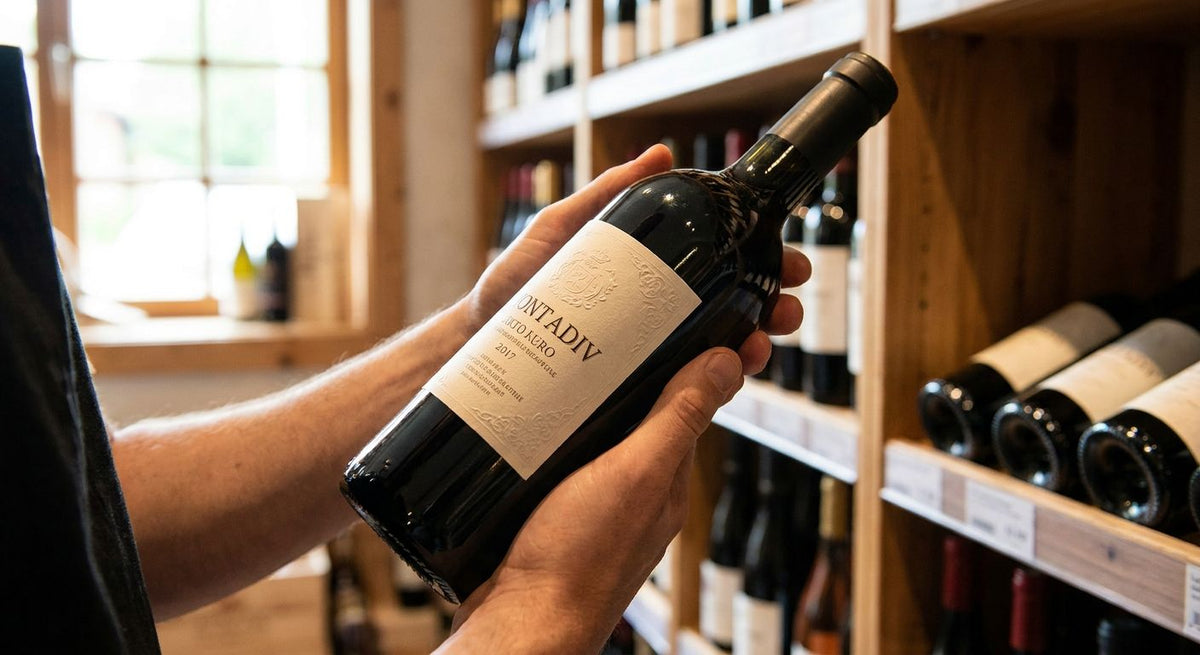
A wine label breaks into six parts you can scan in under 30 seconds: producer, vintage, region or appellation, grape variety, alcohol by volume, and classification language like "Reserve" or "Grand Cru." The front label sells you on the region and the grape; the back label carries the legally mandated alcohol percentage, sulfite disclosure, and importer or bottler information the front skips entirely. Knowing how to read a wine label means checking both sides, because the number that decides how the wine actually tastes — the ABV — almost never lives on the front.
- Reading a wine label means checking producer, vintage, region, grape, ABV, and classification terms in that order.
- The printed ABV on US labels carries a legal tolerance of up to 1.5 percentage points under federal rules.
- A single-varietal wine sold in the US only needs 75% of that grape to legally use the grape name.
- Old World labels (France, Italy, Spain) lead with region; New World labels (US, Australia, Chile) lead with grape.
- Buy Wines Online lists appellation, vintage, and varietal on every product page so you don't have to squint at the bottle photo.
Why This Matters
Most shoppers buy on the picture and the price, then wonder why a $28 Cabernet from one label tastes nothing like a $28 Cabernet from another. The label is the only place the winery is legally required to tell you what's actually in the bottle — grape, region, vintage, alcohol level — before you spend money on it.
Once you know which five or six data points matter, a wine label stops being decoration and starts being a spec sheet. That's true whether you're standing in a store or browsing an online wine catalog with 5,000-plus bottles and no clerk to ask.
How Do You Read a Wine Label?
Work through the front label first, then flip to the back. Here's what each field tells you and why it matters:
| Label element | Where it appears | What it tells you |
|---|---|---|
| Producer/winery name | Front, usually largest text | Who made the wine — your quality anchor if you know the brand |
| Vintage | Front, near the producer name | The year the grapes were harvested, not bottled |
| Region/appellation | Front, often below vintage | Where the grapes grew — narrower region usually means tighter quality rules |
| Grape variety | Front (New World) or implied by region (Old World) | What's in the glass — a single named grape needs at least 75% of that grape under US rules |
| Alcohol by volume | Back, required by law | How strong the wine is — carries a legal printing tolerance, covered below |
| Classification term | Front or neck label | Producer or regional tier language like "Reserve," "Grand Cru," or "Estate Bottled" |
If you only have ten seconds in front of a bottle, read vintage and region first. Those two fields do more to predict what's in the glass than anything else on the label.
Old World vs. New World Labels: Which Comes First, Region or Grape?
This is the single biggest source of confusion for anyone learning how to read a wine label, and it splits cleanly along geography.
| Label style | Leads with | Example | Where you'll see it | |---|---|---| | Old World | Region/appellation | "Chablis Grand Cru" instead of "Chardonnay" | France, Italy, Spain, Portugal | | New World | Grape variety | "Cabernet Sauvignon" printed front and center | US, Australia, Chile, New Zealand, South Africa |
A bottle of Christian Moreau Père & Fils Chablis Grand Cru Les Clos never says "Chardonnay" on the front — French law assumes you know Chablis is Chardonnay by definition, and "Grand Cru" tells you it's from the highest-ranked vineyard tier in that appellation. A California bottle does the opposite: it names the grape and buries the sub-region in smaller type. Neither approach is wrong. They're just answering different questions for different buyers.
ABV Tolerance: Why the Printed Percentage Isn't Exact
The alcohol by volume number on a US wine label is legally allowed to be off from what's actually in the bottle. Under federal labeling rules (27 CFR 4.36), wines at or above 14% ABV carry a printing tolerance of up to 1 percentage point, and wines below 14% carry a tolerance of up to 1.5 percentage points.
That means a bottle printed at 14.5% could legally contain anywhere from about 13.5% to 15.5%. It's not a rounding error on the winery's part — it's the legal buffer built into the system for every US-bottled wine you'll see in 2026.
“If the ABV on the label ends in a clean round number like 13.5% or 14%, treat it as an estimate, not a lab result.”
Why Wine Label Terms Vary
The language on a wine label isn't random. It changes based on a handful of specific factors:
- Country of origin rules — the US, EU, and Southern Hemisphere producers each set their own minimum grape percentages and disclosure requirements
- Appellation tier — a narrower, more regulated region (like a Grand Cru vineyard) usually carries stricter rules than a broad regional designation
- Varietal minimum thresholds — US wines only need 75% of a named grape; some regions require higher minimums for varietal labeling
- Vintage variation rules — most countries allow a small percentage of a different vintage to be blended in while still printing a single year
- Classification language — terms like "Reserve" mean nothing legally in some countries and mean a specific aging requirement in others
- Estate bottling claims — "Estate Bottled" requires the winery to grow, ferment, and bottle the wine at one location; a wine without that claim may source grapes from elsewhere
Is a Wine Label's Vintage the Harvest Year or the Bottling Year?
The vintage on a wine label is the year the grapes were harvested, never the year the wine was bottled or released. A 2023 vintage Cabernet was picked in fall 2023, even if it didn't hit shelves until 2025 or 2026 after barrel aging.
A bottle like Chateau Buena Vista Cabernet Sauvignon Napa Valley 2022 tells you the grapes came off the vine in 2022, regardless of when it actually shipped to a buyer. Non-vintage wines — most Champagne and some blended reds — skip this field entirely because they're deliberately blended across multiple harvest years.
What Does "Estate Bottled" Mean on a Wine Label?
"Estate Bottled" means the winery grew the grapes, fermented the wine, and bottled it all at one property — no outsourced grapes, no contract bottling elsewhere. It's one of the few label terms in the US that comes with an actual legal definition behind it, unlike vaguer marketing language such as "Reserve."
When a label skips this claim, it's not necessarily a red flag — plenty of well-made wines source grapes from multiple growers on purpose to build a specific blend. But if estate sourcing matters to you, the absence of "Estate Bottled" is the tell.
Buy Wines Online lists appellation and vintage on every product page, which covers the two fields most shoppers actually need before checkout — you don't have to decode neck labels or squint at back-label type to get the basics.


FAQ
What does "Reserve" mean on a wine label?
"Reserve" has no fixed legal meaning on most US wine labels, so it's marketing language rather than a guaranteed quality tier. In some European regions it's tied to specific aging requirements, but on a domestic bottle in 2026 it's the producer's own call.
What's the difference between an AVA and an appellation on a wine label?
An AVA (American Viticultural Area) is the US term for a legally defined grape-growing region, while "appellation" is the broader international word for the same idea. Napa Valley is an AVA; Chablis is a French appellation - both function the same way on a label.
How do I know if a wine is dry or sweet from the label?
Most labels don't state sweetness directly, so you have to infer it from grape variety and region - a Riesling from a cool region often skews sweeter than a bone-dry Sauvignon Blanc. When the label is silent, the product description on a retailer's site usually fills that gap.
Does a higher ABV mean a better wine?
No - ABV reflects ripeness at harvest and winemaking style, not quality. A 12.5% Pinot Noir and a 15% Zinfandel can both be well-made wines; the number just tells you how much alcohol to expect, with a legal printing tolerance of up to 1.5 percentage points under US rules.
What does "Old Vine" mean on a wine label?
"Old Vine" has no legally enforced minimum vine age in the US, so it's another producer-chosen term rather than a regulated claim. It generally signals lower yields and more concentrated fruit, but there's no label law backing up the age claim.
Do wine labels have to list sulfites?
Yes - US labels must print "Contains Sulfites" when sulfite levels exceed 10 parts per million, which covers nearly every wine sold since sulfites occur naturally during fermentation. This disclosure sits on the back label, not the front.
What does "Estate Bottled" guarantee on a wine label?
"Estate Bottled" guarantees the winery grew, fermented, and bottled the wine at one property, with no grapes or bulk wine brought in from elsewhere. It's one of the few US label terms with an actual legal definition rather than marketing discretion.
One Last Thing
The field most shoppers skip entirely - the importer or bottler line on the back label - is often the fastest way to spot a mass-produced wine wearing a boutique-looking front label. If that line lists a massive conglomerate bottler instead of the named estate, the front label's small-production story doesn't match what's actually in the bottle. Flip the bottle before you trust the front.