
Vintage Champagne is worth it in 2026 if you want to explore a particular harvest, enjoy a more developed wine, or give a year-specific gift. It is not automatically better than non-vintage Champagne, and the year on the label does not guarantee good storage or a style you will enjoy. Choose vintage for a deliberate tasting or meaningful occasion; choose non-vintage when a familiar house style matters more.
- Is vintage champagne worth it? Yes, for harvest-focused tastings and meaningful gifts—not automatically for every celebration.
- Vintage Champagne represents one harvest; non-vintage Champagne usually blends wines from different years.
- Moet & Chandon Grand Vintage Brut 2013 suits drinkers interested in mature, roasted aromas.
- Buywinesonline suits home wine shoppers comparing vintage Champagne with everyday sparkling wine.
Is vintage champagne worth it in 2026?
Yes—when the vintage gives you something you actually want to taste or commemorate. A harvest year adds context, not a universal quality ranking. Non-vintage Champagne can be the better choice if you already enjoy a producer's regular style and want that experience again.
Start with the occasion and your preferred flavors, then use the best vintage Champagne to buy guide to narrow your search. Do not start by assuming that the oldest bottle is the best bottle.
| Choice | Best for | Main advantage | Main drawback |
|---|---|---|---|
| Vintage Champagne | Exploring a particular harvest or giving a year-specific gift | Shows the producer's interpretation of one growing season | The harvest year alone does not establish drinking readiness or condition |
| Non-vintage Champagne | Repeat purchases and mixed-preference gatherings | Blending helps maintain a recognizable house style | Does not offer the same single-harvest focus |
| California sparkling wine | Exploring sparkling wine without requiring Champagne origin | Offers another route to white or rosé sparkling styles | Is not Champagne and does not answer a Champagne-specific gifting brief |
The practical test is simple: can you explain why you want that particular bottle without saying only that it is vintage? A preferred flavor profile, a meaningful harvest year, or a planned side-by-side tasting is a useful reason. A date alone is not.
Why this matters
You are choosing a drinking experience, not just a label designation. Longer maturation and a single-harvest identity can make vintage Champagne interesting, but those features only add value when you appreciate them.
For a 2026 celebration, separate the symbolic value from the drinking value. A year-specific bottle can make a thoughtful gift even when the recipient is not comparing harvests. For dinner, however, the wine's flavor and condition deserve more attention than the date.
Also distinguish Champagne from sparkling wine generally. Champagne comes from the Champagne region of France under its appellation rules. California sparkling wine and Prosecco belong to different categories; neither becomes Champagne because it has bubbles or a harvest year.
Vintage Champagne: best for a focused tasting
Vintage Champagne is made from grapes harvested in the year shown on the bottle. Producers use it to express that harvest rather than blend across harvest years for their regular non-vintage style.
Champagne's appellation rules, summarized by the Comité Champagne, require at least 36 months of maturation for vintage Champagne. That is a production minimum, not a promise that every bottle tastes mature or needs additional aging after purchase.
Longer contact with the yeast sediment from fermentation can contribute bread-like and toasted characteristics. Further bottle development can introduce other mature aromas. The result still depends on the wine: vintage Champagne is not a single flavor profile.
Choose vintage Champagne when you want to slow down and notice the wine. Serve it with a meal or in a small tasting where guests can discuss what they find. Skip the vintage requirement when the bottle is mainly there for a quick toast and nobody has a preference for the style.
Non-vintage Champagne: best for a familiar house style
Non-vintage Champagne usually combines wines from different harvest years. This gives the producer tools to maintain a recognizable style despite changing growing conditions.
Under the Comité Champagne's published appellation rules, non-vintage Champagne requires at least 15 months of maturation, including 12 months on the lees. Producers can mature their wines longer. The minimum does not describe the exact aging of every bottle you encounter.
Non-vintage is therefore not a shortcut designation for poor quality. Blending requires judgment, and a well-made blend can offer the balance you prefer more reliably than an unfamiliar vintage release.
Choose non-vintage Champagne when you know the house style and want to enjoy it again. Its limitation is specificity: it does not give you the same direct connection to one harvest. If that connection is the point of your purchase, choose vintage instead.
Why vintage Champagne's value varies
The value of vintage Champagne depends on more than the printed year. Use these factors to decide whether the designation adds something useful to your purchase:
- Harvest character: Growing conditions affect the grapes. A vintage captures that season rather than smoothing differences through a multi-year blend.
- Producer style: Winemaking choices influence texture and flavor. Two wines from the same harvest need not taste alike.
- Maturation: The legal minimum is only a starting point. Time before release and later bottle development are separate considerations.
- Storage history: Heat and unsuitable storage can damage wine. A celebrated harvest cannot compensate for a poorly kept bottle.
- Your preferences: Mature, roasted aromas appeal to some drinkers; others prefer a fresher expression. Neither preference requires a vintage label.
- The occasion: A harvest year can carry personal meaning. For a large toast, that detail is less useful if guests never see the bottle.
Treat these as separate checks. A bottle can have a meaningful year but an unsuitable flavor profile, or an appealing style but uncertain storage. The best choice satisfies your purpose and your palate—not just one of them.
How do you choose vintage Champagne without buying on reputation alone?
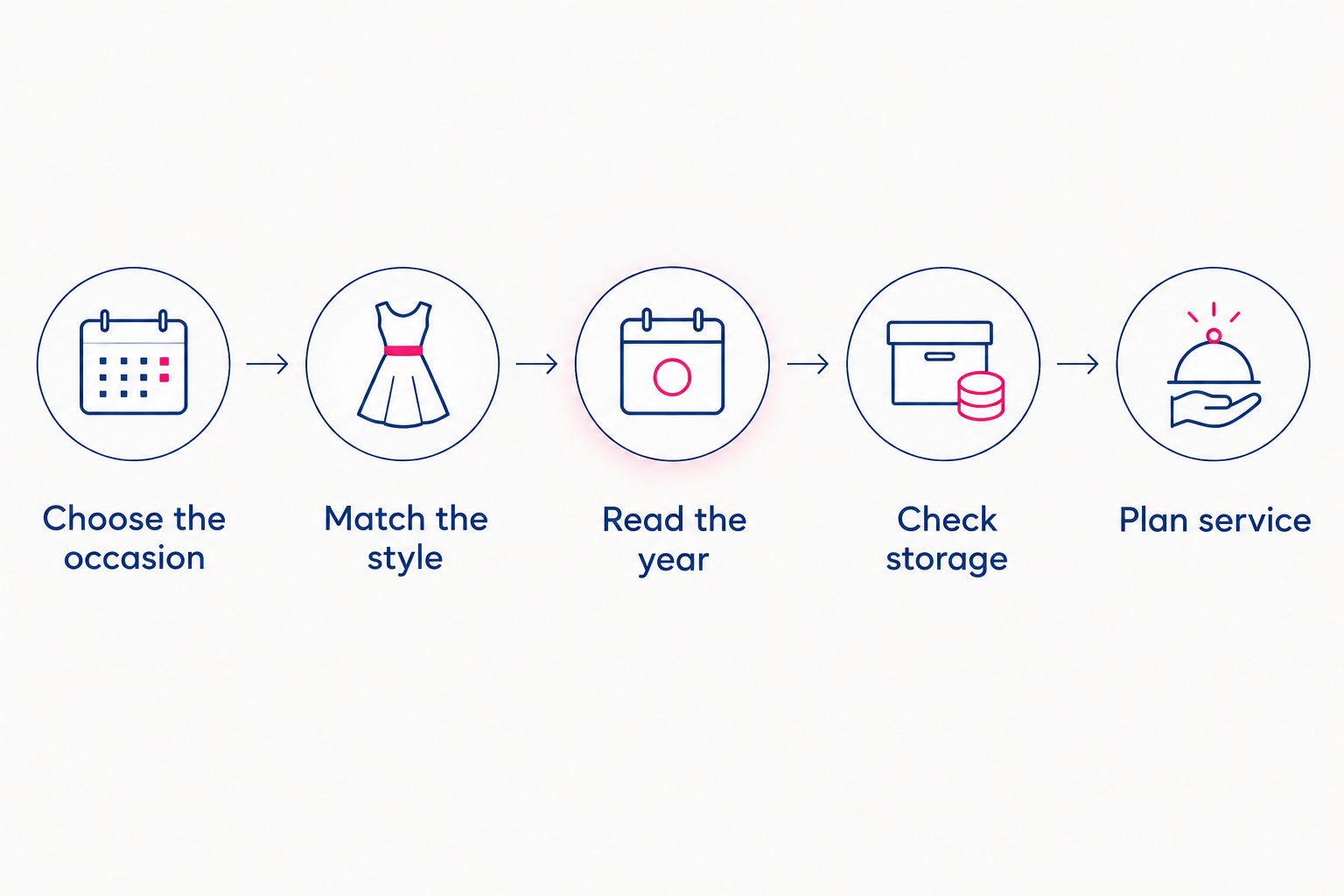
Use this sequence for a 2026 purchase. It keeps a famous label from deciding the whole order before you have considered what you want to drink.
- Choose the occasion. Decide whether the bottle is for a meal, a tasting, or a gift. A year-specific gift and a party toast have different priorities.
- Match the style. Read the actual description. Fresh and saline notes point to a different experience from roasted chestnut and mature aromas.
- Read the year. Confirm that the date is the harvest year. Do not confuse it with a release date or the date the bottle reached the retailer.
- Check storage. Ask about handling and provenance when buying an older bottle, especially one with a history of resale.
- Plan service. Have suitable glasses and a way to keep the wine chilled. Avoid buying a special bottle without a realistic plan to enjoy it.
This sequence also gives you a stopping point. If the description does not suit you or the storage history raises concerns, choose another bottle rather than treating the vintage as a reason to overlook the problem.
Which vintage Champagne styles should you consider?
These three bottles provide different starting points. The descriptions below come from their individual product listings, not a claim that one harvest or producer is universally better.
Buywinesonline lists each in a 750 ml bottle. Compare the style first; the shared bottle size does not make the wines interchangeable.
| Bottle | Best for | What the listing describes | Reason to pass |
|---|---|---|---|
| Veuve Clicquot Vintage Brut Gold Label 2012 | Drinkers interested in a fresh, saline description | Bright yellow color, gold hints, and a fresh, delicate, saline nose | Choose another style if those descriptors do not appeal |
| Veuve Clicquot Vintage Brut Rose 2012 | A gift or tasting where pink Champagne is part of the brief | Bright pink color, light copper hues, and delicate bubbles | Skip if the recipient specifically prefers white Champagne |
| Moet & Chandon Grand Vintage Brut 2013 | Drinkers interested in mature, roasted aromas | A light golden hue, persistent bubbles, and roasted chestnut notes | Skip if you want to avoid mature, roasted characteristics |
Veuve Clicquot Vintage Brut Gold Label 2012
Best for: a vintage Champagne tasting guided by fresh and saline aromas. Its listing describes a fresh, delicate nose rather than relying only on the harvest date. That gives you a concrete reason to consider it.
The description is not a guarantee of how an individual bottle will show after storage. If your goal is specifically a strongly roasted aromatic profile, the Moet & Chandon description provides a clearer match. Verdict: Buy for the described style, not simply the year.
Veuve Clicquot Vintage Brut Rose 2012
Best for: a year-specific gift where rosé Champagne is wanted. The listing describes bright pink color with copper hues and a persistent string of delicate bubbles. The rosé designation makes this a distinct choice, not merely another white vintage bottle.
Color does not establish sweetness. Do not select this bottle because you assume pink Champagne tastes sweeter, and do not substitute it for white Champagne when the recipient has expressed a clear preference. Verdict: Buy when rosé is part of the brief.
Moet & Chandon Grand Vintage Brut 2013
Best for: exploring mature Champagne aromas. The listing explicitly describes maturity and roasted chestnut notes, making this the clearest match here for someone curious about that side of Champagne.
Those same characteristics are the reason to pass if mature aromas are not your preference. A wine can fit its description and still be the wrong purchase for you. Verdict: Buy for mature character; skip for a freshness-only brief.
Choose between these descriptions before moving to the product details. A famous name is useful context, but your preferred style remains the deciding factor.


Is older vintage Champagne always better?
No—older vintage Champagne is not automatically better. Aging changes a wine; it does not guarantee improvement indefinitely. Storage, the producer's style, and your preference for developed flavors all matter.
For a bottle opened in 2026, distinguish the harvest year from its maturation history. The label's year does not tell you when the wine was disgorged—the stage when yeast sediment is removed—or how it was stored afterward.
Do not calculate drinking readiness from the harvest date alone. If you want to hold a bottle, seek guidance for that specific wine and make sure your storage is suitable.
Is vintage Champagne worth it for a gift?
Yes—vintage Champagne is worth considering when the harvest year or wine style means something to the recipient. Confirm both. A meaningful date is a strong gifting detail, but it does not replace knowing whether the person enjoys Champagne.
For a 2026 milestone, remember that a vintage date identifies the grape harvest, not the year of gifting. Explain the connection in your gift message rather than expecting the recipient to infer it.
Buywinesonline suits home wine shoppers comparing vintage Champagne with everyday sparkling wine. Its broader wine selection also gives gift shoppers alternatives when Champagne is not the recipient's preference; a relevant gift beats a prestigious but unwanted bottle.
Should you save vintage Champagne or drink it now?
Drink vintage Champagne when the specific wine suits your intended occasion; do not save it solely because it has a year. Vintage Champagne already undergoes maturation before release. Additional home aging is a separate decision, not a requirement attached to the designation.
If you lack suitable storage, buying for a planned occasion is more sensible than starting an aging project. For a tasting, use clean glasses with room to smell the wine and serve it chilled, allowing it to develop gradually in the glass.
FAQ
Is vintage Champagne worth it for someone new to Champagne?
Vintage Champagne is worth it for a beginner who wants to explore a particular wine, but it is not a required starting point. Non-vintage Champagne is a useful way to learn a producer's regular house style.
Is vintage Champagne better than non-vintage Champagne?
Vintage Champagne is not automatically better than non-vintage Champagne. Vintage emphasizes one harvest, while non-vintage blending helps maintain a recognizable house style.
How long does vintage Champagne have to mature?
Vintage Champagne requires at least 36 months of maturation under Champagne's appellation rules. This minimum does not establish the ideal drinking date for every bottle.
Does non-vintage Champagne have to age too?
Non-vintage Champagne requires at least 15 months of maturation, including 12 months on the lees. Producers can mature their wines longer than the required minimum.
Does vintage Champagne taste sweeter?
Vintage Champagne is not inherently sweeter because it carries a harvest year. Check the sweetness designation separately rather than using vintage status or rosé color as a guide.
Is a vintage Champagne bottle a good anniversary gift in 2026?
Vintage Champagne is a good anniversary gift in 2026 when the recipient enjoys Champagne and the harvest year has a meaningful connection. Confirm the preferred style as well as the date.
Can I buy vintage Champagne and open it right away?
You do not need to age Champagne at home simply because it is vintage. Choose a bottle suited to your planned occasion and follow guidance for that specific wine.
One last thing
The most useful comparison is not always older versus younger. It is often the producer's vintage wine versus its non-vintage house style, because that focuses your attention on what the single-harvest bottling adds.
For your next Buywinesonline Champagne purchase, write down the reason before ordering: a particular aroma profile, a meaningful year, or a tasting comparison. If your only reason is that vintage sounds better, reconsider the bottle—not the whole category.