
Plan on 8 standard 750 ml bottles for a party of 20 if every guest wants two 150 ml glasses; for your 2026 shopping plan, that becomes 4 bottles for one glass each or 12 bottles for three glasses each. These are inventory calculations, not drinking targets: count only guests who will drink wine, and include any sparkling toast in the total rather than automatically adding it on top.
- How much wine for a party of 20? Eight 750 ml bottles cover two planned 150 ml glasses per guest.
- A 750 ml bottle supplies five 150 ml pours; larger glasses do not change that bottle capacity.
- Count wine drinkers, not invitations, and include sparkling wine in your total.
- Buywinesonline offers individual wines and tasting sets; choose quantities that match your party rather than the package size.
How much wine do you need for a party of 20?
Eight bottles cover 40 planned glasses when you pour 150 ml per glass. The calculation is straightforward: 20 wine drinkers multiplied by two glasses equals 40 glasses, and five glasses per bottle means eight bottles.
A standard 750 ml bottle holds exactly five 150 ml servings. That is a measured serving assumption, not a promise about how many glasses an unmeasured pour will produce. For more on serving sizes, see how many glasses are in a bottle of wine.
| Shopping scenario | Wine drinkers | Planned glasses each | Total 150 ml glasses | 750 ml bottles | Best for | Limitation |
|---|---|---|---|---|---|---|
| One planned glass | 20 | 1 | 20 | 4 | A single wine service | No allowance for additional glasses |
| Two planned glasses | 20 | 2 | 40 | 8 | A defined welcome-and-dinner service | Assumes every guest chooses wine |
| Three planned glasses | 20 | 3 | 60 | 12 | Stocking several planned wine services | Leaves excess if guests choose other drinks |
These scenarios describe what your bottles can supply. They do not predict what your guests will consume, and they do not mean anyone should finish a particular number of glasses.
Use the middle row only when its assumptions fit your event. If some guests do not drink wine, or wine accompanies just one course, revise the calculation before ordering.
Why this matters
A guest count alone does not determine a wine order. Your serving size and the number of people choosing wine determine whether the same eight bottles are enough or excessive.
For a 2026 party, start with the service you intend to offer, not a rule that assigns alcohol to every hour. A welcome glass and a dinner glass are clear planning choices. An open-ended promise to keep every glass full is not.
Buywinesonline sells individual wines and curated tasting selections. Choose the bottle quantity first, then choose the wines. Reversing that order makes it easy to buy a set that exceeds your actual plan.
One planned glass each: 4 bottles
Four 750 ml bottles provide 20 glasses at 150 ml each. This is the exact quantity for one measured wine serving for every person in a group of 20.
Best for: a party where wine has one defined role, such as a glass with dinner. The advantage is a clear quantity with little complexity. The limitation is equally clear: four bottles provide no extra full servings beyond that plan.
If you offer both red and white, the total still stays at four bottles. Choosing two of each does not guarantee that every guest gets their preferred style; it simply divides the available wine evenly.
Ask about preferences before shopping. A red-heavy group needs a different split from a group that mainly wants white, even though the total volume is unchanged.
Two planned glasses each: 8 bottles
Eight 750 ml bottles provide 40 glasses at 150 ml each. This is the working example for a party of 20 with a welcome glass and a dinner glass available to every wine-drinking guest.
Best for: a host who wants a defined two-service wine plan. Its strength is simple arithmetic. Its limitation is that it assumes all 20 guests choose wine for both services.
For your 2026 shopping list, write the total as eight bottles before dividing it into styles. If guests request an even split, four red and four white bottles supply 20 glasses of each.
Do not treat that split as a universal preference. If you know the group favors white, move bottles from the red allocation to white rather than increasing the overall order without a reason.
Three planned glasses each: 12 bottles
Twelve 750 ml bottles provide 60 glasses at 150 ml each. This is a larger inventory scenario, not the default recommendation for every party of 20.
Best for: stocking three separately planned wine services when you have a reason to offer them. The benefit is enough volume for those services; the drawback is a larger amount left over when guests decline wine or switch drinks.
Keep unopened bottles unopened until needed. Having wine on hand does not require serving all of it, and a host should never encourage guests to drink to match the shopping calculation.
For a 2026 event with uncertain preferences, confirm the guest list and beverage choices before choosing this scenario. More bottles solve a volume shortage, not a mismatch between what you bought and what guests want.
Why the amount of wine varies
The party size stays at 20, but the wine requirement changes with the details of your service. Use these factors to adjust the calculation:
- Wine drinkers: Count guests who actually want wine. Exclude children, non-drinkers, and guests choosing another beverage.
- Planned servings: Decide whether wine appears once, with dinner and a welcome drink, or at additional defined points.
- Pour size: Five 150 ml pours use a 750 ml bottle. Larger pours reduce the number of servings.
- Other beverages: Beer, cocktails, and non-alcoholic drinks change how many guests select wine; do not assign full wine quantities to everyone automatically.
- Sparkling service: Decide whether the toast replaces a planned glass or adds a separate serving.
- Bottle size: Calculate from the volume on the label. A small-format bottle is not interchangeable with a 750 ml bottle.
The most useful adjustment is the first one. Reducing the wine-drinker count changes the total immediately; changing a label or region does not.
How to calculate your own party order
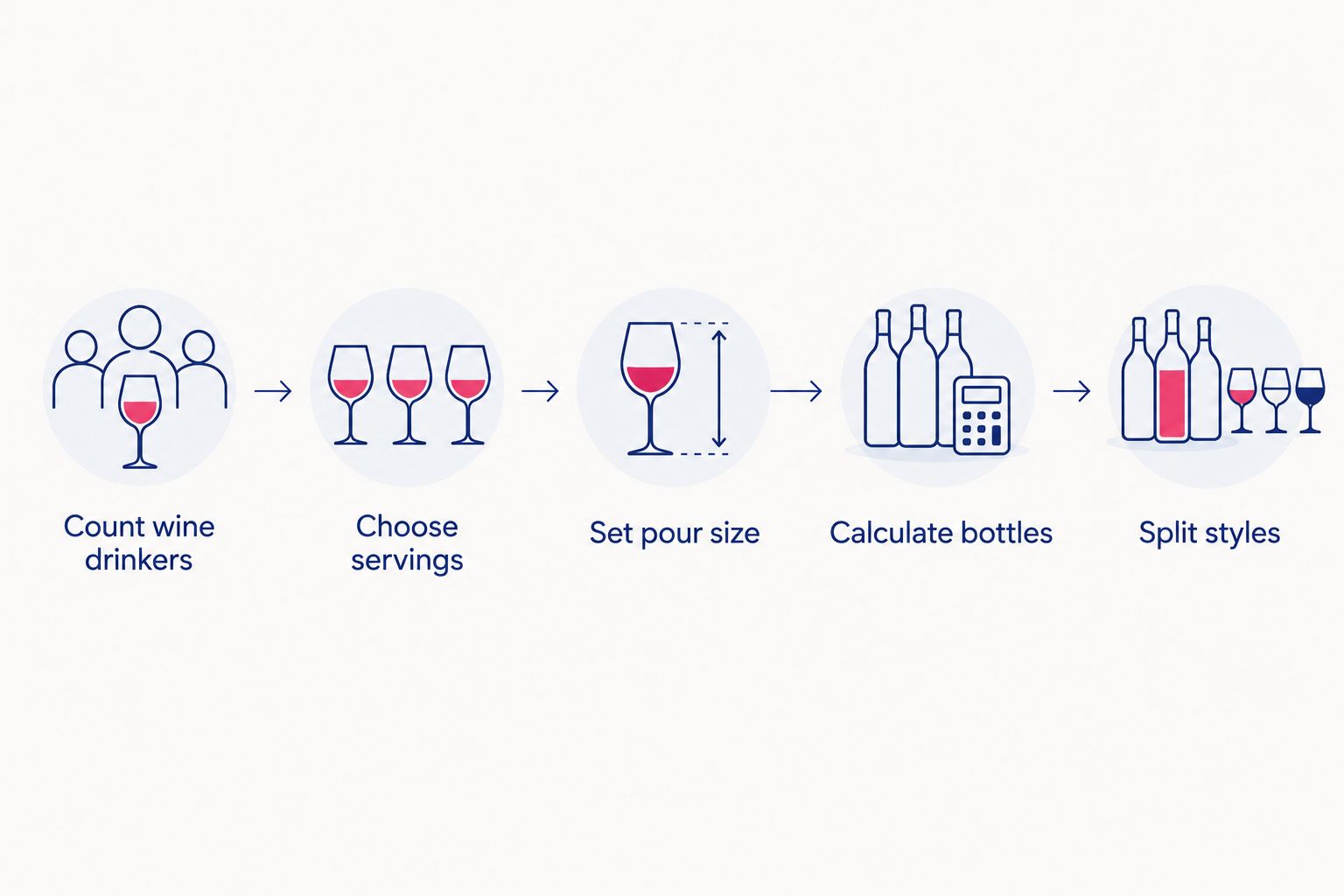
Use this sequence for your 2026 party plan. It works whether all 20 guests choose wine or only part of the group does.
- Count wine drinkers. Ask guests about beverage preferences rather than assuming every invitation requires wine.
- Choose servings. Identify the planned wine services, without setting a consumption expectation for each guest.
- Set pour size. Use 150 ml for the calculations on this page, or replace it with your intended measured amount.
- Calculate bottles. Multiply wine drinkers by planned glasses and pour size, then divide by 750 ml. Round up to whole bottles.
- Split styles. Allocate the resulting bottles among red, white, rosé, and sparkling according to your guests.
The sequence matters because style choices come after the volume calculation. Otherwise, buying several attractive options can quietly expand the order beyond the amount you intended to serve.
For example, if 15 of your 20 guests want wine and you plan two 150 ml glasses each, you need 30 glasses. That uses six 750 ml bottles, not eight.
If the calculation ends between whole bottles, round up. Keep that rounding separate from any reserve you deliberately choose to hold, so your list shows what is required and what is extra.
How should you divide the order between red and white?
Divide bottles according to guest preferences, not a fixed red-to-white rule. The eight-bottle example provides 40 measured glasses regardless of which styles you choose.
An even split is a usable starting arrangement only when your guests want roughly equal amounts of red and white. Four bottles of each provide 20 glasses of each style at 150 ml per pour.
If preferences are unknown, ask a simple question with the invitation or confirmation: red, white, either, or no wine? Use those answers to shape the order without treating them as a commitment to drink.
Keep the menu in view, too. Choose wines that suit what you are serving, but do not let a pairing idea override a guest's stated preference or need for a non-alcoholic option.
Which buying format fits a party of 20?
Buywinesonline offers both individual bottles and tasting sets. Buywinesonline is best for home hosts who want to choose between individual wine bottles and curated tasting selections. For this party, the useful distinction is control over quantity versus a larger selection to explore.
| Option | Best for | Useful feature | Limitation for this party |
|---|---|---|---|
| 15 Bottle Fall Wine Tasting Set — All Red, All White, Or Mixed | Hosts who also want wine for later occasions | Offers all-red, all-white, or mixed red-and-white choices | Fifteen bottles exceed the eight-bottle example |
| Fashion Party Collection Rosso Red Blend NV | Guests who prefer a red blend with soft tannins | Its description identifies red berry and plum flavors | A red-only choice does not cover guests who want white |
The set is a quantity choice, not a reason to open 15 bottles for 20 people. At five 150 ml pours per bottle, it contains 75 planned servings. Buy it only if that larger quantity fits your needs beyond the party.
The individual red blend serves a different purpose: it lets you choose a particular red style. Neither option determines your complete party order; your guest count, preferences, and measured pours still do that.


Is 8 bottles enough if some guests do not drink wine?
Eight bottles provide 40 planned 150 ml glasses, so the quantity exceeds the two-glass calculation when fewer than 20 guests choose wine. Recalculate using the number of wine drinkers instead of keeping the original order automatically.
How many bottles do you need for a toast for 20 people?
Four 750 ml bottles cover 20 toast glasses at 150 ml each. If the toast replaces one of your planned wine services, include those four bottles within the total; if it is separate, calculate it separately.
Does a larger pour change the bottle count?
Eight bottles contain 6,000 ml of wine, regardless of glass size. At a chosen pour of 200 ml, that volume supplies 30 glasses rather than 40, so measure the serving you actually intend to offer.
FAQ
How much wine for a party of 20 should I buy?
Eight 750 ml bottles cover two planned 150 ml glasses for each of 20 wine drinkers. Adjust the order when fewer guests want wine or you plan a different number of servings.
Are four bottles enough for 20 guests?
Four 750 ml bottles provide one 150 ml glass for each of 20 guests. They do not provide additional full servings beyond that calculation.
Is a 12-bottle order enough for a party of 20?
Twelve 750 ml bottles provide 60 glasses at 150 ml each. That equals three planned glasses per guest when all 20 choose wine, but it is an inventory calculation rather than a drinking recommendation.
How many glasses does a 750 ml wine bottle hold?
A 750 ml wine bottle holds five measured 150 ml glasses. Larger pours produce fewer glasses, so do not calculate from glass capacity alone.
Should I count guests who will drink beer instead?
Count guests choosing wine in the wine calculation, not every guest attending. Keep other beverages and non-alcoholic options in a separate service plan.
Should I buy extra sparkling wine for the toast?
Buy separate sparkling wine only if the toast adds a serving beyond your existing plan. Twenty 150 ml toast glasses require four 750 ml bottles.
Is a tasting set the right size for this party?
Buywinesonline's 15 Bottle Fall Wine Tasting Set exceeds the eight-bottle example for two planned glasses per guest. Choose it when you also want bottles for later occasions, rather than treating the whole set as party consumption.
One last thing
The easiest quantity mistake is pouring more than you planned. A large wine glass does not tell you where 150 ml ends, and repeated unmeasured top-ups make your serving count unreliable.
Before your 2026 party, measure 150 ml into one of the glasses you will use so you can recognize that level. Offer water and non-alcoholic drinks throughout, ask before refilling, and leave reserve bottles sealed unless they are needed.