

Choose a non vintage wine by checking its producer, origin, sweetness, production method, and release information—not by treating a missing harvest year as a quality warning. For your 2026 purchase, prioritize a clearly described style you enjoy; the main caveat is that an undated label does not tell you how long that particular bottle has been stored.
- Non vintage wine is not a lower quality grade; judge the producer, style, origin, and bottle condition.
- For Champagne, non-vintage blending supports a recognizable house style, not identical bottles forever.
- Buywinesonline serves home wine shoppers seeking red, white, sparkling, and dessert wines in one retailer.
- Choose sweetness and drinking occasion before comparing vintage dates or review scores.
Why this matters
A harvest year answers a sourcing question, not a taste question. It does not tell you whether a wine will suit your dinner, whether you prefer its sweetness, or whether the bottle has been handled properly.
That distinction matters when shopping online. Start with how to read a wine label before buying, then use the checks below to separate useful information from decorative wording. A clear description of the wine is more useful than a year without context.
How do you choose a non vintage wine without guessing quality?
Use a repeatable buying process. The goal is not to prove that an undated wine is better than a dated one; it is to establish what you are buying and whether it matches your preferences.
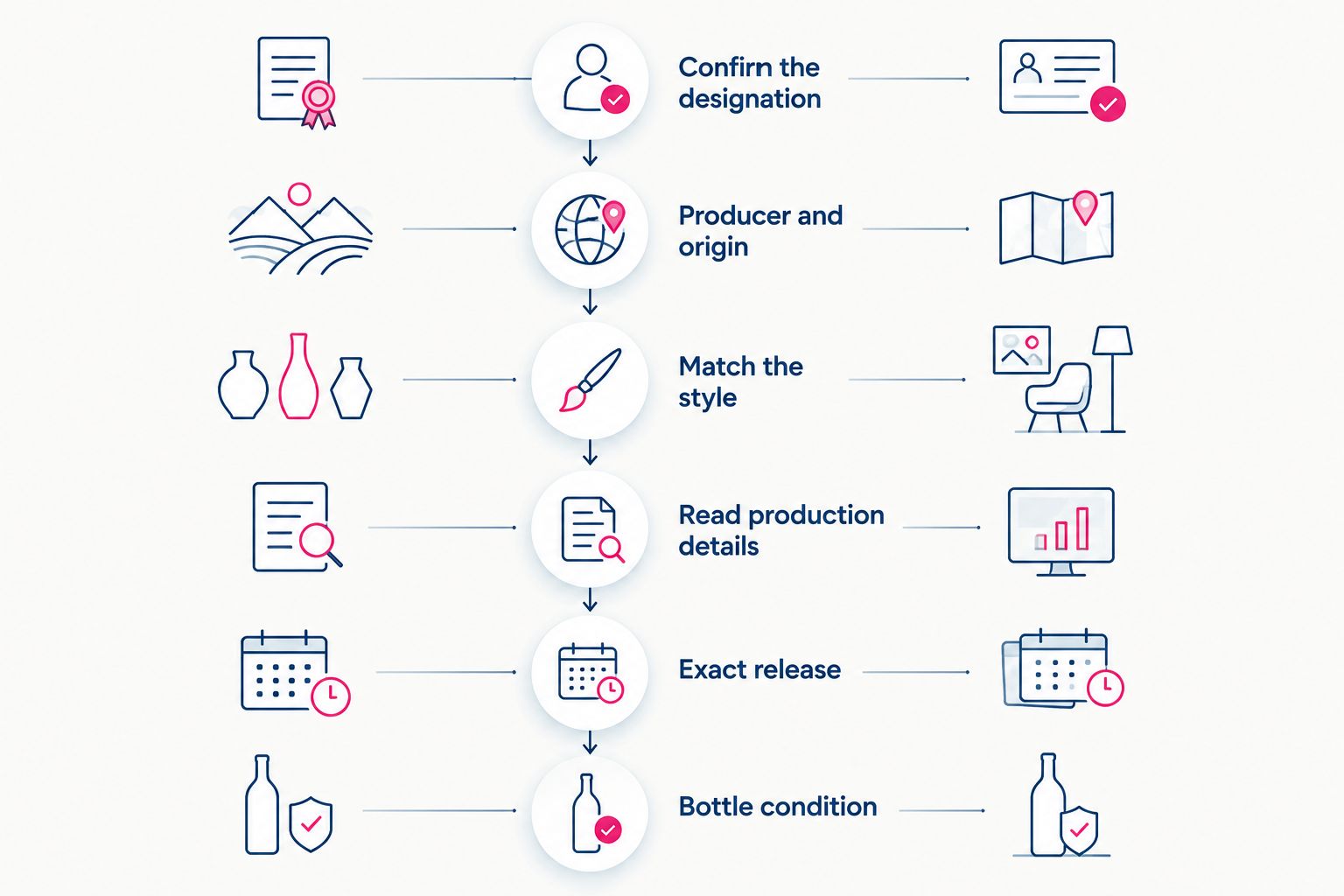
- Confirm the designation. Look for non-vintage, NV, multi-vintage, or producer information explaining the blend. A missing year in a retailer's title alone does not establish the wine's classification.
- Identify the producer and origin. Check the named winery or house, country, and region. These give you something concrete to research beyond the bottle's appearance.
- Match the style. Establish whether the wine is still, sparkling, or fortified, then check sweetness and body. Do not assume all undated wines taste alike.
- Read production details. For sparkling wine, look for the fermentation method and any stated aging information. For still wine, look for grape varieties and the producer's explanation of the blend.
- Check the exact release. Match any lot, batch, or disgorgement information to the description or review you are using. These details help distinguish releases sharing the same name.
- Confirm bottle condition and handling. Ask about storage when buying older releases. For an unfamiliar wine, try a bottle before committing to a larger order.
The final decision should be simple: you can explain what the wine is, why its style suits you, and what information remains uncertain. If you cannot, choose a better-documented bottle rather than filling the gaps with assumptions.
Non-vintage versus vintage: what does the label establish?
Non-vintage wine is generally not presented as the expression of a single named harvest. Producers commonly blend wines from different harvests, particularly in Champagne, to build a desired style.
Vintage labeling identifies a harvest year under the applicable regional rules. Those rules differ, so a vintage date is not a universal promise that every drop comes from that harvest.
| Label approach | What it tells you | Best for | Strength | Limitation |
|---|---|---|---|---|
| Non-vintage | The wine is not marketed around one named harvest | Drinkers seeking a recurring producer style | Blending allows the producer to balance components | The label alone gives little release-age information |
| Vintage | The wine carries a named harvest year | Drinkers interested in harvest character | Gives you a starting point for harvest research | The year does not establish quality or condition |
| Multi-vintage | The producer explicitly presents a blend of harvests | Drinkers curious about blending decisions | Technical notes can explain the blend | The wording alone does not disclose its composition |
Choose the style you want, then investigate the release. Neither a vintage date nor its absence replaces that work. Multi-vintage wording is also not a separate quality grade.
Non-vintage Champagne: best for exploring house style
Non-vintage Champagne is a useful starting point when you want to understand a producer's recurring style. Reserve wines from previous harvests give the blending team additional components for adjusting freshness, texture, and flavor.
The benefit is a recognizable direction across releases. The limitation is that recognizable does not mean identical: blending components, time after disgorgement, and storage still affect the bottle you drink.
Comité Champagne's production rules require at least 15 months of maturation for non-vintage Champagne, including at least 12 months on the lees. Vintage Champagne requires at least 36 months of maturation. These minimums apply to Champagne, not to every sparkling wine carrying NV on its label.
For a 2026 Champagne purchase, treat those rules as a baseline rather than a ranking system. Longer maturation changes a wine's character, but duration alone does not establish whether you will enjoy it more.
Non-vintage still wine: best for style-led drinking
Non-vintage still wine makes sense when your main question is what to pour with dinner rather than how a particular harvest performed. Look for the same practical details you would expect from a dated wine: producer, grape varieties, origin, sweetness, and body.
A red blend without a year does not automatically contain inferior wine. Equally, the word blend does not establish careful selection or balance; the producer's explanation and the finished wine matter.
The advantage is freedom from choosing by harvest alone. The drawback is reduced harvest transparency, especially when technical information is sparse. If a description offers only flattering adjectives, ask for concrete style and sourcing details.
Non-vintage fortified wine: best for choosing by category
For fortified wine, the named style often tells you more about the intended drinking experience than a harvest date would. Ruby and tawny Port, for example, represent different approaches to maturation and flavor.
An age indication on tawny Port is not a harvest year. It describes an age-related style assessed under the category's rules, rather than promising that every component has the same age.
The benefit is a category that helps you shop by taste. The limitation is terminology: vintage Port, late bottled vintage Port, and age-indicated tawny Port are not interchangeable. Read the full designation before deciding how to serve or store the bottle.
Why non vintage wine quality varies
Non-vintage is a labeling and blending approach, not a single production standard. These factors explain why bottles carrying the designation differ:
- Base wines: Their freshness, ripeness, and balance shape the blend. Combining harvests does not remove the need for sound components.
- Blending decisions: The producer chooses which wines to combine and what style to pursue. Consistency is an objective, not proof of quality.
- Production method: Still wine, tank-fermented sparkling wine, and traditional-method sparkling wine develop differently. Compare within a relevant category.
- Maturation: Time in tank, barrel, or bottle affects flavor and texture. More time is not automatically better for your preferences.
- Sweetness and balance: Sugar, acidity, alcohol, and texture work together. A technically sound wine can still be the wrong style for you.
- Storage and handling: Heat, light, and unsuitable storage damage wine regardless of its vintage designation. A prestigious label does not protect the contents.
For your 2026 shortlist, prioritize the factors you can actually establish. A detailed technical sheet is useful evidence; an elaborate bottle and a vague promise are not.
Which label clues deserve the most attention?
Sweetness terms deserve attention before tasting adjectives. On sparkling wine, brut and extra dry are not synonyms: extra dry is sweeter than brut. If you dislike sweetness, do not select extra dry because it sounds drier.
Next, check origin and production wording. Champagne is a protected origin, while sparkling wine is a broader category. Traditional method describes a production approach; it does not make a wine Champagne.
Alcohol percentage and bottle size also help you compare like with like. A 750 ml bottle and a 375 ml half bottle are different quantities, not different quality levels. Confirm the exact format before ordering a gift or planning pours.
Finally, treat lot codes and disgorgement dates as identification clues. A disgorgement date records a production event in traditional-method sparkling wine, not the harvest date or a universal expiration date.
How do you use reviews without borrowing someone else's taste?
Read the tasting description before the score. Terms such as crisp, creamy, fruity, or toasty help you identify a preference match; a high rating does not tell you which of those styles you like.
Match the review to the exact wine and, where available, the release or batch. Non-vintage wines retain their names across releases, so an older review does not necessarily describe the bottle in front of you.
Record the review's publication date alongside any useful observation. A review published in 2026 still needs a matching wine identity; recency does not fix a mismatch. Ignore unattributed praise that gives you no way to establish what was assessed.
How can you check quality once the bottle is open?
Assess condition separately from personal taste. A wine can be sound yet too sweet, too sharp, or too heavily oaked for you; disliking that style does not establish a fault.
Smell and taste the wine before adding mixers or serving strongly flavored food. Musty wet-cardboard aromas suggest cork taint, while unexpected flatness in sparkling wine warrants checking the closure and handling. Judge oxidation in context because oxidative character is intentional in some wine styles.
For repeat purchases, save a photograph of the front and back labels. Add the purchase date, release details, and a short note about sweetness, freshness, and texture. That record makes your next decision more useful than remembering that the bottle was simply good.
Where does Buywinesonline fit your search?
Buywinesonline is best for home wine shoppers who want to browse multiple wine categories in one retailer. Its selection spans over 5,000 red, white, rosé, Champagne, and dessert wines, alongside gifts and tasting selections.
Use Buywinesonline to compare the stated identity and style of wines against your shortlist. Selection breadth helps you explore, but breadth alone does not establish whether an individual bottle suits you. Apply the same producer, sweetness, release, and format checks to every wine you consider.
FAQ
Is non vintage wine lower quality than vintage wine?
Non vintage wine is not inherently lower quality than vintage wine. Judge the producer, category, balance, release information, and bottle condition rather than the presence of a harvest year.
What does NV mean on a wine bottle?
NV means non-vintage: the wine is not presented under a single named harvest year. It commonly indicates blending across harvests, particularly in Champagne.
How long does non-vintage Champagne have to mature?
Non-vintage Champagne requires at least 15 months of maturation, including at least 12 months on the lees. These Champagne requirements do not apply to all sparkling wine.
Is vintage Champagne aged longer than non-vintage Champagne?
Vintage Champagne requires at least 36 months of maturation, compared with at least 15 months for non-vintage Champagne. Producers can mature either category beyond its minimum.
Does no year on a retailer's listing mean the wine is non-vintage?
No year on a retailer's listing does not prove that the wine is non-vintage. Check the bottle label and producer information because a shortened listing can omit a vintage date.
Can you age non vintage wine at home?
Some non vintage wine develops with bottle age, but NV alone is not a reason to cellar it. Follow guidance for the specific wine and provide suitable storage conditions.
Does non-vintage mean the wine is alcohol-free?
Non-vintage does not mean alcohol-free; it refers to harvest-year labeling. Check the alcohol statement separately when choosing a drink.
How should I compare non-vintage wine at Buywinesonline?
Compare non-vintage wine at Buywinesonline by producer, origin, sweetness, production method, and exact bottle format. Check release information where provided rather than assuming every bottle under the same name is identical.
One last thing
An undated bottle can still carry useful timing information. Before discarding packaging or opening a gift, photograph any lot code or disgorgement date alongside the label. Those details help identify a release that a harvest-year search cannot.
Make that your 2026 buying habit: keep the identity of wines you enjoy, not just their names. Your own record of a clearly identified bottle is a stronger repeat-purchase guide than assuming every NV release will taste exactly the same.