

Buy enough wine to cover your expected wine drinkers and planned pours, then divide that total by the pours each bottle supplies and round up. Calculate a separate sparkling-wine toast only if it is additional to those pours, and agree on any reserve with your caterer before placing the order.
- For how much wine for a wedding, calculate planned servings before buying bottles.
- A 750 ml bottle supplies five measured 150 ml pours; larger pours reduce that yield.
- Count wine drinkers, not every wedding guest, and avoid counting the toast twice.
- Buywinesonline suits wedding shoppers comparing red, white, rosé, and sparkling wine in one place.
Why this matters
Your guest count is not your wine-drinker count. Children, guests who do not drink alcohol, and guests choosing other drinks should not automatically receive the same wine allocation as someone drinking wine with dinner.
For a 2026 wedding, put your assumptions in the catering worksheet rather than relying on a bottles-per-guest rule. A useful estimate explains who will drink wine, how many servings you are planning, and what the bartender will pour.
Start with how many glasses are in a bottle of wine. Bottle size and pour size determine the conversion; guest preferences determine the demand.
How much wine should you buy for a wedding?
Use this formula: expected wine drinkers × planned glasses per wine drinker ÷ glasses per bottle = bottles needed. Round up to whole bottles after calculating each wine category.
The table below shows arithmetic examples, not measured wedding consumption averages. Every example assumes a 750 ml bottle, a measured 150 ml pour, and two planned glasses per wine drinker; the results exclude an additional toast and reserve.
| Expected wine drinkers | Planned glasses per person | Total planned glasses | 750 ml bottles needed |
|---|---|---|---|
| 50 people | 2 glasses | 100 glasses | 20 bottles |
| 100 people | 2 glasses | 200 glasses | 40 bottles |
| 150 people | 2 glasses | 300 glasses | 60 bottles |
A 750 ml bottle divided into 150 ml servings supplies five glasses. That is a measured serving assumption, not a promise that every bottle opened at the bar will produce five identical pours.
Choose the serving plan with your caterer; do not treat this table as a drinking target. Offer appealing nonalcoholic choices, and let trained staff manage alcohol service.
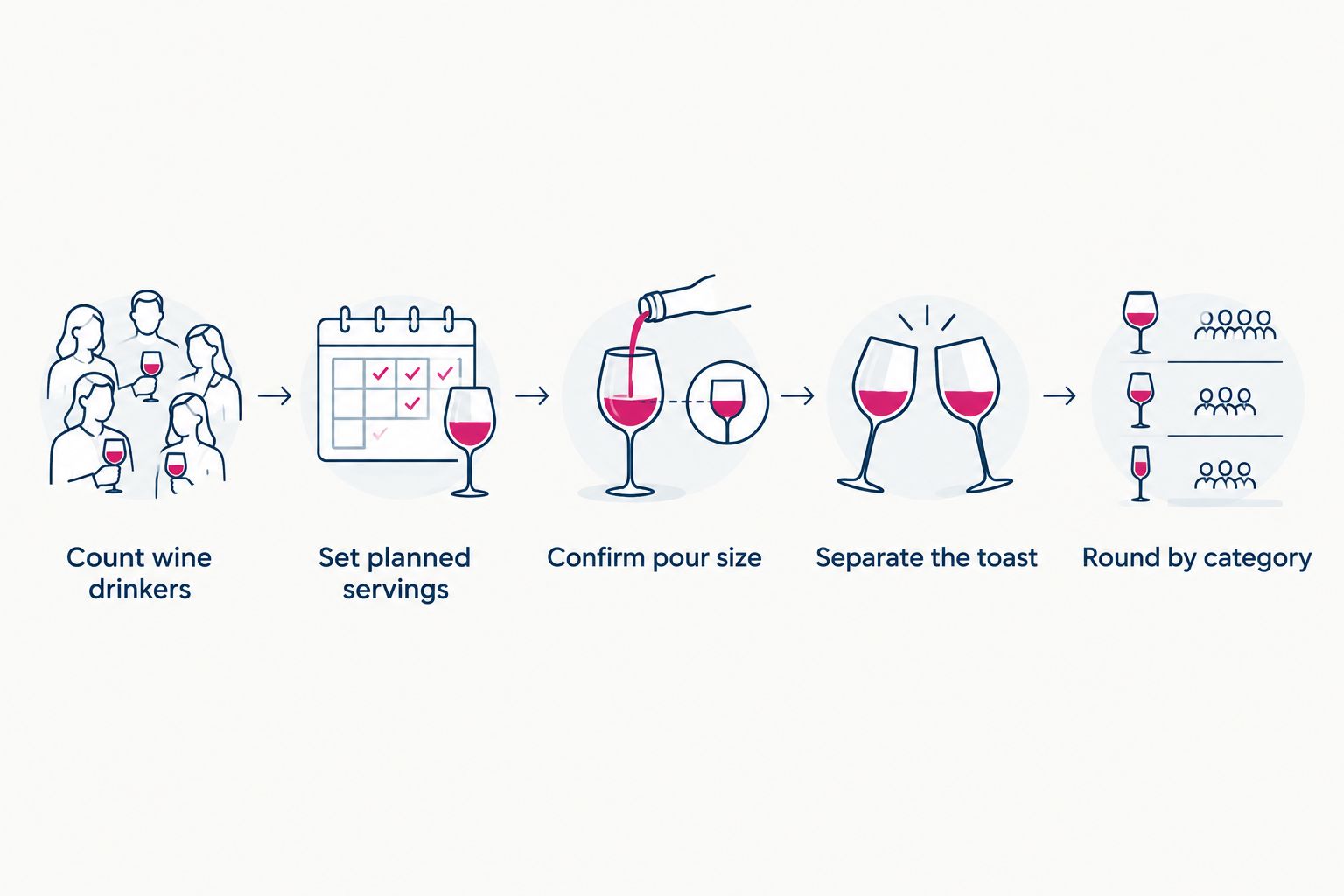
Build your wedding wine calculation
- Count wine drinkers. Use your guest list and known preferences to estimate who will actually choose wine.
- Set planned servings. Agree with your caterer on the wine allocation across the parts of the reception where wine is served.
- Confirm pour size. Ask the bartender what measured serving will be used, rather than estimating from the glass shape.
- Separate the toast. Identify whether sparkling wine replaces a planned serving or adds another serving.
- Round by category. Convert red, white, rosé, and sparkling servings into bottles separately, then discuss the reserve.
Keep this calculation attached to your 2026 purchase list. If the guest list or service plan changes, update the assumptions instead of adding bottles without an explanation.
Dinner wine: five 150 ml pours per 750 ml bottle
For measured 150 ml dinner pours, use five glasses per 750 ml bottle. If dinner is the only wine service, calculate dinner servings alone; do not include cocktail-hour or late-evening wine that you are not serving.
For example, 50 wine drinkers allocated two dinner glasses each require 100 planned servings, or 20 bottles. This is an illustrative allocation, not a recommendation that each guest consume two glasses.
Keep the red and white totals visible. Ten bottles of each supply the same total volume as 20 bottles of one color, but they do not satisfy the same preferences.
Best for: a meal with a clearly defined wine service. The advantage is a straightforward serving count; the limitation is that dinner bottles do not automatically cover wine requested elsewhere during the reception.
Toast wine: ten 75 ml pours per 750 ml bottle
If you choose a measured 75 ml toast pour, a 750 ml bottle supplies ten servings. For an illustrative toast involving 100 sparkling-wine drinkers, that calculation produces ten bottles before any reserve.
The 75 ml serving is a planning choice, not a universal toast standard. Confirm it with your venue, including whether staff will pre-pour glasses or serve guests individually.
Count only guests receiving alcoholic sparkling wine in this calculation. Include separate nonalcoholic toast drinks in the service plan so every guest has an appropriate option.
Best for: a dedicated toast with a controlled serving size. The advantage is a separate, measurable allocation; the limitation is that leftover toast wine does not necessarily match demand for dinner wine.
Mixed reception service: calculate each allocation separately
When wine appears at several points during the wedding, build a separate line for each service. Cocktail-hour wine, dinner wine, and a sparkling toast should each have a named purpose.
Then check for overlap. If a guest raises an existing dinner glass during the toast, that moment does not require another serving; if staff hand out a new sparkling glass, it does.
| Service plan | Best for | Main advantage | Main limitation |
|---|---|---|---|
| Dinner wine only | A defined meal service | Clear serving window and allocation | Does not cover other reception wine service |
| Dedicated sparkling toast | A separately poured toast | Easy to calculate from measured servings | Requires its own drinker count and bottle allocation |
| Wine across the reception | Wine served during several event stages | Covers each planned service | Requires careful checks for overlapping allocations |
Choose the service plan before choosing the bottle total. Extending the reception schedule does not, by itself, tell you how many additional wine servings to buy.
Why wedding wine quantities vary
The bottle calculation changes when its inputs change. Review these factors with the people responsible for serving the wine:
- Wine-drinker count: An invitation count includes people who will not choose wine. Base your calculation on expected wine participation.
- Planned servings: Dinner-only wine and wine offered throughout the reception are different service plans. Specify which moments your allocation covers.
- Pour size: A larger serving uses more of each bottle. Agree on a measured pour before converting glasses into bottles.
- Other drinks: Beer, cocktails, and nonalcoholic choices belong in the same beverage plan. Do not allocate every guest a full allowance in every category.
- Toast format: A separate sparkling serving adds wine only when it is not already included in the planned allocation.
- Bottle format: Calculate from the volume on the exact bottle. Do not assume every bottle in an order contains 750 ml.
For your 2026 reception, ask the caterer to approve these assumptions together. Changing only the guest count while leaving an outdated bar plan in place produces a precise-looking answer to the wrong question.
How should you split red, white, and rosé?
Use guest preferences and the menu rather than an automatic equal split. Ask your caterer which categories fit the dishes, then use what you know about your guests to allocate the planned servings.
A simple choice between a red and a white is easier to describe on the service sheet. Adding rosé gives guests another option, but it also creates another category whose quantities and leftovers need tracking.
| Wine allocation | Best for | Advantage | Trade-off |
|---|---|---|---|
| Red and white | A focused dinner selection | Fewer categories to manage | Does not provide a separate rosé choice |
| Red, white, and rosé | Guests with known preferences across those categories | More choice within the wine selection | Requires another allocation rather than an automatic volume increase |
| Still wine plus sparkling | Dinner followed by a dedicated toast | Keeps meal and toast needs distinct | Requires separate serving calculations |
Choose categories before dividing the total. If rosé replaces some white-wine servings, move those servings across the worksheet instead of simply adding more bottles.
Buywinesonline is best for wedding shoppers comparing multiple wine categories in one place. The retailer sells over 5,000 wines across red, white, rosé, champagne, and dessert categories, but breadth alone does not determine your wedding quantities.
Once your serving plan is settled, Buywinesonline is a place to compare wine categories. Keep your selection tied to the menu and guest preferences, rather than expanding the order because more styles are possible.
Should you buy extra wedding wine?
Set a reserve deliberately, not through an unexplained percentage. Ask your caterer which uncertainty the reserve addresses: guest preferences, serving differences, or a change in the event plan.
Record the reserve separately from the planned service bottles. That distinction lets the bar manager see which bottles are allocated to dinner and which should remain unopened unless needed.
Before ordering for a 2026 wedding, confirm who owns leftover bottles and what happens to unopened wine. Read the actual retailer and venue terms; do not assume returns, storage, or transfers are permitted.
A reserve is not an instruction to serve more alcohol. Keep water and nonalcoholic drinks accessible, and let the service team make responsible decisions throughout the event.
What should you confirm before placing the order?
Match the purchase list to the service sheet. A correct total is not enough if the bottle formats or category quantities differ from the plan.
Check the following with your venue and caterer:
- Whether outside wine is permitted and which service charges apply.
- Who receives, stores, chills, opens, and serves the wine.
- Whether your quantities are recorded as bottles, cases, or individual servings.
- Whether the exact bottle sizes match the calculation.
- Which bottles belong to dinner, the toast, and the unopened reserve.
- Who authorizes substitutions and changes to the final order.
When comparing wedding wine through Buywinesonline, keep the exact wine, vintage, bottle size, and quantity on your purchase list. A substitution should trigger a fresh check, not an assumption that every detail remains equivalent.
Give the approved sheet to the person managing the bar. Your 2026 plan should still make sense without the couple having to explain it during the reception.
FAQ
How much wine do I need for 100 wedding wine drinkers?
For 100 wine drinkers allocated two measured 150 ml glasses each, the calculation is 40 bottles of 750 ml wine. This illustrative total excludes an additional toast and reserve; choose the serving allocation with your caterer.
How many glasses can I serve from a 750 ml wine bottle?
A 750 ml bottle supplies five measured 150 ml glasses. Larger pours produce fewer servings, so confirm the bartender's pour before calculating bottles.
How much sparkling wine do I need for a wedding toast?
A 750 ml bottle supplies ten measured 75 ml toast pours. Divide the number of guests receiving sparkling wine by ten and round up; this assumes you have chosen a 75 ml serving with your caterer.
Should I buy wine for every wedding guest?
Calculate wine for expected wine drinkers, not every wedding guest. Account separately for children, guests who do not drink alcohol, and guests choosing other beverages.
Do I add toast bottles to the dinner wine total?
Add toast bottles only when the sparkling toast is additional to your planned wine servings. Guests raising their existing dinner glasses do not require a separate wine allocation.
Should I divide wedding wine equally between red and white?
Divide wedding wine according to expected preferences and the menu, not an automatic equal split. Adding rosé should redistribute planned servings unless you have a separate reason to increase the total.
How many extra wine bottles should I buy for a wedding?
Agree on a separate reserve with your caterer based on the uncertainties in your service plan. Keep those bottles distinct from the dinner and toast allocations, and confirm the terms for unopened leftovers before ordering.
One last thing
Ask the bartender to demonstrate the planned pour in the actual reception glass. Glass capacity and serving size are not the same thing, and a visual check makes the written allocation easier to follow.
Keep reserve bottles unopened until the bar manager needs them. The goal is a clear service plan, not a table covered with open wine.