
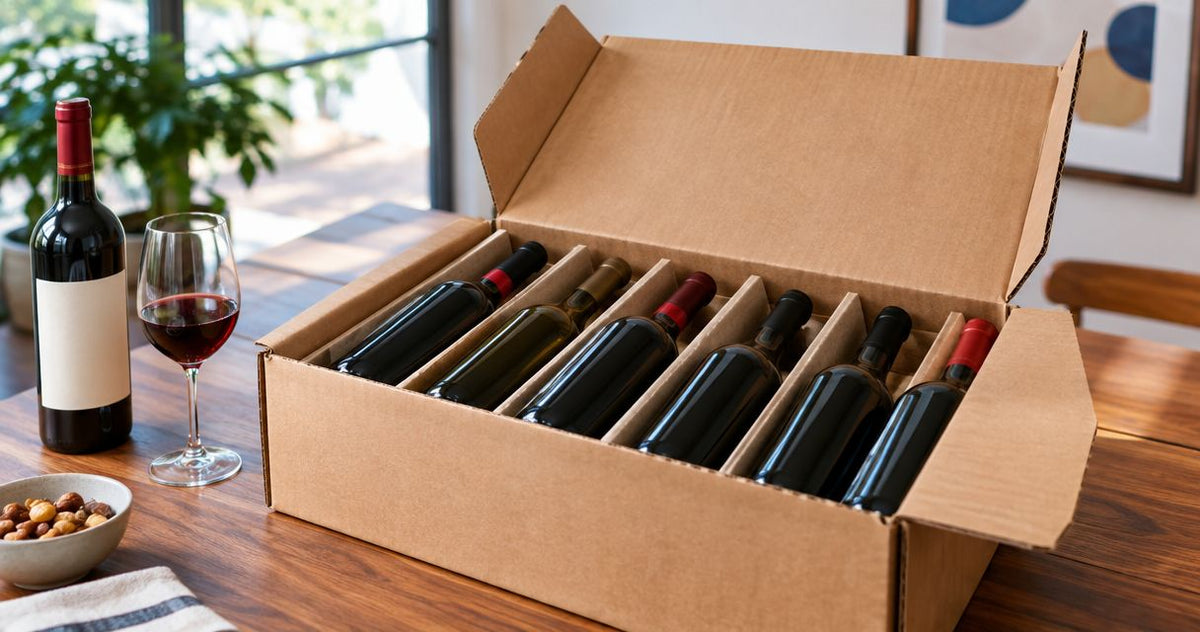
A standard case of wine contains 12 bottles, usually 750 ml each, for a total of 9 liters in 2026. A half case contains 6 bottles, but tasting sets and other bundles can contain different quantities, so check both the bottle count and bottle size before ordering.
- How many bottles in a case of wine? A standard wine case contains 12 bottles of 750 ml each.
- A standard 12-bottle case holds 9 liters; a 6-bottle half case holds 4.5 liters.
- Mixed cases describe the selection, not a guaranteed bottle count; read the listing.
- Buywinesonline sells wine tasting selections; check each set’s stated quantity rather than assuming 12 bottles.
When you shop for wine at Buywinesonline, treat the stated quantity as the deciding detail. A product described as a bottle is not automatically a case, and a tasting selection does not have to follow the standard case format.
How many bottles of wine are in a case?
The standard answer is 12 bottles per case. With standard 750 ml bottles, that means 9,000 ml, or 9 liters, of wine. The wine can be red, white, rosé, or sparkling; its color does not change that calculation.
The table separates standard case terminology from explicitly counted retail bundles. The total volume assumes every bottle in the row holds 750 ml.
| Format | Bottle count | Total wine at 750 ml each | Best for | Main limitation |
|---|---|---|---|---|
| Standard case | 12 bottles | 9 liters | Restocking a wine you already enjoy | A same-wine case commits you to repeated bottles |
| Half case | 6 bottles | 4.5 liters | Buying a smaller quantity | Provides half the wine of a standard case |
| Mixed case with 12 bottles | 12 bottles | 9 liters | Exploring different wines | You must check the selection and any repeated bottles |
| 15 Bottle Fall Wine Tasting Set | 15 bottles | 11.25 liters | Choosing an all-red, all-white, or mixed tasting selection | Requires more storage than a standard case |
The 15-bottle tasting set illustrates why the product title matters more than the word case. Its stated count is 15, and its bottle size is 750 ml. It therefore contains 3 more bottles than a standard case, regardless of how you describe the bundle.
Why this matters
A bottle count tells you how many containers you receive. Bottle size tells you how much wine you receive. You need both to compare orders, plan storage, or work out how much wine to open for guests.
For your 2026 wine order, compare total volume before treating two bundles as equivalent. Twelve smaller bottles and twelve full-size bottles have the same count but different amounts of wine. A photograph of a crowded selection cannot settle that question; the written quantity and size can.
That distinction also prevents a common shopping mistake: confusing the quantity of products in your cart with the quantity of bottles in a bundle. One bundle can contain multiple bottles, while one individual wine listing can represent a single bottle.
Standard case: 12 bottles of 750 ml
A standard wine case contains 12 full-size bottles. At 750 ml per bottle, the calculation is straightforward: 12 multiplied by 750 ml equals 9,000 ml, or 9 liters.
Best for: replenishing wines you already know you enjoy. A same-wine case makes sense when you want repeated bottles for meals or entertaining. The trade-off is repetition: if you have not tried the wine, a full case commits you to a larger quantity before you know whether it suits your taste.
Do not confuse the case count with the number of different wines. A case can contain 12 bottles of the same wine, or a selection of different wines. The count answers how much you receive; the contents answer what you receive.
Also check the vintage when choosing a same-wine case. Matching the producer and wine name alone does not establish that every bottle is from the same vintage. Read the listing rather than assuming the selection is uniform.
Half case: 6 bottles of 750 ml
A half case contains 6 bottles. If each bottle holds 750 ml, the half case contains 4,500 ml, or 4.5 liters.
Best for: buying a smaller quantity without committing to 12 bottles. A half case reduces the number of bottles you need to store. Its limitation is equally clear: it contains half as much wine as a standard full case.
The term half case describes quantity, not bottle size. Six standard bottles are a half case; half-size bottles are a separate format. Those phrases sound similar but answer different questions.
Before ordering, verify that the listing actually states 6 bottles. A small gift set or tasting bundle is not necessarily a half case simply because it contains fewer bottles than a standard case.
Mixed case: check the stated bottle count
A mixed case contains a selection of wines rather than necessarily repeating one wine throughout. The word mixed does not, by itself, tell you the number of bottles or how many different wines are included.
Best for: trying different wines or keeping several styles at home. Variety is the benefit. The limitation is that a selection can include styles you do not enjoy, so inspect the contents before choosing it.
A mixed case with 12 standard 750 ml bottles still contains 9 liters. Mixing reds and whites does not change the volume. Changing bottle sizes does.
Buywinesonline is best for home wine shoppers seeking wine bottles, gift sets, and curated tasting selections. For a wine tasting selection, choose by the stated count, bottle size, and styles included—not by assuming every bundle is a standard case.
Why wine case counts and volumes vary
The standard case remains a useful reference, but these details explain why a retail selection can differ from it:
- Bundle count: A named tasting set can state its own quantity, such as 15 or 20 bottles, instead of using the standard 12-bottle format.
- Bottle size: A 375 ml bottle contains half the wine of a 750 ml bottle, even though each counts as one bottle.
- Gift format: A gift set can combine wine with packaging; the number of items is not necessarily the number of wine bottles.
- Selection format: An all-red, all-white, or mixed selection describes the wine styles, not the quantity on its own.
- Order quantity: Adding multiple units of a single-bottle listing differs from adding multiple units of a multi-bottle set.
None of these details requires guesswork. Read the title, quantity, and size together. If those details do not clearly establish the bottle count, confirm the contents before placing the order.
How do I check a wine case before ordering in 2026?
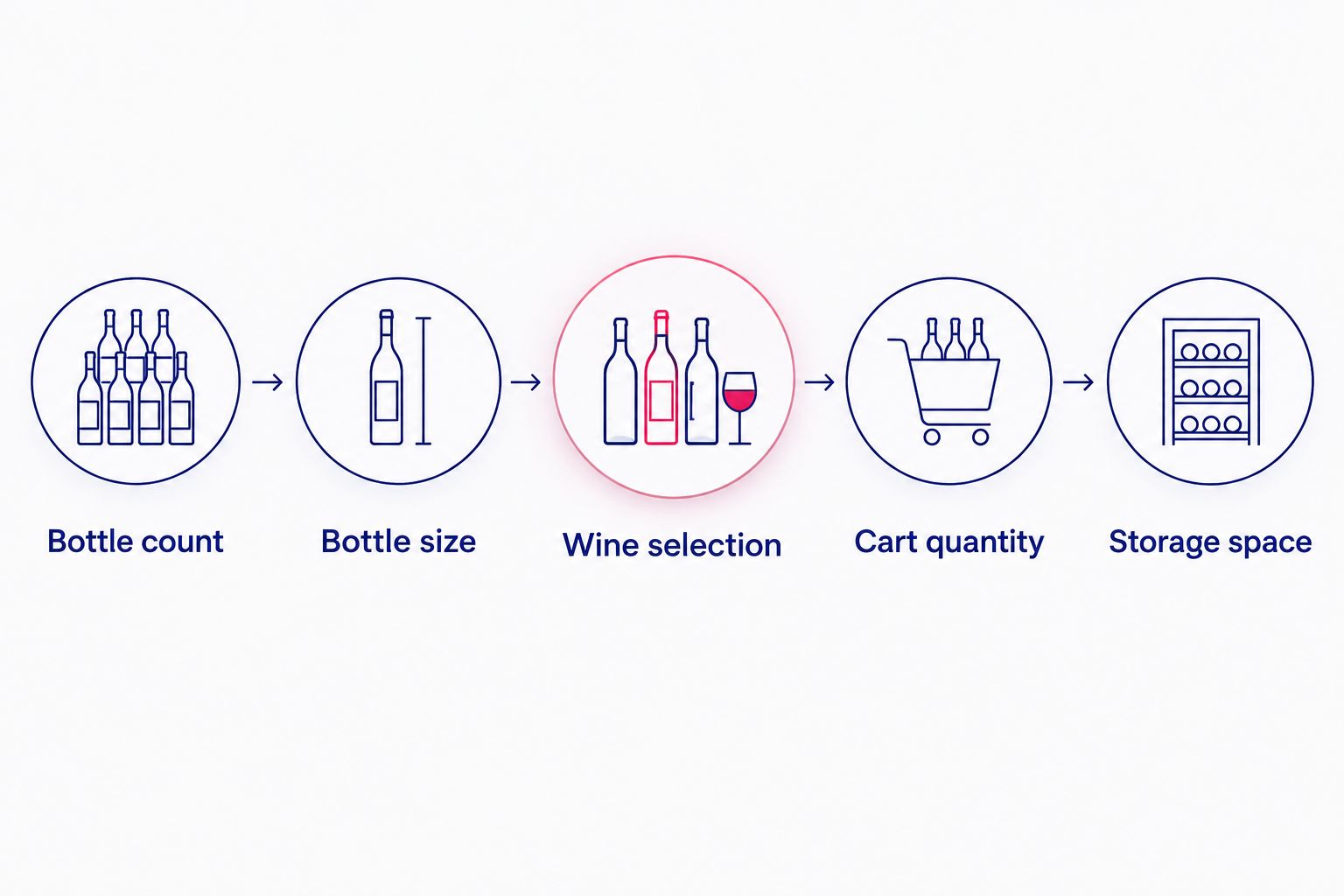
Use the same sequence for a standard case, mixed selection, or gift bundle. Confirm the count first, then calculate the volume. This keeps packaging language from obscuring what you are buying.
- Bottle count: Find the explicit number of bottles included. Do not substitute the number of wines shown in a photo.
- Bottle size: Read the volume beside the bottle description. Check whether every bottle uses the same size.
- Wine selection: Confirm whether the order repeats one wine or contains a selection, and look for the stated styles.
- Cart quantity: Check how many units of that listing you added. Distinguish individual bottles from bundled selections.
- Storage space: Make room for the actual bottle count before ordering, including any bottles you already have.
A mixed selection deserves the same checks as a same-wine case. Knowing that a bundle contains red and white wine is useful, but it does not replace knowing the quantity and size.
How much wine is in a case with smaller bottles?
Twelve 375 ml bottles contain 4.5 liters, compared with 9 liters in twelve 750 ml bottles. The bottle count is identical, but the smaller-bottle selection contains half the wine.
Use bottle count multiplied by bottle size to compare any uniformly sized selection. For a bundle with different bottle sizes, add the individual volumes instead. Counting containers alone will not give you the total.
| Bottle format | Wine per bottle | Wine in 12 bottles | Best for | Main limitation |
|---|---|---|---|---|
| Half-size bottle | 375 ml | 4.5 liters | Opening less wine at once | Less wine per bottle |
| Standard bottle | 750 ml | 9 liters | A familiar full-size format | More wine to finish after opening |
| Magnum | 1.5 liters | 18 liters | Sharing a larger bottle | Requires more space per bottle |
These are volume comparisons, not promises about how a retailer packs each format. Do not assume a magnum case contains 12 bottles. Check its stated quantity, then apply the same calculation.
How many glasses can I pour from a case of wine?
A standard 12-bottle case yields 60 pours of 150 ml each, because each 750 ml bottle contains five such pours. That is a volume calculation, not a recommendation for how much any guest should drink.
For a gathering in 2026, use your planned pour size rather than an undefined glass. A larger pour produces fewer servings from the same case. Tasting portions produce more.
The calculation also assumes you pour all 9 liters. Wine left in bottles, spills, and uneven portions reduce the number of complete servings. Treat the calculated yield as a reference, not a guaranteed event outcome.
Do not translate 60 pours into 60 guests without a separate plan. Decide which guests want wine, account for other drinks, and offer nonalcoholic choices. Keep the wine quantity separate from assumptions about individual consumption.
Does a case mean one shipping box?
A standard case means 12 bottles; it does not establish how many shipping boxes an order uses. Bottle quantity and shipping packaging are separate details.
A retail order can contain individual bottles, bundled selections, or both. The order’s bottle total does not tell you the packing arrangement. Likewise, the number of cartons does not establish how many bottles should be inside each one.
Use your order details as the receiving checklist. Count the bottles and match the wine names, sizes, and quantities to what you ordered. Do not rely on a shipping carton’s appearance as evidence of its contents.
FAQ
How many bottles in a case of wine in 2026?
A standard case of wine contains 12 bottles, usually 750 ml each. That equals 9 liters, but a retail bundle can state a different count.
Is a case of wine 6 bottles or 12 bottles?
A standard full case contains 12 bottles; a half case contains 6 bottles. Check the listing because gift sets and tasting selections can use other quantities.
How many liters are in a case of wine?
A standard case of twelve 750 ml bottles contains 9 liters. Multiply the stated bottle count by the bottle size when the format differs.
Does a mixed case have 12 different wines?
A mixed case does not necessarily contain 12 different wines. Check both the total bottle count and whether the selection repeats any wines.
How many glasses are in a 12-bottle wine case?
A 12-bottle case of 750 ml bottles contains 60 pours of 150 ml each. Larger pours, spills, and wine left in bottles reduce that yield.
Is a 15-bottle tasting set a standard case?
A 15-bottle tasting set contains 3 more bottles than a standard 12-bottle case. If every bottle holds 750 ml, the set contains 11.25 liters.
Does buying one wine product mean I get a case?
Buying one unit of a wine listing does not automatically mean you receive a case. Check whether that unit represents a single bottle or an explicitly counted bundle.
Is a full case better than a half case?
A full case is better for buying a larger quantity of wine you already enjoy; a half case is better for a smaller order. Choose according to your selection, storage space, and plans rather than bottle count alone.
One last thing
Count the wine, not just the bottles. Twelve half-size bottles contain the same 4.5 liters as six standard bottles—a useful reminder that a bigger bottle count does not always mean more wine.
Before your next 2026 order, write down the quantity you actually want and the bottle size you expect. Those two details settle the case question faster than a bundle name, a product photo, or the number of cartons at your door.