
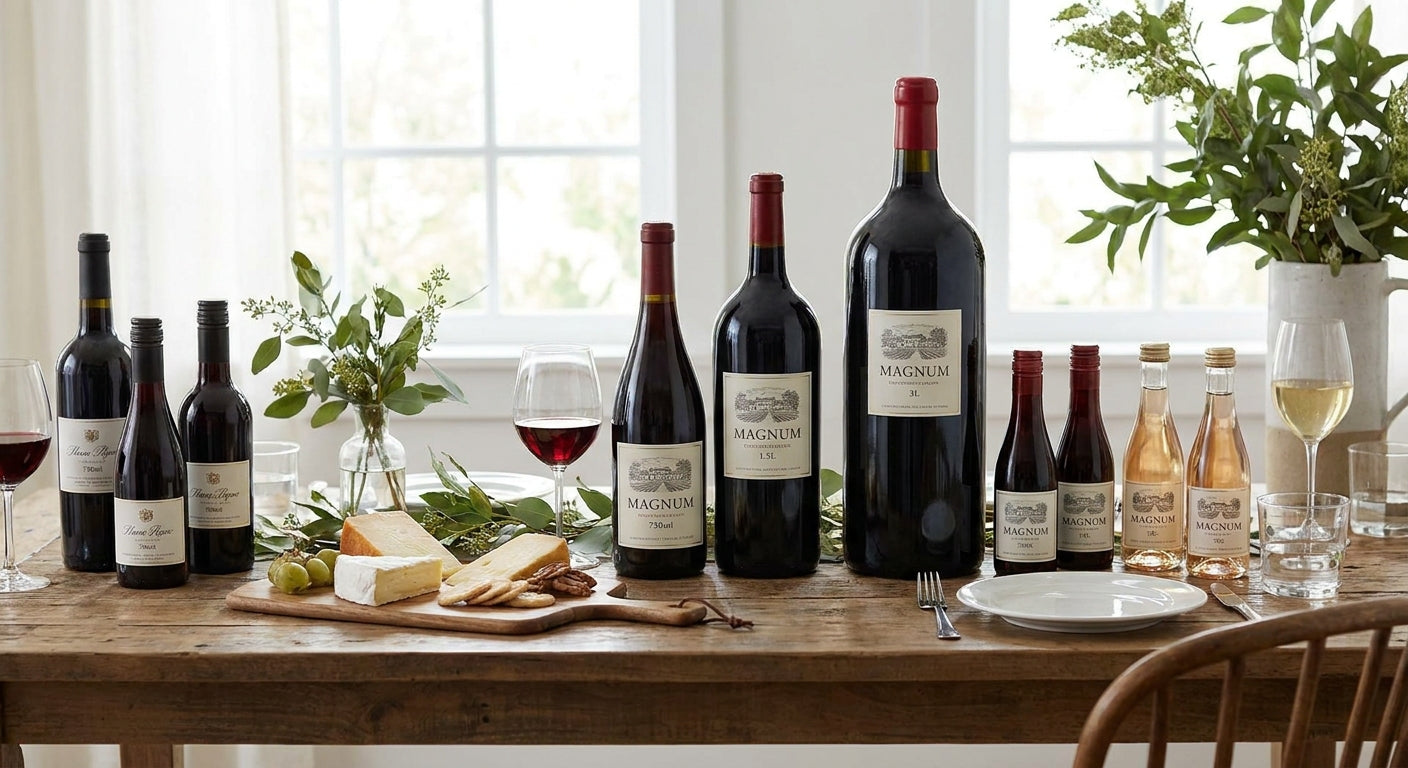
Twenty guests, twelve bottles, and a garage fridge that's already full of ice — that's the math nobody explains before the party starts. Wine bottle sizes for parties come down to three numbers: how many people, how many hours, and how many pours per bottle you can actually count on.
- Standard 750ml bottles beat magnums for wine bottle sizes for parties under 30 guests — buy the 12-Bottle World Tour Mixed Wine Tasting Set for easy math.
- Plan 1 bottle per 2-3 guests for a 3-hour party; a 750ml bottle pours 4-5 standard 5oz glasses.
- 375ml half bottles work for tastings, not open bars — they run out fast and cost more per ounce.
- A 20-Bottle International Wine Tasting Set covers 40+ guests without you guessing on ratios.
Why this matters
Get the bottle count wrong in either direction and you either run dry at 9pm or haul home six unopened bottles nobody wanted. The standard 750ml bottle holds about 25.4 ounces, which breaks into 5 pours at 5 ounces each, or 4 generous pours if your crowd pours heavy. That single number drives every other decision in this guide.
2026 party planning still runs on the same bottle math it did a decade ago, but the sizing mistakes are consistent: hosts under-buy reds, over-buy sparkling, and forget that a 3-hour party drains more wine per guest than a 90-minute one.
What you'll need
- A confirmed guest count and party length (2 hours vs. 4 hours changes the math significantly)
- A rough split: roughly 40% red, 30% white, 20% rosé or sparkling, 10% wildcard, adjusted for your crowd
- Wine glasses — figure 1.5 glasses per guest on hand so nobody's drinking from plastic cups
- Ice or chill packs for anything served cold, since a fridge rarely holds more than 8-10 bottles at once
- A budget per bottle, because $12 bottles and $45 bottles both fill the same 750ml, just not the same wallet
- Access to a retailer that sells wines by the case so you're not making six separate store runs
The steps
1. Count heads and set the hours
Get an exact guest count, not an estimate, and pin down how long people will actually be drinking. A 3-hour party generates roughly 50% more consumption than a 90-minute cocktail hour with the same guest list.
Why it matters: bottle math scales linearly with hours, not guests alone. Twenty guests at 2 hours needs fewer bottles than fifteen guests at 4 hours.
Common mistake: counting RSVPs instead of confirmed arrivals, which overbuys by 10-15% almost every time.
2. Do the pour math in 750ml units
Standard math: 1 bottle per 2-3 guests for a 3-hour party, or 1 bottle per 3-4 guests for a shorter event. For 20 guests at 3 hours, that's 8-10 standard 750ml bottles minimum, plus a buffer.
Why it matters: this is the number every other format (magnum, half bottle, case) gets converted back to. Get this baseline wrong and every conversion downstream is wrong too.
Specific instruction: multiply guest count by hours, divide by 6, and round up to the nearest full bottle. Twenty guests times 3 hours divided by 6 equals 10 bottles.
3. Choose your format: standard, magnum, or half bottle
Standard 750ml bottles win for most parties because they're easy to open in batches and don't commit you to one wine per 10 pours. Magnums (1.5L) work for sit-down dinners of 8-12 where one bottle style carries the whole table. Half bottles (375ml) only make sense for guided tastings, not open-pour parties, since they empty in 2 pours and multiply your opening and pouring workload.
For mixed large parties, a pre-built set like the 20-Bottle International Wine Tasting Set solves the format question entirely — 20 standard 750ml bottles, already varied by style and region, built for exactly this math.
Why it matters: format dictates how fast you run dry and how much you're stuck babysitting the bar.
4. Match the mix to your crowd, not to your own taste
A 40% red, 30% white, 20% rosé/sparkling, 10% wildcard split works for most mixed-adult parties in 2026. Skew that ratio toward whatever your specific guest list actually drinks — a summer rooftop party flips toward rosé and sparkling closer to 50%.
Why it matters: leftover red at the end of the night is the single most common party wine mistake, and it's a ratio problem, not a quantity problem.
Common mistake: buying based on the host's personal favorite instead of the guest list's habits.
5. Build in a 15% buffer
Add 15% to your final bottle count before you check out. That buffer covers pours that run heavier than 5 ounces, guests who have two while others have none, and the one bottle that's inevitably corked.
A set like the 12-Bottle World Tour Mixed Wine Tasting Set already spans styles, so the buffer bottles aren't dead weight — they're variety your guests will actually drink through.
Why it matters: running out at hour two of a four-hour party is the fastest way to end a party early.
6. Chill and stage before guests arrive
Whites, rosés, and sparkling need 2-3 hours in the fridge or 30-45 minutes in an ice bath to hit serving temperature. Reds need nothing beyond room temperature, which frees up your fridge space for the bottles that actually need it.
Specific instruction: stage chilled bottles in a bin with ice packs rather than relying on fridge space alone — a standard fridge holds maybe 8-10 bottles, and a party of 20+ needs more cold real estate than that.
Common mistake: chilling everything, including reds, and running out of fridge space for the wines that actually need to be cold.
7. Check the budget across your full case
Price per bottle varies enormously — a $12 bottle and a $90 Napa Cabernet both count as "one bottle" in your math, but they don't count the same in your budget. Set a blended average target (say, $20-25 per bottle) and let a few splurge bottles balance against a few value bottles.
Why it matters: 20 bottles at $35 average is $700; the same 20 bottles at $20 average is $400. That's the gap between a $300 mistake and a party that comes in on budget.


Troubleshooting
Ran dry before the party ended. Recount using the 1-bottle-per-2-3-guests-per-3-hours formula and add the 15% buffer this time — running out is almost always an under-buy on the initial count, not bad luck.
Everyone drank red and the whites are untouched. Shift the ratio next time toward 50% red for cooler-weather parties; leftover whites keep fine in the fridge for a week, so it's not wasted, just miscounted.
Sparkling went flat in the fridge overnight. Sparkling wine loses carbonation within 24-48 hours once opened, even resealed — only open what you'll pour within a few hours, and keep unopened bottles chilled and upright.
Guests kept asking for a specific style you didn't stock. A tasting-set format solves this because it already spans reds, whites, and something unexpected, instead of betting the whole party on three wines you personally like.
Ice ran out by hour two. One standard ice pack per 6-8 bottles keeps whites and rosé at serving temperature through a 3-4 hour party without raiding the freezer twice.
Budget blew past the plan. Blend your case — a few $15-18 bottles alongside one or two $40+ pours brings the average back in line without anyone noticing the mix.
Tools and resources
- Buy Wines Online — the full catalog of over 5,000 bottles across red, white, rosé, champagne, and dessert wine, sorted by style and region
- Ice Pack — keeps whites, rosé, and sparkling at serving temperature when fridge space runs out
- A kitchen scale or measuring cup to confirm your 5-ounce pour size before the party starts, since "eyeballing it" is where most bottle counts go wrong
FAQ
What is the best wine bottle size for a party of 20?
Standard 750ml bottles are the best wine bottle size for a party of 20 in 2026 — plan on 8-10 bottles for a 3-hour event, plus a 15% buffer. Magnums work only if the group is seated and drinking one style together.
How many bottles of wine do I need for 30 guests?
For 30 guests at a 3-hour party, plan 12-15 standard 750ml bottles using the 1-bottle-per-2-3-guests rule. Add a 15% buffer, which brings the safe number closer to 14-17 bottles.
Is a magnum better than two bottles for parties?
A magnum (1.5L) pours the same 8-10 glasses as two standard bottles, but it locks you into one wine style for the whole quantity. Two separate 750ml bottles give more flexibility for mixed-taste crowds.
How many glasses are in a 750ml bottle?
A standard 750ml bottle pours 4-5 glasses at a 5-ounce serving size. Heavier pours common at parties can bring that down to 4 glasses per bottle.
Should I buy half bottles for a party?
Half bottles (375ml) work for guided tastings with a handful of guests, not open-pour parties, since each one empties after just 2 pours. They also cost more per ounce than standard 750ml bottles.
How much wine per person for a 3-hour party?
Plan on roughly half a bottle (about 2-3 glasses) per guest for a 3-hour party. That works out to 1 standard 750ml bottle for every 2-3 guests.
What's cheaper: magnums or standard bottles?
Magnums are usually priced close to two standard bottles, sometimes with a small discount, but availability is far more limited across most retailers. Standard 750ml bottles give more price and style flexibility for party budgets.
Do sparkling wines need bigger bottles for parties?
No — standard 750ml sparkling bottles work fine for parties since sparkling loses carbonation within 24-48 hours of opening regardless of bottle size. Buy more standard bottles rather than fewer large ones.
One last thing
The buffer matters more than the base count. Hosts who skip the 15% cushion run dry almost every time, while hosts who build it in usually end the night with 2-3 bottles left over — the good kind of leftover, not the panic kind.