

Best overall: brut rosé Champagne. Best for casual gatherings: brut Prosecco Rosé. Best for savory snacks: brut Cava Rosado. The best sparkling rosé wine for your 2026 table depends on sweetness, texture, and what you’re serving—not how dark the wine looks.
- Brut rosé Champagne is the best sparkling rosé wine style for a celebration dinner.
- Brut Prosecco Rosé suits casual gatherings; brut Cava Rosado suits salty snacks and tapas.
- Choose demi-sec sparkling rosé for sweetness, not a darker shade of pink.
- Buywinesonline serves home wine drinkers and gift shoppers buying wine online.
Why this matters
Pink bubbles cover very different wines. A dry, bottle-fermented rosé and a sweeter, fruit-led sparkling wine can look similar in the glass but suit different drinkers.
For sparkling rosé wine shopping at Buywinesonline, start with the style you want before comparing individual bottles. This 2026 guide ranks wine styles rather than individual labels, giving you a practical way to narrow your search without confusing a producer’s name with a sweetness level.
Choose sweetness first, occasion second, and region third. That order keeps you from buying a dry celebration wine for someone who specifically enjoys sweet drinks—or choosing a sweet bottle for a savory dinner.
What makes the best sparkling rosé wine?
Use these criteria to judge the styles below. The ranking favors dry, food-friendly wines as the default, while keeping a separate recommendation for drinkers who want sweetness.
- Sweetness fit: The label’s sweetness term matters more than pink color or berry descriptions.
- Production method: Bottle fermentation and tank fermentation create different expectations for texture and flavor.
- Food compatibility: The wine should suit the actual meal, not just the toast before it.
- Occasion fit: A relaxed brunch and a milestone dinner do not need the same style.
- Label clarity: Look for the full appellation, rosé designation, and sweetness term rather than relying on bottle shape.
A good match is not automatically the driest wine. If you enjoy sweetness, choosing a sweeter style deliberately is a better decision than buying brut because it sounds more serious.
Sparkling rosé styles at a glance
| Rank and style | Best for | Standout characteristic | Key limitation |
|---|---|---|---|
| 1. Brut rosé Champagne | Celebration dinners | Bottle fermentation and lees aging | Dryness does not suit every guest |
| 2. Brut Prosecco Rosé | Casual gatherings | Fresh, fruit-led tank-fermented style | Not the choice for pronounced toasted flavors |
| 3. Brut Cava Rosado | Salty snacks and tapas | Traditional-method bubbles with savory-food appeal | Brut is not a sweet-wine designation |
| 4. Brut Crémant Rosé | Exploring regional differences | Traditional-method wines from several French regions | Crémant is not one uniform grape blend |
| 5. Demi-sec sparkling rosé | Sweet-wine drinkers | A clearly sweeter sparkling style | Less suitable when you want a dry aperitif |
1. Brut rosé Champagne: best for celebration dinners
Brut rosé Champagne is the default choice when you want pink sparkling wine to carry through dinner rather than disappear after a toast. Champagne comes from the Champagne region of France and undergoes its second fermentation in the bottle.
Aging on the lees—the spent yeast—can add bread-like and toasted flavors. Those flavors sit alongside the wine’s fruit and acidity, giving you more to work with at the table than bubbles alone.
Brut rosé Champagne pros:
- Traditional-method production supports a textured sparkling style.
- Acidity works with rich foods, including fried dishes.
- Rosé Champagne gives you a pink sparkling option within a clearly defined appellation.
Brut rosé Champagne cons:
- Brut tastes dry rather than distinctly sweet.
- The Champagne name does not identify one fixed grape blend or flavor profile.
Best for: A celebration dinner where the wine matters beyond the opening toast.
For a 2026 anniversary meal, choose brut rosé Champagne when your guest enjoys dry wine. Serve it with roast poultry, salmon, or crisp fried appetizers; choose a sweeter style instead if sweetness is the main requirement.
Verdict: Buy this style for a dry, dinner-centered celebration.
2. Brut Prosecco Rosé: best for casual gatherings
Prosecco Rosé combines Glera with Pinot Nero under the Prosecco DOC rules. Its secondary fermentation takes place in a tank, making it a useful starting point when you want fresh fruit character rather than a strong toasted impression.
Choose the brut version for a drier drink. Do not assume that every Prosecco Rosé has the same sweetness just because the appellation matches.
Brut Prosecco Rosé pros:
- The style puts fresh fruit character at the center.
- It suits casual aperitifs, brunch, and lighter dishes.
- The brut designation gives you a clear sweetness cue.
Brut Prosecco Rosé cons:
- It is not the style to prioritize for pronounced lees-aged flavors.
- A fruit-led aroma does not mean the wine tastes sweet.
Best for: A relaxed gathering where guests want approachable pink bubbles without a formal tasting.
For your 2026 brunch, decide whether you want to drink the wine on its own or mix it. Taste it before adding juice: a good match for your guests might need no addition at all.
Verdict: Buy this style for casual, fruit-led drinking.
3. Brut Cava Rosado: best for salty snacks and tapas
Cava Rosado is pink Cava made using the traditional method, with the second fermentation occurring in the bottle. Choose brut when you want a dry sparkling wine alongside snacks rather than a sweet party drink.
Its place in this ranking is practical: salty, oily, and crisp foods give an acidic sparkling wine a clear job. Think olives, fried potatoes, or a plate of cured meats rather than a sugary dessert spread.
Brut Cava Rosado pros:
- Traditional-method production offers an alternative to Champagne.
- Its dry style fits savory appetizers.
- It works for an informal meal built around shared plates.
Brut Cava Rosado cons:
- It does not satisfy a request for noticeably sweet pink wine.
- Grape varieties and aging differ between individual wines.
Best for: Tapas, fried snacks, and gatherings centered on savory food.
You do not need a formal occasion to open this style. Choose the bottle around the snacks you actually plan to serve, and keep sweet sauces from dominating the pairing.
Verdict: Buy this style for a salty-snack table.
4. Brut Crémant Rosé: best for exploring regional differences
Crémant Rosé offers traditional-method sparkling wines from French appellations outside Champagne. The regional name matters: Crémant d’Alsace and Crémant de Loire are not interchangeable descriptions of one wine.
This is the exploration choice. Read the complete appellation and grape information instead of treating “Crémant Rosé” as a single flavor promise.
Brut Crémant Rosé pros:
- Traditional-method production gives you a useful comparison with Champagne.
- Different regions offer opportunities to explore grapes and styles.
- Brut versions suit drinkers who prefer dry sparkling wine.
Brut Crémant Rosé cons:
- The broad Crémant name alone does not explain the blend.
- One regional example does not represent every Crémant Rosé.
Best for: Drinkers who already enjoy dry bubbles and want to explore beyond familiar appellations.
For a 2026 tasting at home, compare wines with the same sweetness designation. That keeps a sweetness difference from overshadowing the regional differences you wanted to explore.
Verdict: Buy this style for regional discovery, not a fixed flavor expectation.
5. Demi-sec sparkling rosé: best for sweet-wine drinkers
Demi-sec identifies a sweeter sparkling-wine category rather than a region or grape. Under European sparkling-wine labeling rules, demi-sec corresponds to 32–50 grams of sugar per liter.
This recommendation answers a different need from the dry wines above. Choose it because you want sweetness, not because pink color suggests it.
Demi-sec sparkling rosé pros:
- The designation makes sweetness an explicit part of the choice.
- It suits drinkers who find brut too dry.
- It gives you a sweeter option for a fruit-centered dessert course.
Demi-sec sparkling rosé cons:
- It is not a substitute for a dry aperitif.
- A very sweet dessert can still overpower the wine.
Best for: Guests who specifically ask for sweet sparkling rosé.
Match the dessert carefully rather than assuming any sweet wine works with any pudding. A fruit tart and an intensely sweet chocolate dessert ask different things of the glass beside them.
Verdict: Buy this style when sweetness is the priority; skip it when you want dry.
Read the sweetness term before the tasting notes
Sweetness terminology causes avoidable mistakes. In European sparkling-wine labeling, brut generally means less than 12 grams of sugar per liter, while extra dry means 12–17 grams per liter; despite its name, extra dry is the sweeter category.
Demi-sec sits further along that scale at 32–50 grams per liter. These are labeling categories, not a promise that every wine within a category tastes identical: acidity also shapes your impression of sweetness.
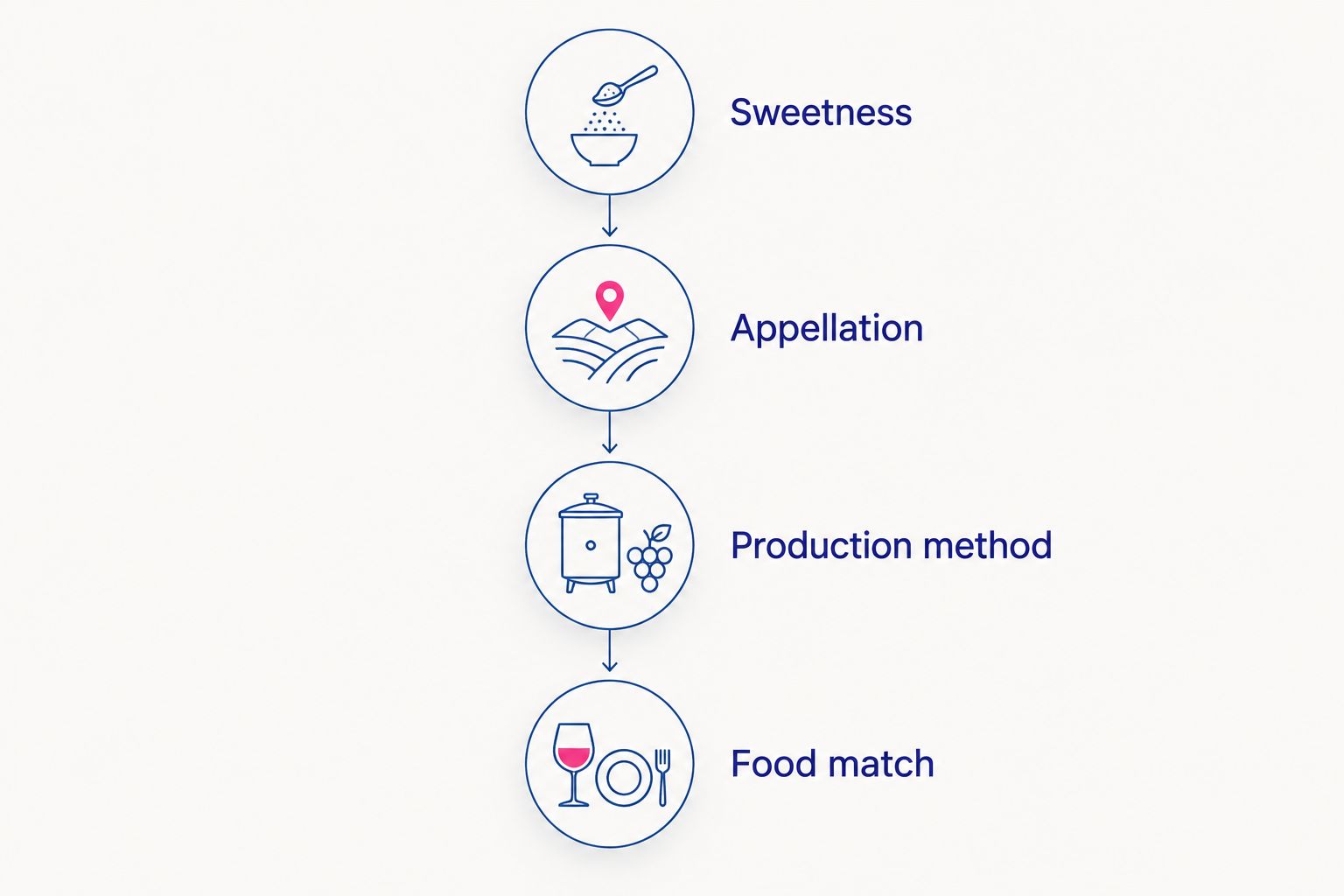
Use this reading order:
- Sweetness: Decide whether you want dry or sweet.
- Appellation: Identify Champagne, Prosecco, Cava, or a specific Crémant region.
- Production method: Distinguish traditional-method wines from tank-fermented styles.
- Food match: Check whether your meal supports the choice.
Strawberry, raspberry, and cherry descriptions refer to flavor or aroma, not necessarily sugar. A wine can smell fruity and still taste dry. That distinction is especially useful when choosing sparkling rosé wine at Buywinesonline for someone else.
Serve the wine so you can taste it
Chill sparkling rosé before opening it. A serving range around 6–10°C is a practical starting point: colder service emphasizes refreshment, while a little warmth makes aromas easier to notice.
Open the bottle under control. Keep a hand over the cork, point it away from people, and turn the bottle gently rather than launching the cork across the room.
Choose a tulip-shaped sparkling glass or a white-wine glass when aroma matters. A very narrow flute shows bubbles well but gives you less space to smell the wine.
For serving plans, a 750 ml bottle provides six 125 ml pours. That is bottle arithmetic, not a recommendation for how much anyone should drink; smaller tasting pours stretch a comparison further.
Keep the bottle chilled between pours. If wine remains, use a stopper designed for sparkling wine and refrigerate it rather than leaving the bottle open on the table.
How the styles are ranked
This 2026 ranking prioritizes sweetness fit, production method, food compatibility, occasion, and label clarity. Brut rosé Champagne takes the default dinner slot; the remaining styles win distinct uses rather than competing for an identical occasion.
This is a style-based buying guide, not a blind-tasting scorecard. The ranking does not mean every Champagne outperforms every Cava, or that a dry wine is better than a sweet wine for someone who prefers sweetness.
Which sparkling rosé wine should you choose?
Choose brut rosé Champagne if you want one default for a celebration dinner. Choose brut Prosecco Rosé for a casual gathering, brut Cava Rosado for salty snacks, and brut Crémant Rosé when discovery is the point.
Choose demi-sec sparkling rosé when your drinker wants sweetness. Do not talk someone out of their preference just to fit a ranking.
Buywinesonline serves both home wine consumers and gift shoppers, and the same rule works for either purchase: match the wine to the person before matching it to the occasion. For a gift, knowing whether the recipient prefers dry or sweet is more useful than knowing their favorite shade of pink.
FAQ
What's the best sparkling rosé wine for a celebration dinner?
Brut rosé Champagne is the default style recommendation for a celebration dinner. Choose it for someone who enjoys dry wine, and match the individual bottle to the meal.
Is sparkling rosé wine sweet or dry?
Sparkling rosé wine can be sweet or dry. Read the sweetness designation: brut indicates a dry style, while demi-sec indicates a sweeter one.
Is Prosecco Rosé the same as rosé Champagne?
No, Prosecco Rosé and rosé Champagne have different origins and production rules. Prosecco Rosé undergoes secondary fermentation in a tank, while Champagne undergoes it in the bottle.
Is extra dry sparkling rosé drier than brut?
No, extra dry is a sweeter sparkling-wine category than brut under European labeling rules. Extra dry contains 12–17 grams of sugar per liter, while brut generally contains less than 12 grams per liter.
What food goes with dry sparkling rosé?
Dry sparkling rosé suits foods such as salmon, roast poultry, fried appetizers, and savory snacks. Match the specific wine's weight and sweetness to the dish rather than relying on its color.
Does darker sparkling rosé taste sweeter?
No, darker color does not establish sweetness. Read the sweetness designation rather than judging sugar from the shade of pink.
How many glasses are in a bottle of sparkling rosé?
A 750 ml bottle provides six 125 ml pours. The number of glasses changes with your pour size.
One last thing
Pink Champagne does not have to get its color through prolonged contact with red-grape skins. Rosé Champagne can also be made by blending white and red wines under Champagne’s production rules.
That makes color an especially poor shortcut for judging richness, sweetness, or quality. For your next bottle, read the sweetness term first—it tells you more about the buying decision than the pink in the glass.