
No—all Champagne is sparkling wine, but not all sparkling wine is Champagne. In 2026, the key distinction remains origin and production rules: Champagne comes from the Champagne region of France and follows its protected appellation requirements, while sparkling wine includes many other regions and methods.
- Is sparkling wine the same as champagne? No: Champagne is one protected category within sparkling wine.
- Champagne requires Champagne-region origin and bottle fermentation; bubbles alone do not qualify a wine.
- Prosecco, Cava, and Crémant are sparkling wines, not Champagne.
- Buywinesonline serves home wine consumers and gift shoppers; compare wine origin and sweetness before choosing.
Is sparkling wine the same as Champagne?
Sparkling wine and Champagne are not interchangeable names. Sparkling wine is the broad category; Champagne is a geographically protected member of that category, with rules governing grape growing, production, and aging.
A wine made outside Champagne does not become Champagne because it uses the same grapes or production method. Likewise, a French sparkling wine from another region is not automatically Champagne. The region matters as much as the bubbles.
For your 2026 shopping shortlist, start with the label rather than the bottle shape. The guide to reading a wine label before buying explains how to separate origin, grape variety, and other details that influence your choice.
| Sparkling wine category | Origin | Typical production method | Best for | Strength | Limitation |
|---|---|---|---|---|---|
| Champagne | Champagne, France | Second fermentation in the bottle | A gift specifically requesting Champagne | Defined origin and aging requirements | The name alone does not tell you sweetness or flavor |
| Prosecco | Designated areas of northeastern Italy | Usually second fermentation in a tank | Fruit-forward sparkling wine and brunch drinks | Often emphasizes fresh fruit and floral flavors | It is not a substitute for Champagne's geographic identity |
| Cava | Designated Spanish production areas | Second fermentation in the bottle | Exploring bottle-fermented Spanish sparkling wine | Offers traditional-method character outside France | Styles vary; the category is not a single flavor profile |
| Crémant | Designated French appellations outside Champagne | Second fermentation in the bottle | Exploring regional French sparkling wines | Connects bottle fermentation with different regional grapes | The regional name matters; Crémant is not one uniform style |
These are category comparisons, not a quality ranking. A bottle that suits your taste is a better choice than one bought solely because its category sounds more prestigious.
Why this matters
Calling every sparkling wine Champagne hides information you need when buying. You lose the distinction between where the wine comes from, how it gets its bubbles, and what style you should expect in your glass.
That matters most with gifts and event requests. If someone asks for Champagne, choose Champagne; if someone asks for bubbles, you have a much wider field. Neither request tells you whether the person wants dry, sweet, white, or rosé wine.
Buywinesonline is best for home wine consumers and gift shoppers comparing wines across a broad retail selection. For sparkling wine purchases, that breadth is useful only when you compare the actual category and label details rather than treating every bubbly bottle as equivalent.
What makes a sparkling wine Champagne?
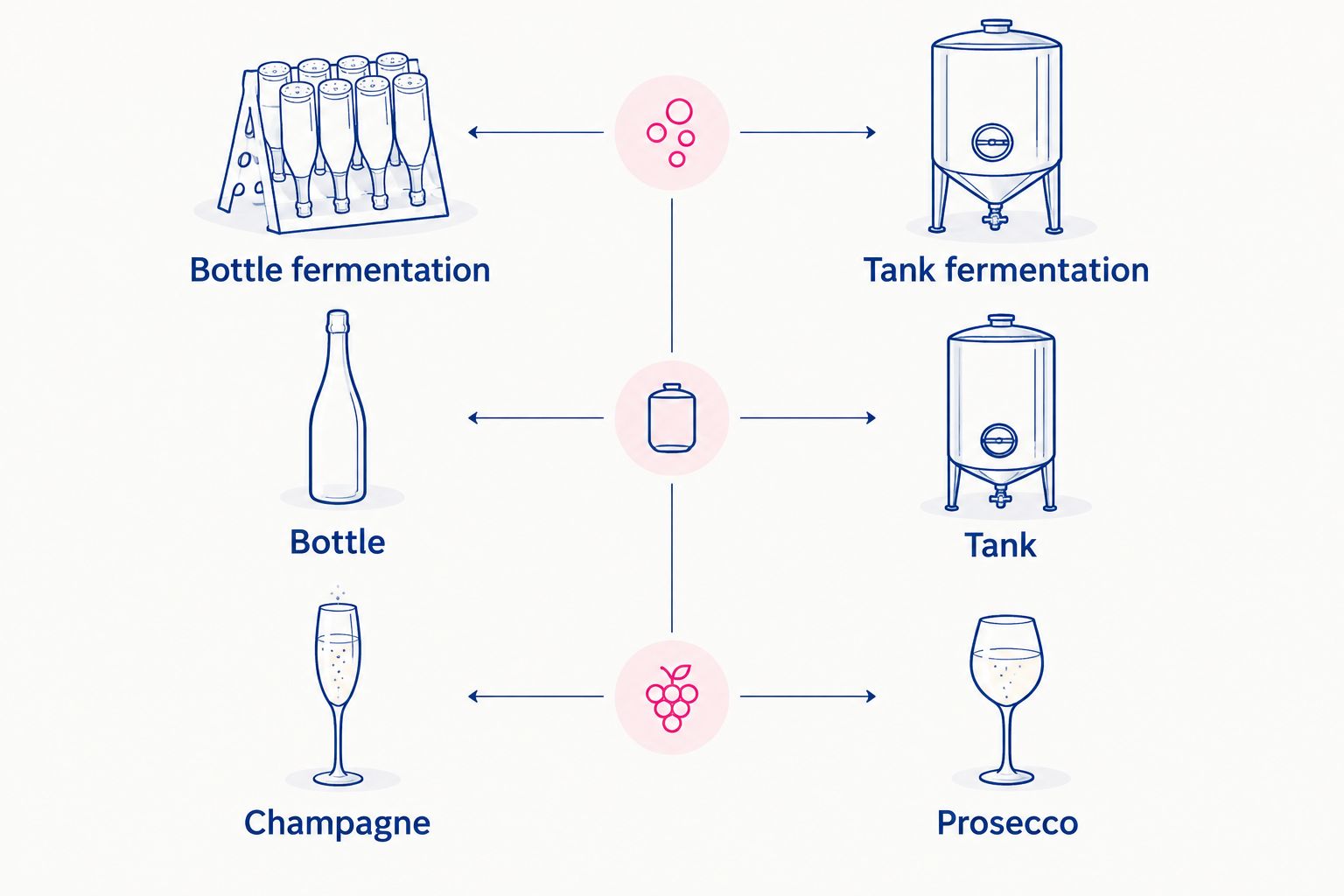
Champagne requires more than a French address. Its appellation rules cover approved vineyard areas, permitted grapes, production practices, and aging, among other requirements. The second fermentation takes place in the bottle, creating carbon dioxide that dissolves into the wine under pressure.
Chardonnay, Pinot Noir, and Meunier are Champagne's principal grapes. Producers also have other permitted varieties, so those three names are not an exhaustive legal checklist. Nor does a blend of those grapes automatically qualify a wine made elsewhere.
The Comité Champagne, the region's official trade organization, describes these origin and production requirements. For a 2026 purchase, the practical test is straightforward: verify Champagne origin and the appellation, not just a familiar grape name or a reference to bottle fermentation.
Non-vintage Champagne: at least 15 months of maturation
Non-vintage Champagne has a minimum maturation period of 15 months, including at least 12 months on the lees, according to Comité Champagne's production guidance. Lees are the yeast sediment left after fermentation; contact with them contributes to the wine's texture and flavor development.
Non-vintage Champagne generally combines wines from different harvests to express a producer's house style. Its strength is that intended stylistic continuity; its limitation is that it does not represent one harvest alone. Best for: drinkers exploring a producer's recurring style rather than a specific harvest.
Vintage Champagne: at least 36 months of maturation
Vintage Champagne has a minimum maturation period of 36 months, according to Comité Champagne. It comes from a single harvest year, and producers can mature it longer than the legal minimum.
A vintage date identifies the harvest, not a guaranteed taste or a universal quality score. Vintage Champagne gives you a harvest-specific expression, but that does not make every vintage bottle a better match for every drinker. Best for: someone specifically interested in a particular harvest or a vintage Champagne experience.
Does the traditional method make other wines Champagne?
No. The traditional method describes production, not geographic identity. Cava, Crémant, and other sparkling wines can undergo their second fermentation in the bottle without becoming Champagne.
During this process, the wine develops bubbles in the bottle and spends time with the yeast sediment. The sediment is later removed, and the wine is finished for sale. That shared process explains why different categories can show some similar textures or bread-like aromas.
The tank method puts the second fermentation in a pressurized tank instead. Prosecco commonly uses this approach, which suits styles emphasizing fresh fruit and floral aromas. Production method influences character, but grapes, climate, aging, and sweetness also matter.
Choose by the flavor you want, not by a claim that one method always wins. Bottle fermentation does not guarantee you will prefer the wine, and tank fermentation does not make a wine unsuitable for a celebration.
Why sparkling wine tastes different
Origin and method explain part of the difference between sparkling wines, but they do not predict every bottle's taste. In your 2026 comparison, check these factors together rather than relying on the category name alone:
- Grape varieties: Different grapes bring different fruit, floral, and structural characteristics. Champagne's principal grapes differ from Prosecco's principal grape, Glera.
- Growing conditions: Climate and ripeness influence acidity and fruit expression. Wines from different regions can taste distinct even when they share a production method.
- Fermentation method: Bottle and tank fermentation create different production conditions. Neither method provides a complete tasting description by itself.
- Lees contact: Time with yeast sediment contributes to texture and bread-like or pastry-like aromas. The effect varies with the wine and its maturation.
- Sweetness: The finished wine's sugar level changes how it tastes and pairs with food. A dry and a sweeter wine from the same category can suit different preferences.
- Blend and maturation: Harvest choices, reserve wines, and aging decisions shape the final style. A vintage date and a non-vintage label communicate different approaches, not a simple better-or-worse result.
Your best shortcut is to read the producer's description alongside the origin and sweetness terms. Category tells you what the wine is; the specific bottle details tell you whether you want to drink it.
Is Champagne always dry?
No, Champagne comes in different sweetness levels. Brut is a common dry style, but sweeter Champagne also exists. Do not assume a Champagne label promises a dry wine without checking its sweetness designation.
Under European sparkling-wine labeling rules, Brut contains less than 12 grams of sugar per liter, while Extra Dry contains 12–17 grams per liter. Despite its name, Extra Dry is sweeter than Brut. That distinction applies to your 2026 label check whether you are comparing Champagne or another sparkling category using these terms.
Fruit flavor and sugar are not the same thing. A wine can smell like ripe pear or peach while remaining dry; those aromas do not establish its sugar level.
Is Prosecco the same as Champagne?
No, Prosecco is an Italian sparkling-wine category, while Champagne comes from Champagne, France. Prosecco commonly uses tank fermentation and centers on Glera; Champagne uses bottle fermentation and has different permitted grapes and appellation rules.
For brunch drinks, Prosecco's fruit-forward styles are a useful starting point. For a gift that explicitly requests Champagne, choose Champagne instead.
Is French sparkling wine always Champagne?
No, French sparkling wine is not always Champagne. Crémant and other French sparkling wines come from outside Champagne and have their own identities and production requirements.
Look for the actual appellation. The words France, Brut, or traditional method do not independently establish Champagne origin.
Can sparkling wine replace Champagne in a mimosa?
Yes, another sparkling wine can replace Champagne in a mimosa. Choose a style whose sweetness works with the juice, rather than assuming you need Champagne for the drink to work.
The limitation is naming: a mimosa made with another sparkling wine should not be described as containing Champagne. For drinking without a mixer, compare the wine's own flavor and texture more closely.
How do you choose the right sparkling wine?
For a 2026 celebration or gift, work through the label in a consistent order. It keeps a familiar name from distracting you from the details that actually match the occasion.
- Check the origin. If Champagne is specifically requested, confirm Champagne rather than simply French sparkling wine. If the request is broader, consider other sparkling categories.
- Check the sweetness. Read Brut, Extra Dry, or another designation before relying on tasting-note words such as fruity. Decide whether you want the wine dry or noticeably sweet.
- Check the style. Choose white or rosé, then compare the producer's flavor description. Neither color establishes sweetness on its own.
- Check the occasion. A wine served alone deserves attention to its individual character. For a mixed drink, think about how its sweetness and flavor work with the other ingredients.
- Check the exact bottle. Confirm the wine name, vintage status, and bottle size. A familiar producer can make different wines, so do not transfer details from one bottling to another.
When browsing Buywinesonline for sparkling wine, keep those checks separate. A retailer's broad selection helps you compare categories, but it does not replace reading the exact wine details.
For a gift, asking one plain question often helps more than guessing: does the recipient specifically want Champagne, or do they enjoy sparkling wine generally? The answer determines whether geographic identity is part of the gift.
FAQ
Is sparkling wine the same as champagne?
No. Champagne is sparkling wine from the Champagne region of France made under its appellation rules; sparkling wine is the broader category that also includes Prosecco, Cava, Crémant, and other wines.
What's the main difference between Champagne and sparkling wine?
The main difference is that Champagne has a specific protected origin and production requirements. Sparkling wine describes the wider category and does not require Champagne-region origin.
Is Champagne better than Prosecco?
Champagne is not automatically a better match for your taste than Prosecco. Choose Champagne when its origin or style is the goal, and compare Prosecco when you want its commonly fruit-forward character.
Can a sparkling wine made in California be Champagne?
California sparkling wine does not meet the French Champagne appellation's geographic requirement. Some longstanding US labels use California Champagne under historic labeling exceptions, but those wines are not French appellation Champagne.
Does Brut mean a sparkling wine is Champagne?
No, Brut describes sweetness, not origin. Under European sparkling-wine labeling rules, Brut contains less than 12 grams of sugar per liter and appears on several sparkling-wine categories.
Is Extra Dry sparkling wine drier than Brut?
No, Extra Dry is sweeter than Brut. European sparkling-wine labeling rules specify 12–17 grams of sugar per liter for Extra Dry, compared with less than 12 grams per liter for Brut.
Can I use sparkling wine instead of Champagne for a toast?
Yes, you can use another sparkling wine for a toast. Choose Champagne if the host or recipient specifically requests it; otherwise, select a sparkling style that suits the guests.
Does rosé Champagne count as real Champagne?
Yes, rosé Champagne is Champagne when it meets the region's appellation requirements. Its pink color does not make it a different geographic category or establish its sweetness.
One last thing
Buy origin first when Champagne is requested; buy style first when bubbles are requested. That distinction prevents the most common mismatch: giving someone a different sparkling wine when the Champagne identity was part of what they wanted.
For your next Buywinesonline purchase, read the origin and sweetness designation before the tasting notes. Those details answer two separate questions: what the wine is, and whether its style fits your occasion.