
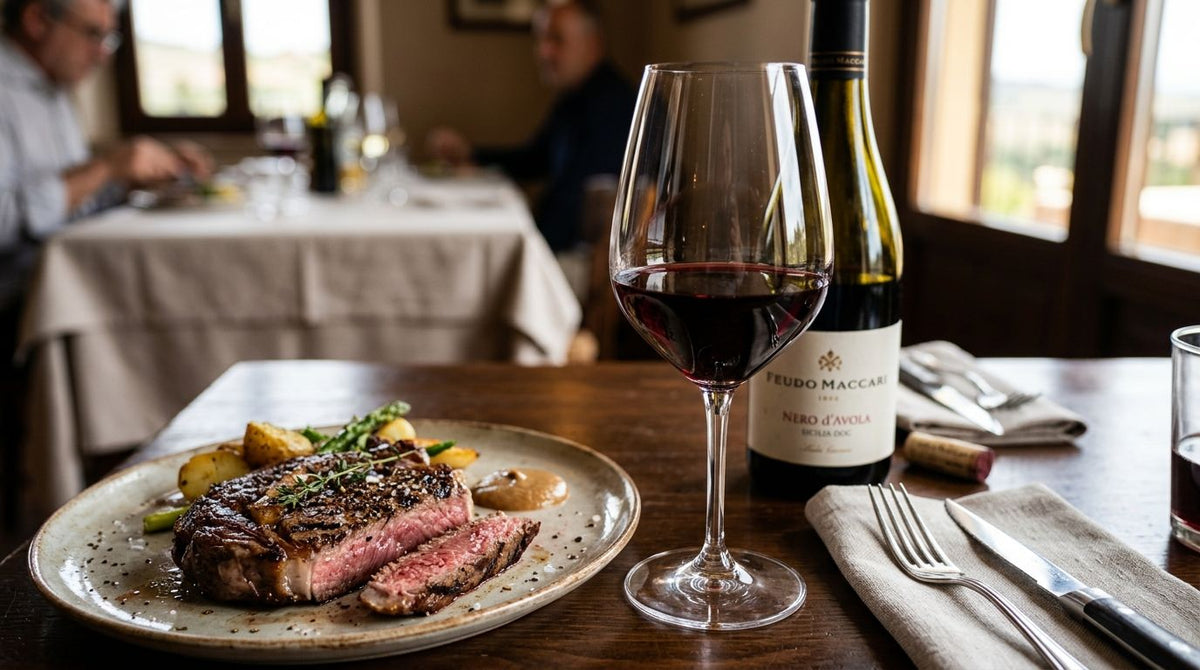
Nero d'Avola wine for red meat dishes is Sicily's answer to steak, lamb, and grilled pork: dark-fruited, medium-to-full bodied, and built with enough tannin to stand up to char without the sticker shock of a Napa Cabernet. Home cooks who search for a red meat pairing that works on a Tuesday grill night and a Sunday roast keep landing on Nero d'Avola because it splits the difference between structure and drinkability.
- Donnafugata Mille e Una Notte Nero d'Avola 2021 is the buy pick for grilled or roasted red meat in 2026.
- Nero d'Avola wine pairs best with charred, spiced, or tomato-based red meat, not delicate veal or plain roasts.
- Serve Nero d'Avola at 60-65°F; decant reserve-style bottlings 30-45 minutes before steak or braised short rib.
- Cabernet Sauvignon and Petite Sirah outmuscle Nero d'Avola on very fatty cuts like ribeye.
Why Nero d'Avola matters for red meat pairing
Nero d'Avola is Sicily's most widely planted red grape, grown across the island's DOC and IGT zones from Avola in the southeast up through the interior. It ripens in heat, which is why the fruit runs dark and jammy while the tannin stays moderate compared to Cabernet Sauvignon or Nebbiolo.
That combination matters for red meat because most home cooks aren't grilling filet mignon on a Tuesday. They're working with skirt steak, lamb shoulder, pork chops with a spice rub, or a Sunday roast — cuts that want fruit and grip, not a wine that needs 20 years to soften. The Donnafugata Mille e Una Notte Nero d'Avola 2021 shows the upper end of that range in one bottle, with enough concentration to sit next to a seared chop and enough acid to reset the palate between bites.
Searchers looking for "nero d'avola wine" in 2026 are usually planning a specific dinner, not building a cellar. The pairing logic below is built for that use case: what to serve, at what temperature, and when to reach for the reserve bottle instead of the everyday one.
Match tannin and acid to the cut
Red meat isn't one category. A flank steak and a braised short rib need different wines even though both are beef.
- Lean cuts (flank, skirt, filet) want moderate tannin — Nero d'Avola's structure fits without flattening the meat's texture
- Fatty cuts (ribeye, short rib, lamb shoulder) want more grip — reach for a reserve-style Nero d'Avola or step up to a Cabernet-based blend
- Ground and spiced red meat (kofta, meatballs, spiced lamb burgers) wants bright acid to cut through fat — Nero d'Avola's natural acidity does this better than a soft, low-acid red
- Char-forward grilling wants dark fruit that can compete with smoke, which is Nero d'Avola's strongest suit
Serve Nero d'Avola at the right temperature
Serving red wine at true room temperature — 72°F or warmer in most houses — makes tannin taste harsh next to charred meat.
- Target 60-65°F for Nero d'Avola, closer to a cool cellar than a warm kitchen
- Chill the bottle in the fridge for 15 minutes before pouring if your house runs warm
- Never serve above 68°F alongside grilled or blackened meat; the alcohol and tannin both read hotter
- Pour smaller glasses more often rather than one large pour that warms up on the table
Choose between young and reserve Nero d'Avola styles
Not every red meat dinner needs the same bottle. An entry-level Nero d'Avola and a reserve-style single-vineyard bottling do different jobs.
- Young, unoaked Nero d'Avola: weeknight grilling, pork chops, burgers, casual lamb skewers
- Reserve or single-vineyard Nero d'Avola, like the Donnafugata Mille e Una Notte 2021: slow-roasted lamb, standing rib roast, holiday dinners where the meat is the centerpiece
- If the bottle sits in the glass for over an hour at the table, the reserve style holds up better than the young style, which can fade
- For a side-by-side comparison across styles and regions, a curated multi-bottle tasting set lets you taste young versus reserve structure in one sitting
The faster path here is picking one bottle built for the occasion instead of guessing — BuyWinesOnline stocks both entry and reserve-tier Nero d'Avola for exactly this reason.
Pair by cooking method, not just the protein
The same cut of beef changes what it needs depending on how it's cooked.
- Grilled or charred red meat: Nero d'Avola's dark fruit and moderate smokiness stand up to char without a fight
- Braised or stewed red meat (short rib ragù, osso buco): pick the reserve style with more tannin and structure
- Herb-roasted lamb or pork: young Nero d'Avola's herbal edge echoes rosemary and thyme
- Tomato-based red meat dishes (Sunday sauce with braised beef): Nero d'Avola's acid matches the sauce instead of clashing with it
Decant for braises and long-cooked red meat
Decanting isn't required for every bottle, but it changes how a reserve-style Nero d'Avola shows up next to a heavy braise.
- Reserve-style Nero d'Avola: decant 30-45 minutes before serving with braised or slow-roasted meat
- Young, everyday Nero d'Avola: pour and serve, no decanting needed
- No decanter on hand: swirl in a wide-bowled glass for a minute before the first sip
- Skip decanting entirely for quick weeknight grilling pairings — the wine doesn't need it
How Nero d'Avola compares to other red-meat wines
| Wine | Best for | Key limitation |
|---|---|---|
| Nero d'Avola (Donnafugata Mille e Una Notte 2021) | Grilled, spiced, or roasted red meat with dark-fruit sauces | Less structure than Napa Cabernet on very fatty cuts like ribeye |
| Cabernet Sauvignon for steak night dinners | Thick-cut steak, heavy char, butter-based sauces | Overwhelms leaner cuts like flank or skirt steak |
| Petite Sirah | Smoked brisket and barbecue with heavy spice rubs | High tannin needs 30+ minutes of air before serving |
| Chianti (Sangiovese) | Tomato-based braised red meat, Sunday sauce dishes | Too acidic for plain grilled steak without a sauce |
Verdict: Nero d'Avola wins for grilled and roasted red meat with a spice rub or dark-fruit glaze; Cabernet Sauvignon wins for a plain thick-cut steak with nothing but salt and butter.
Common Nero d'Avola pairing mistakes
- Serving it too warm. Sicily is hot, but the wine isn't meant to be served at outdoor-patio temperature — 65°F, not 75°F
- Pairing it with delicate veal or plain roast chicken. The dark fruit and tannin overpower lean, mild proteins; save Nero d'Avola for red meat with actual char or spice
- Skipping the reserve style for a special dinner. An entry-level bottle works for a Tuesday, but a holiday rib roast deserves the extra structure of a single-vineyard bottling
- Ignoring the rub or marinade. A heavily spiced red meat dish needs the young, fruit-forward style; a plain roast needs the reserve style — matching the wrong style to the dish is the most common error
- Forgetting acid matters as much as tannin. Fatty red meat without a bright wine alongside it tastes heavier than it should


FAQ
What's the best Nero d'Avola wine for red meat dishes in 2026?
The Donnafugata Mille e Una Notte Nero d'Avola 2021 is the top pick for red meat in 2026 because it carries enough structure for grilled and roasted cuts. It also holds up through a slow braise, unlike lighter entry-level bottlings.
Is Nero d'Avola better than Cabernet Sauvignon for steak?
Nero d'Avola wins for steak with a spice rub or char-forward glaze; Cabernet Sauvignon wins for a plain thick-cut steak with just salt and butter. The choice comes down to how the meat is seasoned, not just the cut.
Should Nero d'Avola be chilled before serving with red meat?
Yes, chill it briefly to 60-65°F rather than serving at full room temperature. Warmer pours make the tannin taste harsher next to charred or grilled meat.
What food doesn't pair well with Nero d'Avola?
Delicate proteins like veal, plain roast chicken, or mild white fish get overwhelmed by Nero d'Avola's dark fruit and tannin. Save it for red meat, especially anything grilled, spiced, or tomato-sauced.
Is Nero d'Avola a light or full-bodied wine?
Nero d'Avola sits in the medium-to-full bodied range, heavier than Pinot Noir but generally lighter in tannin than Cabernet Sauvignon or Nebbiolo. That range is exactly why it works across grilled, roasted, and braised red meat.
Does Nero d'Avola need to be decanted?
Reserve-style bottlings benefit from 30-45 minutes of decanting before a braise or roast, while young, everyday styles don't need it. Pour-and-serve is fine for weeknight grilling pairings.
What's the difference between Nero d'Avola and other Italian reds like Chianti?
Nero d'Avola runs darker in fruit and lower in acid than Chianti's Sangiovese base, which makes it better for charred or spiced red meat and Chianti better for tomato-based braises. Both are Italian reds, but they solve different pairing problems.
One last thing
The name Nero d'Avola literally translates to "black grape of Avola," the small town on Sicily's southeastern coast where the variety was first documented — a detail most bottle labels never mention but that explains why the grape thrives in heat that would stress out Cabernet or Pinot Noir. That heat tolerance is exactly why Nero d'Avola wine keeps showing up on red meat pairing lists in 2026: it was built for a hot climate and a hearty table, not a cellar.