
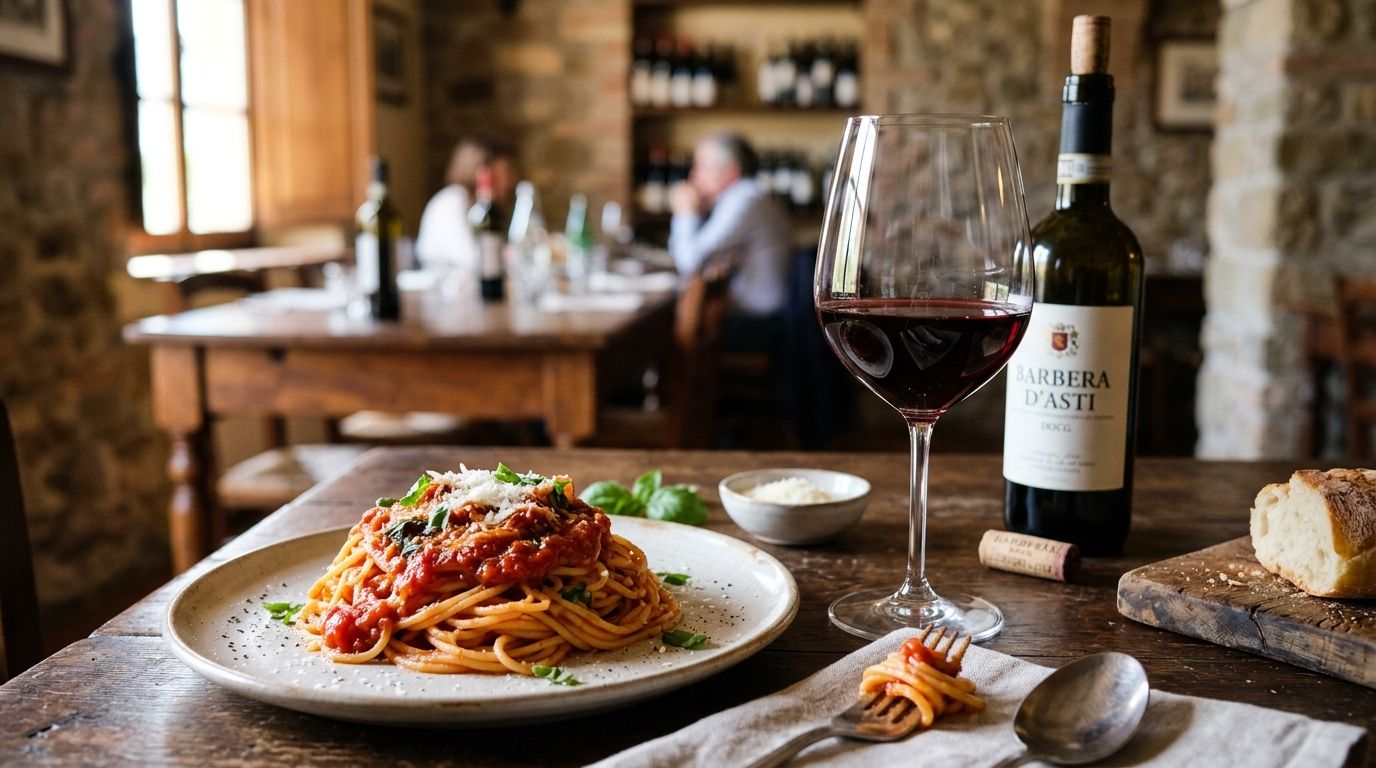
Barbera wine for tomato-based pasta works because the grape's acidity matches the acidity in tomato sauce instead of fighting it, which is why a straightforward Piedmont Barbera outperforms a heavy, tannic red on a weeknight marinara or a slow Sunday gravy. Home cooks building dinner around red sauce need a wine that survives garlic, acid, and herbs without turning bitter or flat, and Barbera does that job better than most reds on the shelf.
- Barbera wine's high acidity and low tannin match tomato sauce acid instead of clashing with it, unlike tannic Cabernet or Barolo.
- Barbera d'Asti fits quick marinara and pizza night; Barbera d'Alba and Nizza DOCG handle meat-heavy ragù.
- Nero d'Avola and Sangiovese-based Chianti are the closest backups when a specific Barbera vintage sells out.
- Serve Barbera slightly below room temperature, around 60-65°F, to keep the fruit forward without dulling the acid.
- For 2026 pasta night, Barbera wine is the safer weeknight buy than a big Napa red at the same everyday price point.
Why barbera wine matters for tomato-based pasta cooks
Tomato sauce is acidic. A red wine with soft acidity and heavy tannin - a lot of Cabernet Sauvignon and some New World Merlot fall here - tastes metallic and bitter next to it because the tannin grabs onto the sauce's acid with nothing to balance it. Barbera wine solves this because it carries some of the highest natural acidity of any widely planted red grape, paired with tannin levels closer to Pinot Noir than to Cabernet.
That combination is why Piedmont cooks have poured Barbera next to ragù, marinara, and tomato-braised meats for generations, long before "food and wine pairing" became a marketing phrase. Most bottles run 12.5% to 14.5% ABV, which keeps the wine food-friendly rather than a standalone sipper, and browsing the full wine selection shows how many of those bottles land in that everyday-drinking range compared to bigger, oakier reds.
The practical difference for a home cook in 2026: Barbera wine rarely needs decanting, rarely needs a special occasion, and rarely clashes with the dish it's poured next to.
Match the sauce weight to the wine's structure
Not every tomato sauce needs the same Barbera. A thin, quick marinara wants a lighter pour; a three-hour Sunday gravy with sausage or braised short rib wants more structure behind the fruit.
- Quick marinara or arrabbiata - lean toward Barbera d'Asti, the lighter, fruitier expression of the grape
- Meat-based ragù or bolognese - move up to Barbera d'Alba, which gets more oak and structure from Alba's soils
- Vodka sauce or cream-tomato hybrids - the cream softens acidity, so a mid-weight Barbera avoids overwhelming the dish
- Pizza with red sauce - Barbera d'Asti again, since its acid cuts through melted cheese as well as tomato
Check the Barbera subregion before you buy
"Barbera" on a label covers a wide range of styles, and the subregion tells you more than the vintage does.
- Barbera d'Asti DOCG - the classic, fruit-forward expression, DOCG status since 2008
- Barbera d'Alba DOCG - fuller body, more structure, often aged partly in oak
- Nizza DOCG - a single-commune designation carved out in 2014, built for age-worthy, more tannic Barbera
- Barbera del Monferrato - the everyday-table version, usually the lightest and most acid-forward
Serve it at the right temperature
Barbera wine gets served too cold more often than any other red on a tomato-pasta table, and that mistake buries the fruit under the acid.
- Pour it at 60-65°F, cooler than a Cabernet but warmer than a chilled rosé
- Pull the bottle from the fridge 20-30 minutes before serving if it's been stored cold
- Skip decanting for Barbera d'Asti; it's built to drink on release
- Give Nizza DOCG bottles 30-45 minutes of air if the vintage is young and tight
Build a backup shortlist from Italian reds you already know
Barbera sells fast on pasta-focused sites, and a specific vintage running out shouldn't derail the meal. Keep two backups in mind before you shop.
- Sangiovese-based Chianti - similar acid profile, slightly more tannin, works for the same sauces
- Nero d'Avola - Sicily's answer to the same problem, a touch riper and fuller than most Barbera
- Montepulciano d'Abruzzo - softer tannin than Chianti, a reasonable stand-in for lighter sauces
The Donnafugata Mille e Una Notte Nero d'Avola 2021 is the closest fuller-bodied match on BuyWinesOnline's list when a Sunday gravy needs more weight than a standard Barbera d'Asti gives it.
Verify the vintage and check the catalog before you order
Once the sauce and subregion are decided, the last step is confirming the bottle actually matches what's listed. Buying wine online removes the chance to read the label in hand, so the retailer's catalog accuracy matters more than usual.
- Confirm the vintage year shown on the product page matches current stock, not a leftover photo from a prior release
- Check that the wine is a current listing, not a clearance or damaged-stock line, since those change fast
- Use a retailer with a searchable catalog - BuyWinesOnline lists more than 5,000 wines, which makes cross-checking a specific Barbera subregion or vintage straightforward
- If ordering in warm months, factor in shipping conditions so the bottle doesn't sit on a hot porch
Taste more than one Barbera before committing to a case
Barbera's range from Monferrato to Nizza is wide enough that one bad bottle experience shouldn't rule out the grape. Sampling two or three styles side by side against the same tomato sauce settles the question faster than reading tasting notes.
- Pour a Barbera d'Asti and a Barbera d'Alba next to the same bowl of pasta and compare
- Note which one still tastes balanced after the dish cools slightly, since acid softens as food cools
- Keep notes on subregion, not just producer, since that's the variable that predicts the next bottle
Barbera wine vs. the other tomato-pasta reds
| Wine | Best for | Key limitation | Verdict |
|---|---|---|---|
| Barbera d'Asti / d'Alba | Weeknight marinara, pizza, garlic-and-oil pasta | Less structure for slow-braised meat ragù | Buy |
| Chianti (Sangiovese) | Meat-based ragù, lasagna | More tannin can fight a very quick, bright sauce | Buy |
| Nero d'Avola (Donnafugata Mille e Una Notte) | Sunday gravy, sausage ragù | Fuller body can overpower a simple marinara | Hold for richer dishes |
| Barolo (G.D. Vajra Albe) | Slow-braised meat, mushroom ragù | Tannin and structure are overkill for a quick tomato sauce | Skip for weeknight pasta |
Common mistakes tomato-pasta drinkers make
- Reaching for a big Napa Cabernet with marinara. The tannin grips the sauce's acid and the wine tastes metallic instead of fruity.
- Serving Barbera fridge-cold. Over-chilling mutes the fruit and leaves only the acid, making the wine taste sharper than it is.
- Treating all Barbera as one wine. A Barbera del Monferrato and a Nizza DOCG are built for different sauces; buying blind ignores that.
- Skipping the vintage check at checkout. Product photos lag behind current stock more often than shoppers expect, especially on fast-moving Italian reds.
- Pairing delicate marinara with an oaked, heavy red. The oak's vanilla and spice notes compete with basil and garlic instead of supporting them.
FAQ
What is Barbera wine best known for?
Barbera wine is best known for high natural acidity and low tannin, a combination that lets it pair with tomato-based dishes most tannic reds struggle with. It's grown mainly in Piedmont, Italy, under the Barbera d'Asti, Barbera d'Alba, and Nizza DOCG designations.
Is Barbera wine dry or sweet?
Barbera wine is dry, not sweet. Its high acidity can read as tart on its own, which is exactly why it works alongside acidic tomato sauce instead of a dessert course.
What's the difference between Barbera d'Asti and Barbera d'Alba?
Barbera d'Asti is lighter and more fruit-forward, best for quick marinara or pizza. Barbera d'Alba, grown on Alba's soils, tends toward more structure and oak, better suited to meat-based ragù.
Does Barbera pair better with pizza or pasta?
Barbera pairs well with both because the acid profile that works with tomato pasta sauce also cuts through melted cheese on pizza. Barbera d'Asti specifically is the lighter choice for either.
Should Barbera wine be chilled?
Barbera wine should be served cooler than a typical red, around 60-65°F, but not fridge-cold. Over-chilling mutes the fruit and leaves only the sharp acidity.
Is Barbera better than Chianti for tomato sauce?
Barbera and Chianti both work well with tomato sauce, but Barbera has less tannin, making it the safer pick for a bright, quick marinara. Chianti's extra tannin suits a heavier, meat-based ragù better.
What food should you avoid pairing with Barbera?
Avoid pairing Barbera with very rich, cream-heavy dishes or delicate seafood, since its acidity overwhelms subtle flavors. It's built for tomato, garlic, and herb-forward dishes, not butter-based sauces.
Can you age Barbera wine?
Most Barbera d'Asti and Monferrato bottles are made to drink within a few years of release. Nizza DOCG bottlings, built with more structure, can hold and develop over a longer stretch.
One last thing
Barbera's acidity is high enough that it sits closer to some white wines than to most reds on a lab test - which is exactly why it survives a squeeze of lemon or a splash of red wine vinegar in a sauce that would flatten a Cabernet. If a 2026 pasta night involves anything acidic beyond plain tomato - capers, olives, a vinegar-forward puttanesca - Barbera is still the safer pour, not a lighter white.