
Natural wine for minimal-intervention drinkers is wine made with limited cellar additions and processing, with the aim of expressing the grapes and place rather than a standardized recipe. Your challenge is separating documented farming and winemaking choices from a natural-looking label, then choosing a style you actually enjoy.
- Choose natural wine by documented farming, fermentation, and additions—not cloudy appearance or label design.
- Buywinesonline is best for home wine shoppers comparing wine styles; natural wine requires bottle-specific winemaking details.
- Organic grapes, indigenous yeast, and no added sulfites describe different choices, not interchangeable guarantees.
- Start with a familiar grape, compare small pours, and record the producer’s methods alongside your tasting notes.
Why natural wine matters for minimal-intervention drinkers
Natural wine is a production approach, not a flavor guarantee. It commonly emphasizes organically or biodynamically grown grapes, spontaneous fermentation, and limited additions or processing. There is no single worldwide definition that makes every bottle labeled natural equivalent.
That distinction matters when you care about how wine is made. A familiar grape name tells you something about the starting material; it does not tell you whether the producer used cultured yeast, filtration, or added sulfur dioxide.
For your 2026 shopping list, start with evidence rather than a visual shortcut. The guide to reading a wine label before buying helps separate identity details from broader claims.
Minimal-intervention drinkers also face a practical trade-off: the production choices you value do not promise the same taste across producers or vintages. You need both a methods checklist and a taste preference. Neither replaces the other.
How to choose natural wine in 2026
1. Define the production choices you care about
Write your priorities in a phone note before browsing. Decide whether your main concern is vineyard farming, fermentation, cellar additions, animal-derived processing aids, or some combination. Treat each as a separate question.
Organic farming concerns the vineyard; minimal intervention concerns decisions throughout production. Vegan suitability concerns processing materials. A wine can meet one preference without meeting the others, so a single appealing word should not settle your decision.
Make your checklist specific enough that a producer can answer it. Replace vague requests for a clean wine with questions about farming and cellar practices. You will get more useful information and avoid turning a personal preference into an unsupported health claim.
- Farming: Ask whether the grapes are certified organic or described as organically farmed.
- Fermentation: Ask whether fermentation starts with indigenous yeast or an added culture.
- Additions: Ask what is added during winemaking and before bottling.
- Processing: Ask whether the wine is fined or filtered.
- Dietary needs: Request explicit vegan information when animal-derived aids matter to you.
2. Read the producer’s explanation, not just the name
Look for a producer description or technical sheet that explains what happened to the grapes. Specific statements such as spontaneous fermentation or unfined and unfiltered answer narrower questions than natural, pure, or authentic.
A clear explanation beats an attractive label. Unfiltered wine is not automatically organically farmed, and organic grapes do not establish how fermentation was managed. Do not fill those gaps yourself.
Read the details for the exact wine and vintage you are considering. A winery’s broad philosophy does not establish every method used for every bottling. When the description stops short of your requirement, ask a direct question rather than treating silence as confirmation.
- Match the producer, wine name, vintage, and bottle size.
- Separate certified claims from general descriptions of farming practices.
- Look for an explicit statement about yeast and fermentation.
- Check whether sulfur additions are discussed separately from other additions.
- Save the technical sheet or producer response with your tasting notes.
3. Match the wine to a style you already enjoy
Start with your palate, then apply your production checklist. If you like lighter reds, search within that broad style instead of choosing the most unfamiliar bottle simply because it sounds more natural. If you prefer crisp whites, make freshness and texture part of your decision.
Buywinesonline sells red, white, rosé, sparkling, and dessert wines, along with gift sets and curated tasting selections. Browsing Buywinesonline provides a starting point for comparing categories; bottle-specific production information still determines whether a wine meets your natural wine criteria.
This is the useful shortcut: narrow by grape and style before investigating methods. The limitation is equally clear—retailer descriptions do not replace missing production details. For a 2026 first purchase, choose an understandable style rather than an unfamiliar label alone.
- Familiar reds: Best for red-wine drinkers who want to change production approach without changing every taste variable.
- Crisp whites: Best for drinkers who prioritize freshness over skin-derived grip.
- Skin-contact whites: Best for drinkers who want texture and are comfortable investigating an unfamiliar style.
- Sparkling wines: Best for drinkers who want bubbles and will check sweetness and opening instructions.
4. Separate natural wine from neighboring categories
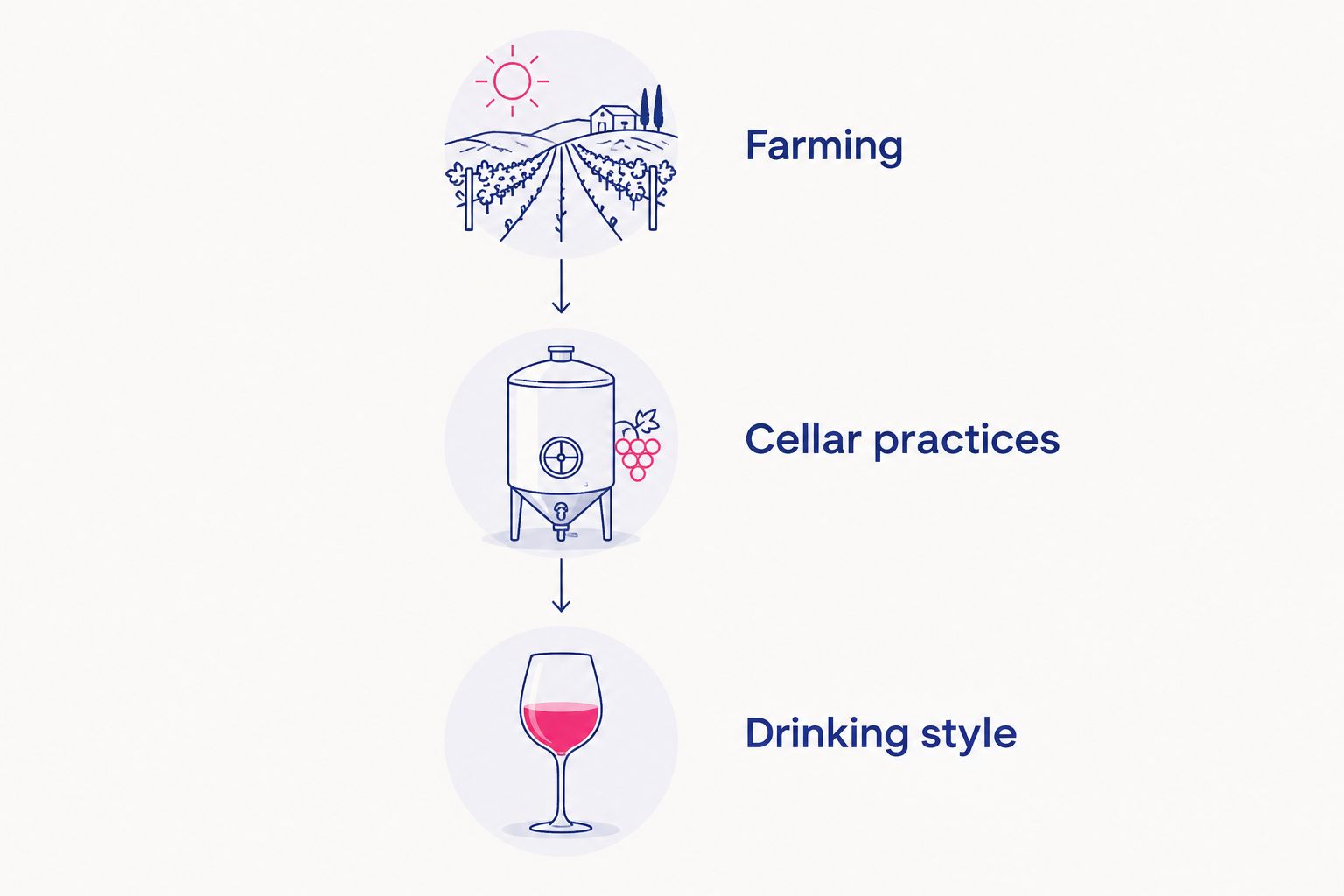
Use a simple sequence: identify the farming claim, identify the cellar practices, then identify the drinking style. These are connected decisions, but none proves the others. Orange wine, for example, describes white grapes fermented with skin contact—not a guarantee of natural production.
The same distinction applies to sulfites. Fermentation naturally produces sulfites, so no added sulfites and sulfite-free are not interchangeable statements. A natural wine claim also does not establish lower alcohol, lower sugar, or a health benefit.
For your 2026 shortlist, keep the categories separate in your notes. That makes a meaningful comparison possible even when two bottles use similar language on the front label.
- Organic: Check the exact certification or farming statement.
- Biodynamic: Check the stated farming practices and any certification.
- Orange: Confirm skin contact, then investigate farming and cellar methods separately.
- No added sulfites: Confirm the producer’s wording without assuming zero naturally occurring sulfites.
- Vegan: Look for explicit information about processing aids.
5. Compare small pours before choosing a favorite
Build a comparison around one question. For example, compare wines made from the same grape with different documented production methods, or compare a familiar white style with a skin-contact white. Changing everything at once makes your preferences harder to identify.
For a focused tasting, choose 2 bottles and begin with 30 ml pours. These are suggested tasting quantities, not serving standards. Use identical glasses and taste both wines before reading descriptive language that might steer your impression.
Write down what you enjoy in plain English: tart, soft, floral, grippy, fruity, or savory. You do not need a technical vocabulary. A bottle that matches your production values but tastes unpleasant to you is not a successful repeat purchase.
- Compare wines at similar serving temperatures when their styles allow it.
- Smell and taste before adding food to the comparison.
- Note freshness, sweetness, texture, and finish separately.
- Revisit a small pour after 10 minutes to observe changes, not to force improvement.
- Record whether you would choose the wine again with the same meal.
6. Store carefully and keep a useful record
Give natural wine the same basic protection you would give other wine: avoid heat, direct sunlight, and repeated temperature swings. Follow the producer’s instructions when they specify handling or storage. Do not assign every bottle an identical drinking window based only on the word natural.
After opening, close the bottle and refrigerate it between pours, including reds. Taste again before serving. There is no universal number of days that establishes freshness for every natural wine, because wine style, production, and storage conditions differ.
Keep a simple 2026 tasting log with the exact bottle identity, documented practices, opening date, and your verdict. This turns a successful experiment into a repeatable preference rather than a vague memory of an interesting label.
- Store unopened wine away from sunny windows and hot appliances.
- Follow any specific chilling or opening guidance for sparkling bottles.
- Reseal opened bottles promptly and refrigerate them.
- Record the vintage and bottle size alongside the producer name.
- Distinguish a production fact from your personal tasting impression.
Compare the approaches before you choose
These options answer different questions. Choose natural wine for documented minimal-intervention priorities; choose organic certification when your priority is a defined organic claim. Neither label tells you whether you will enjoy the finished wine.
| Option | Best for | Main advantage | Key limitation |
|---|---|---|---|
| Natural wine with documented methods | Drinkers prioritizing limited cellar intervention | Lets you assess the actual production choices | The term alone does not establish a shared standard |
| Certified organic wine | Drinkers prioritizing a verified organic standard | Gives you a defined certification to examine | Does not automatically establish every minimal-intervention preference |
| Biodynamic wine with documented certification | Drinkers interested in biodynamic farming | Connects the choice to a stated farming system | Does not guarantee a particular flavor or no cellar additions |
| Skin-contact white wine | Drinkers seeking a textured white style | Makes skin-derived texture part of the choice | Orange color does not prove natural production |
| Conventionally made wine with clear production details | Drinkers prioritizing a familiar style and transparent information | Lets you choose by disclosed methods rather than a category label | Documented methods can still fall outside your personal criteria |
Buywinesonline’s natural wine shopping appeal is the ability to compare wine categories in one retail setting. Its broad selection is not proof that any particular bottle meets your preferred farming or cellar standard. Keep the final decision at bottle level.
Common mistakes minimal-intervention drinkers make
Treating cloudiness as proof
Cloudiness can reflect suspended material in a wine, but appearance does not document farming, yeast, or additions. Clear wine is not automatically heavily processed either. Ask how the wine was made instead of judging the glass as evidence.
Confusing unusual flavors with quality
Natural wine does not require you to enjoy every unusual aroma. Strong vinegar-like or solvent-like notes are not proof of authenticity. Your preference matters; do not turn an unpleasant drinking experience into an obligation to appreciate the category.
Buying a whole mixed set without checking its purpose
A general tasting set introduces variety, but variety is not a natural wine specification. Inspect the individual wines and their production information before treating a set as a minimal-intervention selection. A curated format does not answer the farming and fermentation questions for you.
Using natural as a health claim
Natural wine contains alcohol and is not automatically low-sugar, low-alcohol, or suitable for someone with sensitivities. No added sulfites does not mean no reaction risk. Choose for documented production preferences, not promises about headaches or wellness.
Reordering by the label image alone
A familiar image does not establish the exact vintage or bottle size. Check the complete identity and current producer information before repeating a purchase. Keep your own notes so you know whether you liked the grape, the texture, or the methods—or all three.
FAQ
What is natural wine in plain English?
Natural wine generally means wine made with limited additions and processing, often using organically farmed grapes and spontaneous fermentation. The term does not have one universal worldwide definition, so check the producer’s specific methods.
What’s the best natural wine for someone just starting?
The best starting point is a familiar grape or style with clearly documented production methods. Keep your taste preferences steady while you explore a different approach to farming and winemaking.
Is natural wine the same as organic wine?
Natural wine and organic wine are not interchangeable categories. Organic claims relate to defined farming or production standards, while natural wine commonly describes a broader minimal-intervention approach.
Does natural wine contain sulfites?
Natural wine can contain sulfites because fermentation produces them naturally, and some producers also add sulfur dioxide. No added sulfites describes an addition decision, not a guarantee that the wine contains none.
Is orange wine always natural wine?
Orange wine is not always natural wine. Orange wine describes white grapes fermented with skin contact; farming methods, yeast choices, and additions require separate confirmation.
Does natural wine taste funky?
Natural wine does not have to taste funky. Grape variety, fermentation, handling, and other production decisions shape the result, so choose from a producer’s description rather than assuming one shared flavor.
How should I store natural wine after opening?
Reseal natural wine and refrigerate it between pours, including red wine. Follow bottle-specific guidance and check the wine before serving rather than assuming every bottle has the same lifespan.
Can I choose natural wine from Buywinesonline by the name alone?
A wine’s name alone does not establish its production methods. Check the exact bottle and producer information for farming, fermentation, additions, and processing before deciding whether it meets your criteria.
One last thing
Your most useful natural wine discovery might be a method, not a grape. If you enjoy a wine, record what is documented about its production alongside how it tastes. That gives your next purchase a clearer starting point than searching for another cloudy bottle or another colorful label.