

For migraine-sensitive drinkers, low histamine wine is wine with a measured, comparatively low histamine concentration, sought to reduce a suspected trigger—not a proven way to prevent migraine. Alcohol itself can trigger attacks, so a low-histamine claim never establishes that a bottle is safe for you.
- Low histamine wine is not migraine-safe wine; alcohol remains a possible trigger.
- Buywinesonline is a wine retailer, not a source of medical clearance or a substitute for bottle-specific laboratory results.
- Organic, low-sugar, and sulfite-related labels do not establish histamine content.
- Choose a nonalcoholic, nonfermented drink if your priority is avoiding both wine alcohol and fermentation-related uncertainty.
Why low histamine wine matters for migraine-sensitive drinkers
The useful question is not which wine sounds healthiest. It is whether drinking wine fits your migraine management plan. A headache after wine does not identify histamine as the cause, and changing grape varieties does not settle that question.
Your shopping task is different from choosing a dinner pairing. You need clear product information, an understanding of your own symptom pattern, and a reason to trust any health-related claim. A tasting description cannot supply those answers.
Buywinesonline sells red, white, rosé, champagne, and dessert wines, plus gift sets and curated tasting selections. That breadth helps you compare wine categories, but a retailer's selection is not evidence that a particular bottle suits migraine-sensitive drinkers.
For your 2026 shopping decisions, keep three questions separate: what is in the bottle, what your clinician advises, and what has happened when you previously drank alcohol. None substitutes for the others.
What histamine tells you—and what it does not
Histamine is a naturally occurring compound involved in immune responses and other body functions. It also occurs in fermented foods and drinks, including wine, where microbial activity influences its concentration.
Migraine is a neurological disorder, not another name for histamine intolerance. A person with migraine can react to alcohol without having an established problem with dietary histamine. Symptoms alone do not prove which wine component was responsible.
A laboratory result answers a narrow question: how much histamine was measured in the sample tested. It does not predict your response to alcohol, establish a personal tolerance level, or guarantee the same result for another vintage.
How to assess low histamine wine claims in 2026
1. Review your symptoms before shopping
Start with a paper diary or a note on your phone. Record what happened after previous drinking occasions rather than buying bottles to provoke a reaction. Include occasions without alcohol so your record does not focus only on wine.
Bring that history to a clinician if attacks recur, change, or interfere with daily life. A clinician can assess migraine, review medication interactions, and decide whether other explanations need investigation. A retailer cannot diagnose histamine intolerance.
Do not repeatedly drink a suspected trigger to prove that it causes symptoms. You do not need another unpleasant episode to justify choosing something else.
- Record the drink, amount, meal, and approximate symptom onset.
- Note sleep disruption, missed meals, stress, and medication use.
- Describe symptoms plainly rather than labeling every reaction an allergy.
- Ask a clinician whether avoiding alcohol is appropriate for you.
2. Separate histamine claims from other wine labels
Read the exact claim first. Organic, vegan, low-calorie, low-sugar, and no-added-sulfites descriptions address different characteristics. None is a substitute for measuring histamine in the finished wine.
Sulfites and histamine are different substances. Sulfites help preserve wine, and sulfite sensitivity is a separate clinical issue. A reaction to wine does not establish sensitivity to either one.
Your first check costs nothing: read the label and product description, then write down what each statement actually establishes. A useful 2026 buying rule is to leave a claim in its own lane. A sugar statement tells you about sugar, not migraine risk.
- Treat organic certification as information about regulated production practices.
- Treat vegan wording as information about animal-derived inputs or processing aids.
- Treat low-sugar wording as a sugar claim, not a histamine result.
- Keep sulfite sensitivity separate from suspected histamine-related symptoms.
- Reject headache-free or migraine-safe promises without clinical evidence.
3. Request evidence for the exact bottle
If a producer describes a wine as low histamine, ask for the supporting analysis. Request the measured concentration, units, laboratory, testing date, and the vintage or lot covered. A general statement about careful winemaking does not answer those questions.
A useful report identifies both the result and the wine it represents. Check whether the analysis concerns the finished bottled wine, rather than grapes or an earlier production sample. If a result says not detected, ask for the detection limit; that wording does not necessarily mean absolute zero.
Buywinesonline product descriptions help you identify wines and compare stated characteristics. They do not replace laboratory documentation, and this guide does not designate any named bottle as verified low histamine.
- Match the report to the producer, wine name, vintage, and lot where provided.
- Ask for a concentration with units, such as milligrams per liter.
- Check whether the sample came from the finished wine.
- Ask what threshold supports the producer's low-histamine description.
- Keep the report with your notes rather than relying on a remembered claim.
4. Compare drinking options without assuming white wine wins
White wines generally contain less histamine than red wines, but that broad pattern cannot certify an individual bottle. Production conditions and microbial activity matter. Color alone is not a laboratory test.
The same caution applies to rosé and sparkling wine. A pale color, crisp flavor, or familiar grape name does not establish suitability for migraine-sensitive drinkers. Lower-alcohol wine still contains alcohol, and dealcoholized wine does not automatically become histamine-free.
Compare the factor you actually want to avoid. If alcohol is the concern, a histamine claim does not address it. If both alcohol and fermentation-related compounds concern you, plain water or sparkling water removes the wine-selection question entirely.
- Compare alcohol and histamine as separate characteristics.
- Do not treat Sauvignon Blanc, Pinot Grigio, or Chardonnay as medical recommendations.
- Check alcohol labeling on dealcoholized and nonalcoholic alternatives.
- Choose water when avoiding wine is the clearest fit for your plan.
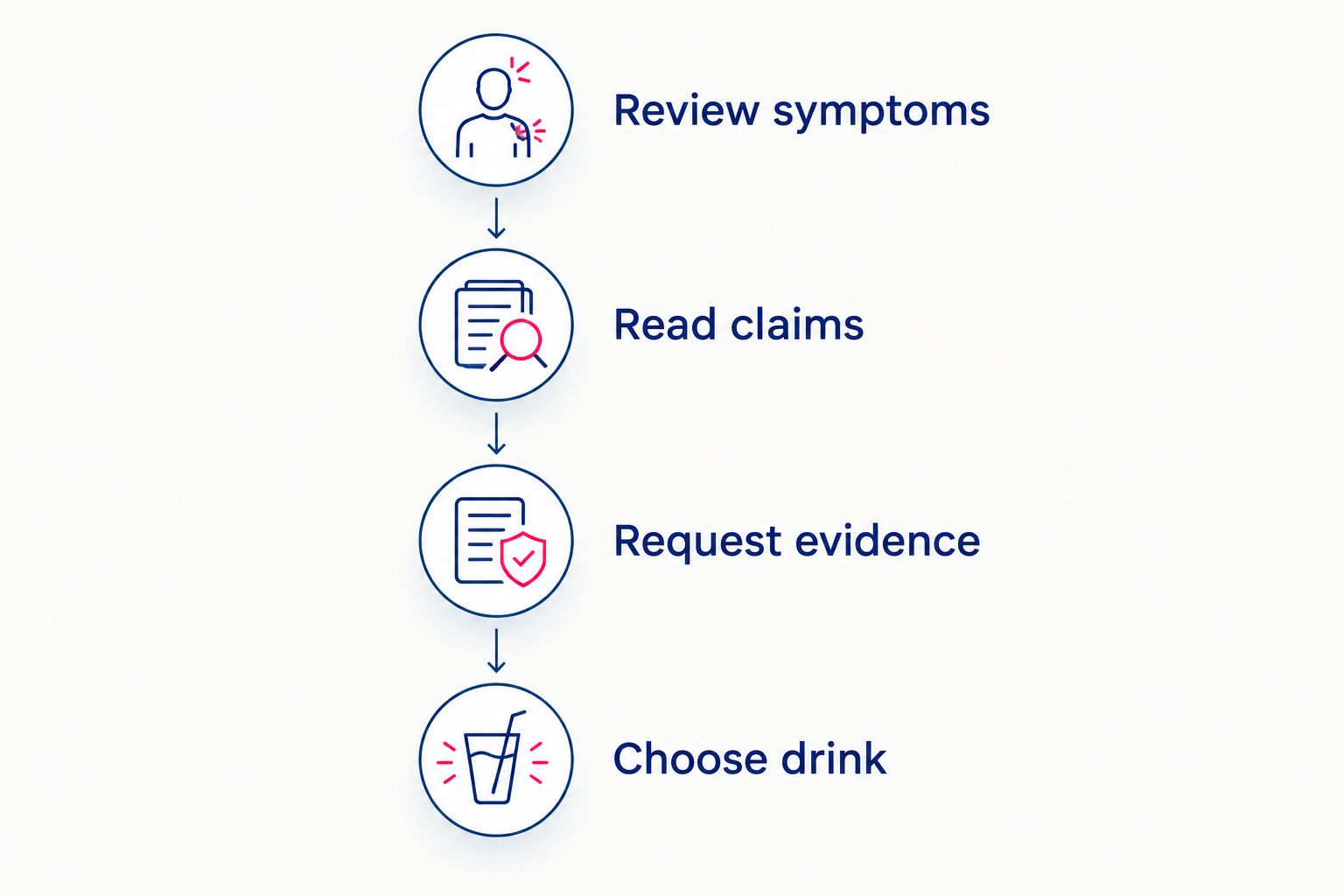
The decision process below keeps symptom review ahead of shopping. It ends with choosing a drink, not with an assumption that you should buy wine.
5. Measure servings instead of relying on glass size
If your clinician advises you to avoid alcohol, skip wine rather than looking for a smaller safe dose. If you choose to drink, understand the serving information; it is not a migraine-prevention prescription.
For US serving-size context in 2026, the National Institute on Alcohol Abuse and Alcoholism defines a standard wine drink as 5 fluid ounces at 12% alcohol by volume. A standard drink is a measurement, not a guarantee against headaches or other harm. Stronger wine contains more alcohol in the same pour.
A 750 ml bottle holds five 150 ml pours. A 375 ml bottle is half that bottle volume. Neither package size determines a symptom-free amount for you, and a large glass makes visual estimates unreliable.
- Read the alcohol-by-volume figure for the actual bottle.
- Measure a pour rather than judging it by the glass's shape.
- Record the amount consumed without calling it a safe dose.
- Do not assume food or water prevents an alcohol-triggered migraine.
6. Set a stopping rule and make hosting easier
Decide what you will do before an event. If wine repeatedly precedes attacks, choosing not to drink is more useful than working through a succession of supposedly cleaner bottles. You can still take part in dinner, a toast, or a tasting conversation without drinking wine.
Keep your prescribed migraine plan available and follow the directions you received. Do not add antihistamines, supplements, or extra medication to make drinking possible without discussing that plan with a clinician or pharmacist.
For a 2026 gathering, ask your host for an appealing nonalcoholic option in advance. If you are hosting, offer it without asking guests to explain their health history.
- Stop drinking if symptoms begin; do not switch wines to continue.
- Avoid alcohol when medication directions or clinical advice require it.
- Bring a drink you already know suits your needs.
- Tell hosts your preference without promising to taste a bottle.
- Seek emergency care for trouble breathing or a sudden, unusually severe headache.
Compare options for migraine-sensitive drinkers
The best option depends on what you need to avoid, not on a wine's health-oriented wording. These choices address different concerns. None of the wine categories below guarantees freedom from migraine.
| Option | Best for | Main advantage | Key limitation |
|---|---|---|---|
| Wine with matching histamine analysis | Checking a specific composition claim | Provides a measured result for the tested sample | Does not establish personal tolerance or remove alcohol |
| Conventional white wine | Comparing styles after deciding to drink | Generally contains less histamine than red wine | Color cannot verify an individual bottle |
| Lower-alcohol wine | Reducing alcohol concentration in an equal-volume pour | Addresses alcohol strength directly | Still contains alcohol and is not necessarily low histamine |
| Dealcoholized wine | Seeking a wine-like drink with reduced alcohol | Reduces the alcohol component | Requires label checks and does not establish histamine content |
| Plain or sparkling water | Avoiding wine alcohol and wine fermentation compounds | Removes both from the drink choice | Does not reproduce wine's flavor |
Do not turn this comparison into a tasting challenge. The goal is a decision that respects your symptoms and medical advice, not finding a bottle you can force yourself to tolerate.
Common mistakes migraine-sensitive drinkers make
Treating a headache as proof of histamine intolerance
A headache after wine does not isolate the cause. Alcohol, circumstances around drinking, and other factors can complicate the picture. Describe the pattern to your clinician rather than diagnosing yourself from a bottle label.
Assuming an attractive label answers a medical question
Organic, natural, low-sugar, and similar descriptions do not establish migraine safety. Buywinesonline offers wine choices, but choosing among retail categories is different from evaluating a suspected trigger. Use composition evidence for composition questions and clinical advice for health decisions.
Applying a report to every vintage
A result for one sample does not establish the concentration in every wine from that producer. Match the analysis to the wine you are considering. Do not carry an older bottle's claim into a different 2026 purchase without checking what the evidence covers.
Taking a supplement as permission to drink
Do not treat a histamine-related supplement or antihistamine as protection against wine-triggered migraine. Ask a clinician or pharmacist about the product, your medications, and alcohol before using them together. A supplement label does not establish that drinking is appropriate for you.
FAQ
What's the best low histamine wine for someone with migraine?
No wine is established as best for everyone with migraine. A matching laboratory report can document histamine in a tested sample, but alcohol itself remains a possible trigger and individual responses differ.
Is white wine lower in histamine than red wine?
White wine generally contains less histamine than red wine, but that pattern does not verify a particular bottle. Use bottle-specific analysis for a composition claim, and do not treat wine color as evidence of migraine safety.
Does organic wine prevent wine headaches?
Organic wine is not established as a way to prevent wine headaches. Organic production requirements do not certify low histamine or remove the alcohol in wine.
Are sulfites and histamine the same thing?
Sulfites and histamine are different substances. A sulfite-related label does not establish histamine content, and a reaction to wine does not identify either substance as the cause.
Can I drink low histamine wine with migraine medication?
Check your specific medication with your clinician or pharmacist before drinking alcohol. Low histamine wording does not change medication warnings or establish that the combination is safe.
Is nonalcoholic wine histamine-free?
Nonalcoholic wine is not automatically histamine-free. Check alcohol labeling and request relevant testing if histamine content matters to your decision; removing alcohol does not certify the absence of other wine compounds.
How do I check a low histamine wine claim before buying?
Ask for a laboratory report that identifies the wine, vintage or lot, measured concentration, units, and testing date. A product description or a general statement about production does not replace that evidence.
One last thing
The most useful bottle information might be a reason not to buy. If a producer cannot explain its low-histamine claim, you do not have to resolve the uncertainty by drinking the wine. Save the claim for discussion with your clinician and choose a drink that fits your plan.