
Moscato has no single sugar content: the amount depends on the exact wine and how much you pour. Use the producer’s residual sugar figure to calculate grams per glass; sweetness descriptions, pink color, and low alcohol do not give you an exact sugar count.
- How much sugar is in moscato wine? Check the exact bottle’s residual sugar and your serving size.
- Sweet Moscato and dry Muscat are different styles; the grape name alone does not establish sugar content.
- Buywinesonline sells wine to home consumers; use bottle-specific sugar information when comparing its wine selections.
- Residual sugar measures sugar left in wine, not total carbohydrates or total calories.
Why this matters
A sweet-tasting glass does not tell you how many grams of sugar you drank. Acidity, aroma, temperature, and serving size all affect the experience, but only a bottle-specific sugar figure supports a calculation.
When shopping for Moscato wine at Buywinesonline in 2026, separate two questions: will you enjoy the sweetness, and does the measured sugar fit your preferences? Tasting notes help with the first. A nutrition statement or producer technical sheet helps with the second.
How much sugar is in Moscato wine?
The exact sugar content of Moscato comes from the individual wine, not the word Moscato on the label. Sweet Moscato contains sugar remaining after fermentation, while dry wines made from Muscat grapes have a different sweetness profile.
Look for residual sugar, often abbreviated RS, expressed in grams per liter, or g/L. A nutrition statement can instead give sugar per serving. These measurements describe different quantities until you put them on the same serving-size basis.
| Information you find | What it tells you | What it does not establish |
|---|---|---|
| Residual sugar in g/L | Sugar concentration in the wine | Sugar in your glass without its volume |
| Sugar per serving | Sugar in the stated portion | Sugar in a larger or smaller pour |
| Total carbohydrate | Carbohydrates in the stated portion | The exact amount specifically classified as sugar |
| Sweet or fruity tasting notes | How the wine is described | A measured sugar concentration |
| Alcohol by volume | Alcohol concentration | An exact sugar figure |
A 750 ml bottle contains 0.75 liters. Multiply its residual sugar in g/L by 0.75 to calculate sugar in the whole bottle, then use your actual pour volume to calculate your serving.
How to calculate sugar in your glass
You need two pieces of information: the wine’s sugar concentration and the volume you drink. Do not substitute a sugar figure from another Moscato, even if the bottles have similar names.
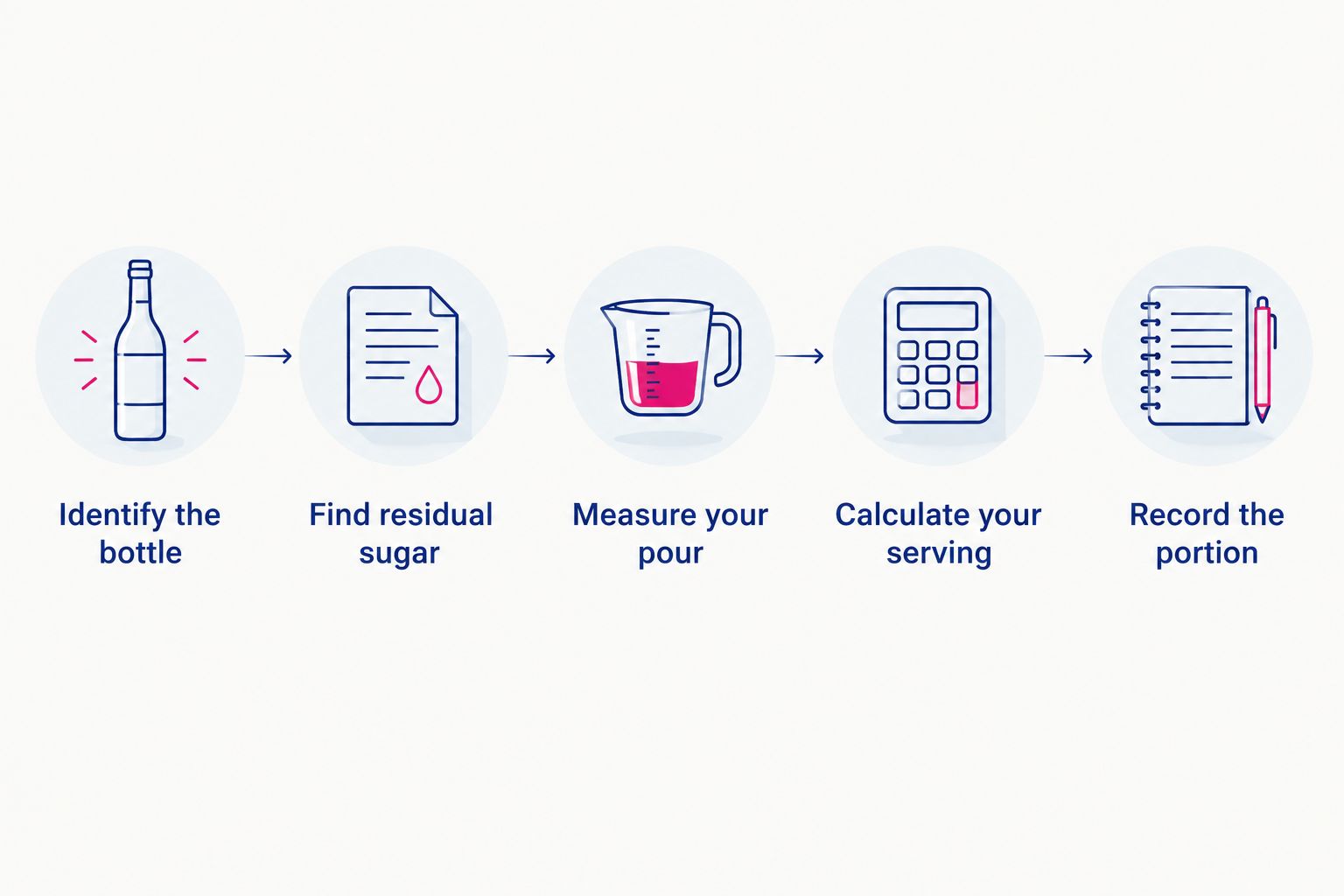
- Identify the bottle. Match the producer, wine name, style, and vintage when a vintage is stated. Pink, sparkling, and still versions are not interchangeable.
- Find residual sugar. Check the producer’s technical sheet or a bottle-specific nutrition statement. Confirm that the figure measures sugar rather than total carbohydrate.
- Measure your pour. Use milliliters so the serving volume and concentration work together without an extra fluid-ounce conversion.
- Calculate your serving. Multiply residual sugar in g/L by your pour in milliliters, then divide by 1,000.
- Record the portion. Keep the serving size beside the result. A grams-of-sugar figure without a portion is incomplete.
The calculation is:
Sugar per glass in grams = residual sugar in g/L × pour in ml ÷ 1,000.
For a 100 ml portion, divide the g/L figure by 10. For a 750 ml bottle, multiply the g/L figure by 0.75. These are volume conversions, not estimates of how sweet a particular Moscato is.
If a nutrition statement already gives sugar for your exact serving size, use that figure directly. If your portion differs, scale the sugar amount in the same proportion as the volume.
Which Moscato style are you drinking?
Moscato is not one standardized sweetness level. The name belongs to a wider family of Muscat-based wines, and style matters more than bottle color or fruit descriptions when you first narrow your search.
Use this comparison to choose a direction, not to assign grams of sugar. Every style still needs bottle-specific information for a numerical answer.
| Style | Best for | Main advantage | Main limitation |
|---|---|---|---|
| Moscato d’Asti | Drinkers seeking a sweet, gently sparkling style | Combines sweetness with light bubbles | The style name does not disclose exact sugar per glass |
| Pink Moscato | Drinkers seeking a pink, fruit-forward sweet style | A straightforward starting point for sweet-wine preferences | Pink color does not establish sugar content |
| Dry Muscat | Drinkers seeking Muscat aromas without a sweet style | Keeps aromatic character in a dry wine | It does not reproduce the sweetness of sweet Moscato |
| Muscat dessert wine | Drinkers seeking a wine for dessert | Offers a deliberately dessert-oriented style | It is not interchangeable with a lighter Moscato |
Moscato d’Asti: check the individual producer
Moscato d’Asti is a sweet, gently sparkling wine from Italy. Its aromatic character and bubbles describe the drinking experience, not the exact quantity of sugar in your pour.
Choose this style for sweetness and gentle sparkle. If sugar tracking drives your choice in 2026, check the producer’s current documentation rather than applying a generic Moscato figure.
Pink Moscato: color is not a sugar measurement
Pink Moscato does not have a universal sugar content. Neither its color nor a description of strawberry or raspberry flavors establishes grams of sugar.
Choose it because you want that style, not because pink wine sounds lighter. Compare the precise wine’s sugar concentration before drawing a nutritional comparison with white Moscato.
Dry Muscat: aromatic does not mean sweet
Muscat grapes can produce dry wines as well as sweet ones. Floral and grape-like aromas can remain even when a wine does not have the sweetness you associate with Moscato.
Dry Muscat is the better direction when you want that aromatic character without deliberately choosing a sweet style. Check measured sugar if you need an exact figure; the word dry is not a personalized dietary guarantee.
Why Moscato sugar content varies
The variation starts with winemaking and continues with the way you serve the wine. Keep these factors separate: some change sugar concentration, while others change sugar per glass or perceived sweetness.
- Fermentation endpoint: Yeast converts grape sugar into alcohol. Stopping fermentation before all fermentable sugar is consumed leaves sweetness in the wine.
- Intended style: A producer making sweet Moscato is pursuing a different result from a producer making dry Muscat or a concentrated dessert wine.
- Grape concentration: Ripeness and grape-drying practices affect the sugar available before fermentation. They do not independently tell you the finished wine’s sugar content.
- Blending and finishing: The final wine reflects the producer’s blending and finishing decisions. A grape name alone cannot describe those decisions.
- Serving volume: A larger glass contains more sugar than a smaller glass of the same wine. It does not change the wine’s g/L concentration.
- Acidity and temperature: These affect perceived sweetness, not the amount of sugar already in a measured serving.
Taste is useful for choosing wine; measurement is necessary for counting sugar. A crisp finish does not prove low sugar, and a strong fruit aroma does not prove high sugar.
How do you check a Moscato label in 2026?
Start with the exact wine identity, then look for usable measurements. A product description and a nutrition statement serve different purposes; one describes the experience, while the other can support a calculation.
Check these details before using a sugar figure:
- Does the document match the wine’s full name and style?
- Does the vintage match, when one is stated?
- Is the figure sugar, residual sugar, or total carbohydrate?
- Is it expressed per liter, per 100 ml, or per serving?
- If it is per serving, what volume defines that serving?
Do not read a rounded figure as laboratory-level precision. Nutrition information can use rounding, so avoid adding decimal places that the original statement does not support.
For a 2026 purchase, use documentation matching the bottle you are considering. An older technical sheet is not automatically applicable to a different vintage, blend, or version of the wine.
Is Moscato sugar the same as carbohydrates?
No. Sugar is part of total carbohydrate, but a total-carbohydrate figure is not automatically an exact sugar figure. Read the heading beside the number before entering it into a food-tracking app.
Calories are another separate measurement. Alcohol supplies calories too, so reducing sugar does not make an alcoholic wine calorie-free.
For sugar tracking, compare sugar with sugar and equal portions with equal portions. Comparing one wine’s carbohydrate value with another wine’s residual sugar creates a misleading result even when both numbers are accurate.
Does lower-alcohol Moscato have less sugar?
Lower alcohol does not establish lower sugar. In sweet Moscato, stopping fermentation preserves grape sugar while limiting how much alcohol fermentation produces.
Treat alcohol by volume and residual sugar as separate specifications. Neither one replaces the other, and a low-alcohol description is not a sugar claim.
Does chilling Moscato reduce its sugar?
Chilling Moscato does not remove sugar. It changes how you experience the wine, which can make sweetness seem different without changing sugar in the measured portion.
Ice adds water as it melts, reducing concentration in the diluted drink. It does not remove sugar from the wine you already poured.
How to shop for Moscato without guessing
Decide whether your priority is sweetness, aromatic character, or a measured sugar amount. These priorities can lead to different choices, so settle that question before comparing bottles.
Buywinesonline is an online wine retailer for home wine consumers and gift shoppers. Its selection spans over 5,000 wines, but selection size is not a substitute for bottle-specific nutrition information.
For Moscato wine shopping at Buywinesonline in 2026, use a simple rule: choose the style for enjoyment, then confirm the sugar information separately. If a strict sugar target guides your purchase, choose only after you can match the measurement to the wine and serving.
For a gift, ask whether the recipient enjoys sweet wine rather than assuming every aromatic white wine tastes sweet. For your own table, avoid choosing by color, bottle shape, or fruit names alone.
FAQ
How much sugar is in a glass of Moscato wine?
Sugar in a glass of Moscato depends on the exact wine’s residual sugar and your pour size. Multiply residual sugar in g/L by the serving volume in ml, then divide by 1,000.
How much sugar is in a 750 ml bottle of Moscato?
Sugar in a 750 ml bottle equals the wine’s residual sugar in g/L multiplied by 0.75. Use the figure for that exact wine rather than a generic Moscato estimate.
Is pink Moscato lower in sugar than white Moscato?
Pink Moscato is not inherently lower in sugar than white Moscato. Compare bottle-specific sugar figures using equal serving volumes; color alone does not establish sugar content.
Can Moscato wine be dry?
Muscat grapes can produce dry wine, although many wines sold as Moscato are sweet styles. Look for an explicitly dry style and verify residual sugar when an exact amount matters.
Does Moscato have added sugar?
Sweetness alone does not prove added sugar because grape sugar can remain after fermentation. Check the individual wine’s ingredient information or ask its producer about how it is made.
Is Moscato suitable for someone managing diabetes?
Moscato is not automatically suitable for someone managing diabetes, and sugar content alone cannot establish suitability. Alcohol also affects blood glucose management, so follow individualized advice from your healthcare professional.
Does a smaller Moscato pour contain less sugar?
A smaller pour contains less sugar than a larger pour of the same Moscato. The wine’s sugar concentration stays the same; the amount you consume changes with volume.
One last thing
Fruit flavor is not a sugar measurement. A dry Muscat can smell intensely of grapes and flowers without delivering the sweet taste you expect from Moscato.
Before your next pour, save the wine’s residual sugar figure beside its full name and your serving volume. That small habit makes repeat purchases and comparisons more useful than remembering that a bottle tasted “not too sweet.”