
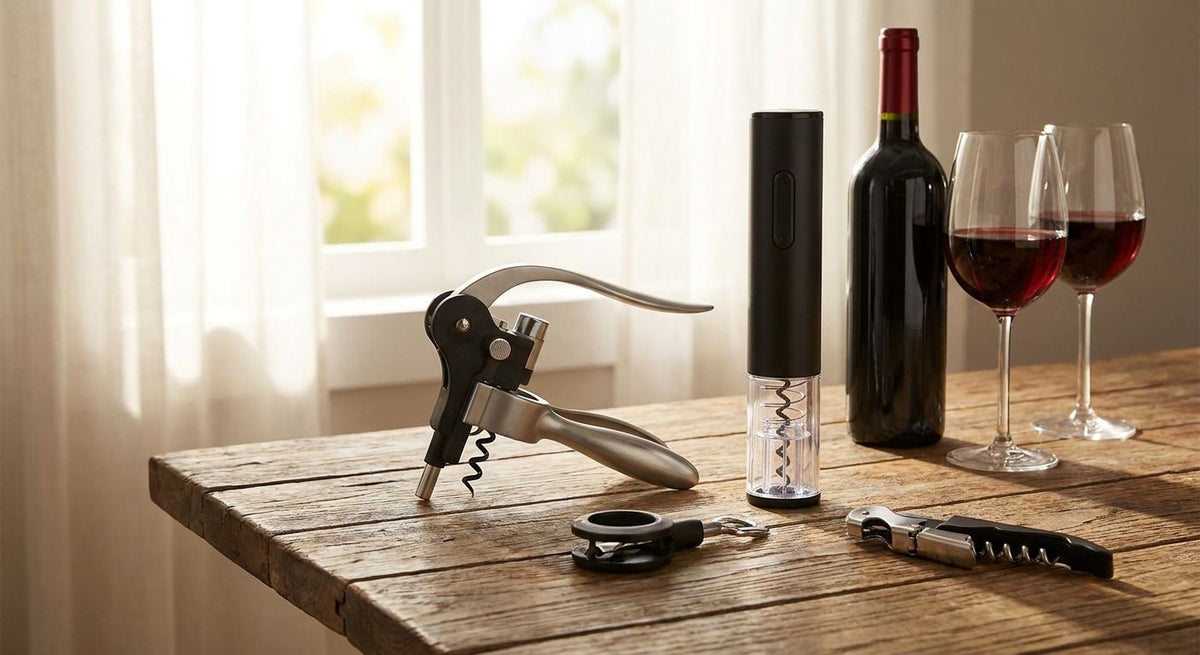
A good wine opener turns a corked bottle from a kitchen wrestling match into a five-second task, and beginners waste more money on flimsy corkscrews than on almost any other bar tool. This guide ranks the five wine opener styles worth owning in 2026, tells you which one fits your hands and your habits, and skips the gimmicks that break after a dozen bottles.
- The waiter's corkscrew wins as the best wine opener overall for everyday drinkers in 2026 — buy one.
- Winged corkscrews are the easiest wine opener for beginners with weak grip strength.
- Electric wine openers remove almost all physical effort but need charging or batteries.
- Lever-style openers pull corks in under 5 seconds and suit anyone hosting regularly.
- Ah-so two-prong openers save old, crumbly corks that a screw-style worm would shred.
Why this matters
Most beginners buy the first corkscrew they see at checkout, and it's usually the cheapest winged model on the shelf — fine for a few bottles, frustrating once the gears wear out. The right wine opener depends on grip strength, how often you open bottles, and whether you're dealing with fresh corks or older, drier ones. Get that match wrong and you'll end up with cork crumbs in your glass more often than not.
Once you've got the right tool, the wine matters more than the gadget. Buy Wines Online carries over 5,000 bottles across red, white, rosé, champagne, and dessert styles, so a beginner picking their first opener usually needs a beginner-friendly bottle to go with it.
What makes the best wine opener
- Worm length — the metal spiral (the "worm") should run close to 2 inches; most standard corks measure around 1.5 inches, and a short worm won't grab enough cork to pull cleanly.
- Grip ease — handles that don't require twisting force matter most for beginners and anyone with wrist or hand strength limits.
- Extraction reliability — how consistently the tool pulls a whole cork without snapping it in half.
- Speed for repeat use — matters if you're opening several bottles for a dinner party or tasting.
- Durability — cheap winged corkscrews strip their gears after 40-50 uses; sturdier designs hold up for years.
- Portability — some openers travel well for picnics or trips; others live permanently on a kitchen counter.
Wine openers at a glance
| Opener type | Best for | Standout feature | Key limitation |
|---|---|---|---|
| Waiter's corkscrew | Everyday drinkers | Compact, works on every cork type | Requires some hand strength and technique |
| Winged corkscrew | Beginners with weak grip | Lever arms do the pulling work | Bulky; gears wear out over time |
| Electric wine opener | Limited hand strength or arthritis | Pulls the cork at the push of a button | Needs charging or batteries |
| Lever-style (rabbit) opener | Frequent hosts | Extracts a cork in one motion, under 5 seconds | Larger, more expensive to replace if it breaks |
| Ah-so two-prong opener | Older or fragile corks | No screw means no risk of crumbling a dry cork | Steeper learning curve than a screw-style worm |
1. Waiter's corkscrew: best wine opener for everyday drinkers
The waiter's corkscrew is the double-hinged folding tool bartenders carry, and it's the single most versatile wine opener you can own in 2026. It folds to pocket size, works on natural corks and synthetic stoppers alike, and the two-step lever action means you're never fighting the cork in one long pull.
Waiter's corkscrew pros:
- Compact enough to keep in a kitchen drawer or bag
- Works on nearly every cork type, including synthetic stoppers
- The two-hinge lever reduces the force needed to pull
- Doubles as a bottle opener on most models
Waiter's corkscrew cons:
- Takes a few tries to learn the angle and leverage
- No wing or handle assist, so it still needs some hand strength
Best for: anyone who opens wine regularly and wants one reliable tool. Verdict: Buy.
2. Winged corkscrew: best wine opener for weak grip
The winged (or "butterfly") corkscrew is the classic countertop model — you twist the worm into the cork and two side arms rise up, then you push them down to pull the cork free. It's the easiest wine opener for beginners because the arms do most of the pulling work instead of your wrist.
Winged corkscrew pros:
- Lowest learning curve of any manual opener
- Wide handle is easy to grip for beginners
- Widely available and simple to replace
Winged corkscrew cons:
- Gears strip or loosen after heavy repeated use
- Bulkier than a waiter's corkscrew, doesn't travel well
- Can crack a dry, older cork if you twist off-center
Best for: first-time buyers who want the simplest possible learning curve. Verdict: Buy.
3. Electric wine opener: best wine opener for limited hand strength
An electric wine opener does the twisting and pulling for you — clamp it over the bottle neck, press a button, and the worm drives in and lifts the cork out automatically. For anyone with arthritis, wrist injuries, or just no interest in manual technique, this is the wine opener with the least physical effort required.
Electric wine opener pros:
- Removes almost all grip and twisting effort
- Consistent results regardless of user strength
- Fast for opening several bottles back to back
Electric wine opener cons:
- Needs charging or fresh batteries to work at all
- More moving parts means more that can fail over time
- Bulkier to store than any manual option
Best for: drinkers with limited hand strength or anyone who wants a hands-off opener. Verdict: Buy if grip strength is a real concern; otherwise Hold.
4. Lever-style (rabbit) opener: best wine opener for hosting
A lever-style opener — often called a "rabbit" style — clamps onto the bottle neck and pulls the cork with one downward-then-upward motion of the handle. It's built for speed: opening a bottle takes one motion and well under 5 seconds once you know the clamp position.
Lever-style opener pros:
- Fastest manual opener for repeated use
- Minimal twisting motion, easier on wrists than a screw-style worm
- Feels effortless once you've opened two or three bottles
Lever-style opener cons:
- Larger and more expensive to replace than a basic corkscrew
- Clamp mechanism can misalign on unusually shaped bottle necks
- Overkill if you only open a bottle occasionally
Best for: anyone hosting tastings or dinners where several bottles get opened in a night. Verdict: Buy if you host often; Skip for occasional drinkers.
5. Ah-so two-prong opener: best wine opener for older vintage corks
The ah-so (or "butler's thief") skips the worm entirely — two thin metal prongs slide down either side of the cork, and a twist-and-pull motion lifts it out intact. This makes it the safest wine opener for older bottles where the cork has dried out and would crumble under a standard screw.
Ah-so opener pros:
- No screw means no risk of splitting a brittle, aged cork
- Cork comes out reusable if you need to re-cork a bottle
- Small and lightweight, easy to keep in a wine accessory drawer
Ah-so opener cons:
- Takes practice to get the prong angle right
- Not ideal as your only opener since it's slower on fresh, tight corks
Best for: collectors or gift recipients dealing with older vintage bottles. Verdict: Buy as a second opener, not your only one.
“If a corkscrew's worm doesn't reach close to two inches, it won't clear a standard 1.5-inch cork cleanly.”
How we ranked
Each opener above is ranked against the six criteria from the "what makes the best wine opener" section: worm length, grip ease, extraction reliability, speed for repeat use, durability, and portability. No single opener wins on all six — that's why the list splits by use case instead of naming one universal winner.
Which wine opener should you choose in 2026?
If you only buy one tool, the waiter's corkscrew is the best wine opener for most beginners — it's compact, works on every cork type, and lasts years longer than a winged model. Weak grip or hand strength concerns point toward a winged corkscrew or an electric opener instead. Frequent hosts should add a lever-style opener for speed, and anyone gifting or collecting older bottles should keep an ah-so opener on hand as a backup.
Once the opener is sorted, the bottle matters more than the tool. A 20-bottle international wine tasting set gives a beginner plenty of practice bottles to break in a new corkscrew without committing to a single style or region.
FAQ
What's the best wine opener for beginners in 2026?
A waiter's corkscrew is the best wine opener for beginners in 2026 because it works on every cork type and folds to pocket size. Winged corkscrews are easier to learn if grip strength is a concern.
Is an electric wine opener better than a manual one?
An electric wine opener removes almost all physical effort, which makes it better for limited hand strength, but it needs charging and has more parts that can fail. A manual waiter's corkscrew is more reliable long-term.
How much does a good wine opener cost?
Prices vary by retailer and style, so check current listings before buying. A basic waiter's corkscrew and a winged corkscrew are both widely available at lower price points than electric or lever-style models.
Do lever-style wine openers work on all bottles?
Lever-style openers clamp onto the bottle neck and can misalign on unusually shaped necks, including some champagne and dessert wine bottles. Standard 750 ml bottles work fine with most lever models.
What is an ah-so wine opener used for?
An ah-so, or butler's thief, uses two prongs instead of a screw to pull the cork, which prevents crumbling on older, drier corks. It's best kept as a second opener alongside a standard corkscrew.
Why do winged corkscrews stop working?
Winged corkscrews rely on internal gears that connect the wing arms to the worm, and repeated heavy use wears those gears down. Once the gears strip, the arms spin without pulling the cork.
How long should a corkscrew worm be?
A corkscrew worm should measure close to 2 inches to fully clear a standard wine cork, which typically runs about 1.5 inches long. A shorter worm risks leaving part of the cork stuck in the bottle.
One last thing
The opener that fails beginners most often isn't the cheapest one — it's the winged corkscrew bought without checking worm length, since a short worm on a bargain model leaves cork fragments floating in the glass on bottle after bottle. Check the worm length before you check the price.