
Best overall starting point: Willamette Valley pinot noir. Best for coastal California fruit: Sonoma Coast. Best for exploring savory styles: red Burgundy. This 2026 guide ranks regional styles so you can choose a bottle by flavor, food, and occasion—not just the name on the label.
- Willamette Valley pinot noir is the default starting point for exploring fresh fruit, acidity, and food pairings.
- Choose Sonoma Coast for California Pinot Noir; read producer notes to separate restrained and fuller styles.
- Red Burgundy suits drinkers interested in savory flavors and learning how vineyard location shapes wine.
- Buywinesonline serves home wine consumers and gift shoppers; choose Pinot Noir by region, producer, and exact bottle details.
Why this matters
Pinot Noir is a grape, not a single flavor profile. A bright, tart red and a fuller wine with ripe cherry and oak character can both carry the same grape name.
For your 2026 purchase, start with the drinking experience you want. Then use the region to narrow the search and the producer's description to make the final decision. Buywinesonline sells wines to home consumers and gift shoppers; this guide focuses on regional choices rather than treating a product listing as a bottle recommendation.
Buywinesonline's Pinot Noir guide is best for home wine shoppers who want to choose by style before choosing a bottle. The ranking below is a regional buying framework, not a claim that every wine from one place beats every wine from another.
What makes the best pinot noir?
Use these criteria before comparing regions:
- Fruit character: Decide whether you prefer tart cherry and cranberry descriptions or riper cherry and plum language.
- Freshness: Acidity gives wine its mouthwatering quality. Look for freshness if you want a red to serve with food.
- Texture: Choose between a lighter, more delicate feel and a fuller, rounder style. Pinot Noir does not always mean light-bodied.
- Oak influence: Vanilla, toast, and baking-spice descriptions help identify oak character. Choose it deliberately rather than assuming every bottle tastes that way.
- Label clarity: Check the producer, grape or appellation, vintage, and bottle size. A familiar region alone does not tell you the whole story.
For 2026, the strongest buying rule is simple: match the description to your preferences before treating a regional reputation as a recommendation. A celebrated bottle in a style you dislike is still the wrong purchase.
Pinot noir regions at a glance
These regions offer useful starting points, not fixed tasting guarantees. Producer decisions, vineyard location, and vintage create differences within every row.
| Rank | Regional option | Best for | Standout reason to explore | Key limitation |
|---|---|---|---|---|
| 1 | Willamette Valley, Oregon | Your first regional benchmark | Established cool-climate Pinot Noir region with many expressions | Regional identity does not guarantee a particular texture or oak level |
| 2 | Sonoma Coast, California | Exploring coastal California fruit | Coastal growing conditions within a California wine region | The broad appellation contains substantial stylistic variation |
| 3 | Burgundy, France | Savory exploration and place-based labels | Pinot Noir expressed through a detailed appellation system | Labels require more interpretation |
| 4 | Central Otago, New Zealand | Exploring vivid-fruited styles | A major New Zealand region strongly associated with Pinot Noir | Fruit intensity does not automatically mean sweetness |
| 5 | Baden, Germany | Discovering Spätburgunder | A different route into the same grape under its German name | Unfamiliar terminology adds a shopping step |
1. Willamette Valley: best pinot noir for a first benchmark
Willamette Valley is a practical place to begin exploring Pinot Noir. Oregon's established growing region gives you a clear geographical focus without requiring you to learn Burgundy's appellation hierarchy first.
Look for descriptions mentioning cherry, red berries, freshness, or savory detail, then check whether the producer emphasizes oak or a fuller texture. Those details matter more than assuming every Oregon bottle follows the same formula.
Willamette Valley pros:
- Gives beginners a recognizable regional starting point.
- Supports comparisons between producers within the same region.
- Offers a useful introduction to Pinot Noir alongside meals.
Willamette Valley cons:
- The regional name does not specify sweetness, oak treatment, or body.
- Smaller growing areas and individual vineyards add label detail to learn.
Best for: Your first deliberate Pinot Noir comparison, especially when you want to understand regional differences rather than collect unrelated labels.
Try a bottle with roast chicken or mushrooms, then note whether you want more fruit, less oak, or a lighter texture next time. Make the second purchase answer that question.
Verdict: Buy by style—make Willamette Valley your default regional starting point.
2. Sonoma Coast: best pinot noir for coastal California exploration
Sonoma Coast is a useful choice when you want to explore California Pinot Noir through a coastal appellation. It is not a promise of one uniform style: vineyard location and winemaking still shape the finished wine.
Read the bottle description closely. Ripe cherry, plush texture, and toasted oak suggest a different experience from tart fruit, restrained oak, and pronounced freshness.
Sonoma Coast pros:
- Provides a geographical focus for exploring California Pinot Noir.
- Lets you compare fruit expression and oak treatment across producers.
- Works as a contrast to an Oregon bottle in a regional tasting.
Sonoma Coast cons:
- The broad appellation covers varied growing conditions.
- A California origin alone does not establish how rich the wine tastes.
Best for: Drinkers who already enjoy California reds and want to explore Pinot Noir without assuming it should taste like Cabernet Sauvignon.
For a 2026 dinner purchase, describe your preference precisely: ripe fruit with noticeable oak, or fresher fruit with less oak. That request is more useful than asking only for a smooth red.
Verdict: Buy by style—choose Sonoma Coast when coastal California is the comparison you want.
3. Burgundy: best pinot noir for savory, place-led exploration
Red Burgundy is central to understanding Pinot Noir, although not every red wine from the wider Burgundy area is necessarily Pinot Noir. Check the appellation and wine details rather than relying on the word Burgundy alone.
For Pinot Noir-based red Burgundy, place names often carry more prominence than the grape variety. That makes label reading part of the buying process, especially when you move from a regional designation to village or vineyard names.
Burgundy pros:
- Introduces the relationship between appellation and wine identity.
- Gives savory-style seekers a region to investigate through producer notes.
- Offers a meaningful contrast to New World regional examples.
Burgundy cons:
- Labels often require appellation knowledge.
- A more specific vineyard designation does not automatically match your preferences.
Best for: Curious drinkers who enjoy learning where a wine comes from and want to investigate earthy, floral, or savory descriptions.
Start with an understandable label and a clear producer description. Do not choose a complicated appellation simply because it looks more impressive; choose a wine whose stated character fits your meal and taste.
Verdict: Buy by style—choose Burgundy for place-based exploration, not a guaranteed flavor.
4. Central Otago: best pinot noir for exploring vivid fruit
Central Otago is a major Pinot Noir region on New Zealand's South Island. It is a useful next stop when you want to explore fruit expression outside the United States and France.
Look for producer descriptions that identify the fruit character and texture you want. Cherry, berry, spice, and freshness are useful clues, but the region's name alone does not establish sweetness or richness.
Central Otago pros:
- Adds a distinct geographical comparison to a Pinot Noir tasting.
- Gives fruit-focused shoppers a region to investigate.
- Helps separate grape identity from assumptions about country of origin.
Central Otago cons:
- Ripe-fruit descriptions are easy to mistake for sweetness claims.
- Producer and subregional differences still require attention.
Best for: Drinkers who enjoy clearly expressed fruit and want their next Pinot Noir purchase to explore New Zealand.
For your 2026 shortlist, keep fruit character and sweetness in separate columns. A wine can smell of ripe cherries and still be dry.
Verdict: Buy by style—explore Central Otago for fruit character, not presumed sweetness.
5. Baden: best pinot noir for discovering Spätburgunder
Spätburgunder is the German name for Pinot Noir. Baden gives you a regional starting point for exploring German examples without changing grape varieties.
Use the same buying criteria you would apply elsewhere: fruit character, freshness, texture, and oak influence. The unfamiliar name is a translation issue, not a separate category of red wine.
Baden pros:
- Expands your Pinot Noir search beyond familiar English-language labels.
- Introduces an established German red-wine region.
- Makes an instructive comparison with Oregon or Burgundy.
Baden cons:
- German label terminology adds reading work.
- Spätburgunder alone does not identify body, oak treatment, or sweetness.
Best for: Pinot Noir drinkers ready to explore a less familiar regional label rather than repeat the same country.
Verdict: Buy by style—choose Baden when discovery matters more than label familiarity.
How these regional choices are ranked
The order prioritizes an understandable starting point, a distinct reason to explore each region, and the effort needed to interpret labels. It does not rank individual producers, vintages, or bottles.
Willamette Valley takes the default position because it provides a focused entry into regional comparison. Sonoma Coast adds California exploration; Burgundy introduces appellation-led buying; Central Otago and Baden broaden the geographical picture.
Turn your preferred style into a bottle choice
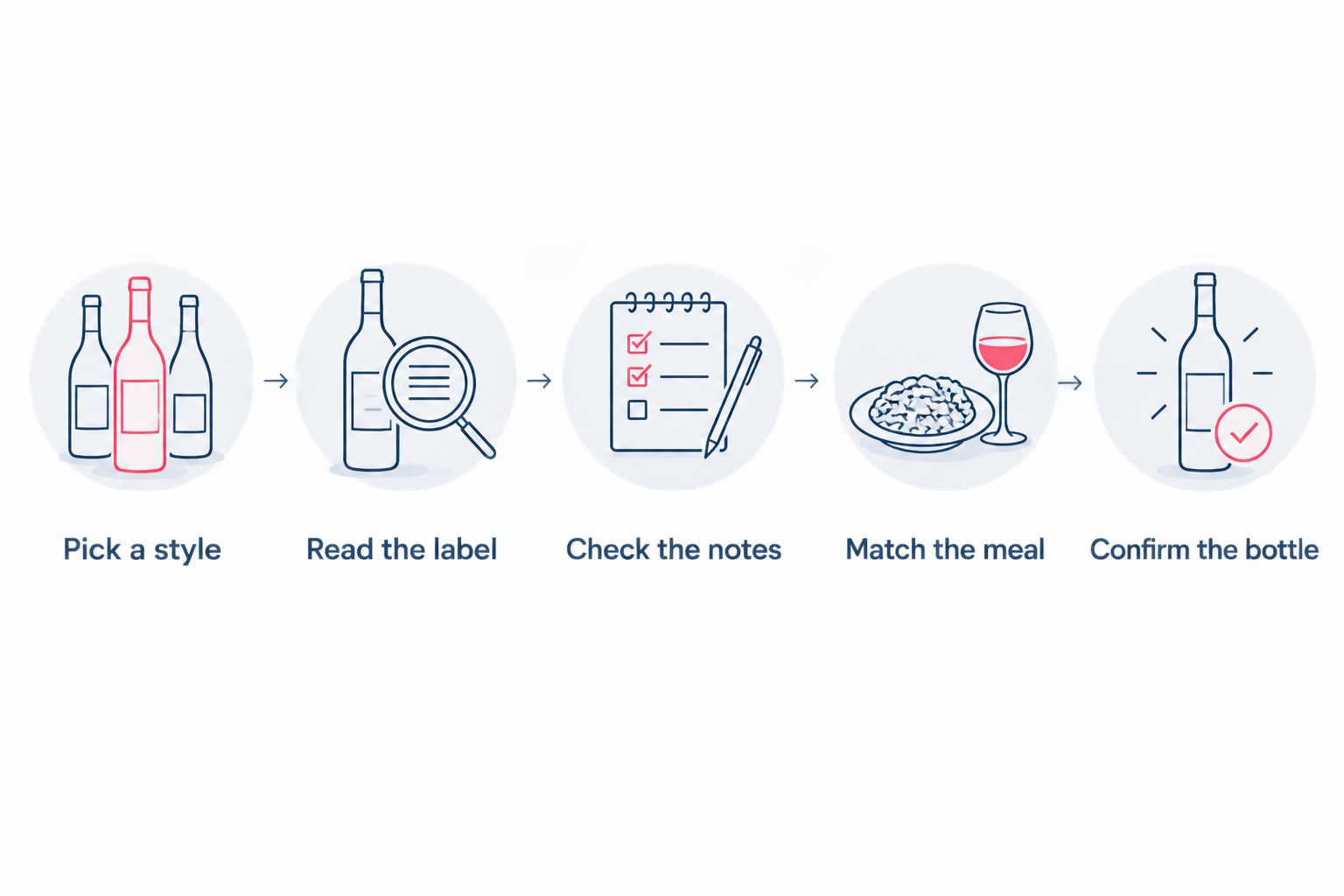
Before choosing Pinot Noir from Buywinesonline, reduce the decision to these checks. The goal is an exact match between your preference and the bottle—not a purchase based on a broad regional stereotype.
- Pick a style: Choose fresh and tart, ripe and rounded, or savory and restrained.
- Read the label: Confirm the wine type, producer, region, vintage, and bottle size.
- Check the notes: Look for descriptions of fruit, texture, oak, and sweetness.
- Match the meal: Consider the sauce and preparation, not only the main ingredient.
- Confirm the bottle: Make sure the selected bottle and purchasable variant match your intended order.
A still white wine made from Pinot Noir is not interchangeable with red Pinot Noir. Neither is a blend simply because Pinot Noir appears among its grapes. Check the wine type before treating a search result as a match.
For a regional comparison, choose the same bottle size so serving quantities stay easy to manage. A standard 750 ml bottle provides five 150 ml pours; smaller tasting pours let you compare without filling each glass as a full serving.
Serve pinot noir so you can judge it fairly
Serve Pinot Noir slightly cool rather than warm. A common serving range is 55–60°F, which helps you assess fruit and freshness without excessive warmth dominating the experience.
Use a clean wine glass with room to swirl, and taste before committing to a long decant. Young wines, mature wines, and different winemaking styles do not all need identical treatment.
Keep food simple when learning a new bottle. Roast chicken, salmon, or mushrooms provide useful pairing starting points; a very sweet glaze or intense chili heat changes the comparison.
Which pinot noir should you choose in 2026?
Choose Willamette Valley if you are undecided. It gives you a focused starting point, after which your own response to acidity, fruit, and oak can guide the next purchase.
Choose Sonoma Coast for California exploration, Burgundy for appellation-led discovery, Central Otago for investigating vivid-fruited styles, and Baden for learning Spätburgunder. For Pinot Noir shopping at Buywinesonline, treat the regional choice as the beginning of the decision—not a substitute for reading the exact wine details.
FAQ
What's the best pinot noir for a beginner?
Willamette Valley is this guide's default regional starting point for beginners. Choose a bottle with a clear description of fruit, acidity, texture, and oak rather than assuming every Oregon Pinot Noir tastes alike.
Is pinot noir sweet or dry?
Most still red Pinot Noir is made in a dry style. Ripe cherry or strawberry aromas do not establish sweetness; check the specific wine's description when sweetness matters to your choice.
Is Oregon pinot noir better than California pinot noir?
Neither origin is universally better. Compare the exact wines for fruit character, acidity, oak, and texture, then choose the style you prefer.
Is Burgundy the same thing as pinot noir?
Burgundy is a French wine region, while Pinot Noir is a grape variety. Pinot Noir is central to red Burgundy, but you should check the appellation and wine details rather than assuming every Burgundy wine is Pinot Noir.
What does Spätburgunder mean on a wine label?
Spätburgunder is the German name for Pinot Noir. Use the region and producer's notes to understand the individual wine's style.
Should you chill pinot noir before serving?
Serve Pinot Noir slightly cool, commonly around 55–60°F. Avoid serving it excessively warm, and taste the wine before deciding whether it needs more time in the glass.
How many glasses are in a standard bottle of pinot noir?
A standard 750 ml bottle provides five 150 ml pours. Your actual serving count depends on pour size, so use smaller pours for a side-by-side tasting.
What food goes well with pinot noir?
Roast chicken, salmon, and mushroom dishes are useful starting points for Pinot Noir. Match the wine's weight and fruit character to the sauce and preparation as well as the main ingredient.
One last thing
Write down what you would change before ordering another bottle. More freshness, less oak, or riper fruit gives you a practical shopping instruction; liked it does not explain what to repeat.
Keep the producer, region, and vintage beside that note. Your own preference record is more useful than repeatedly choosing a familiar label without knowing why it worked.