
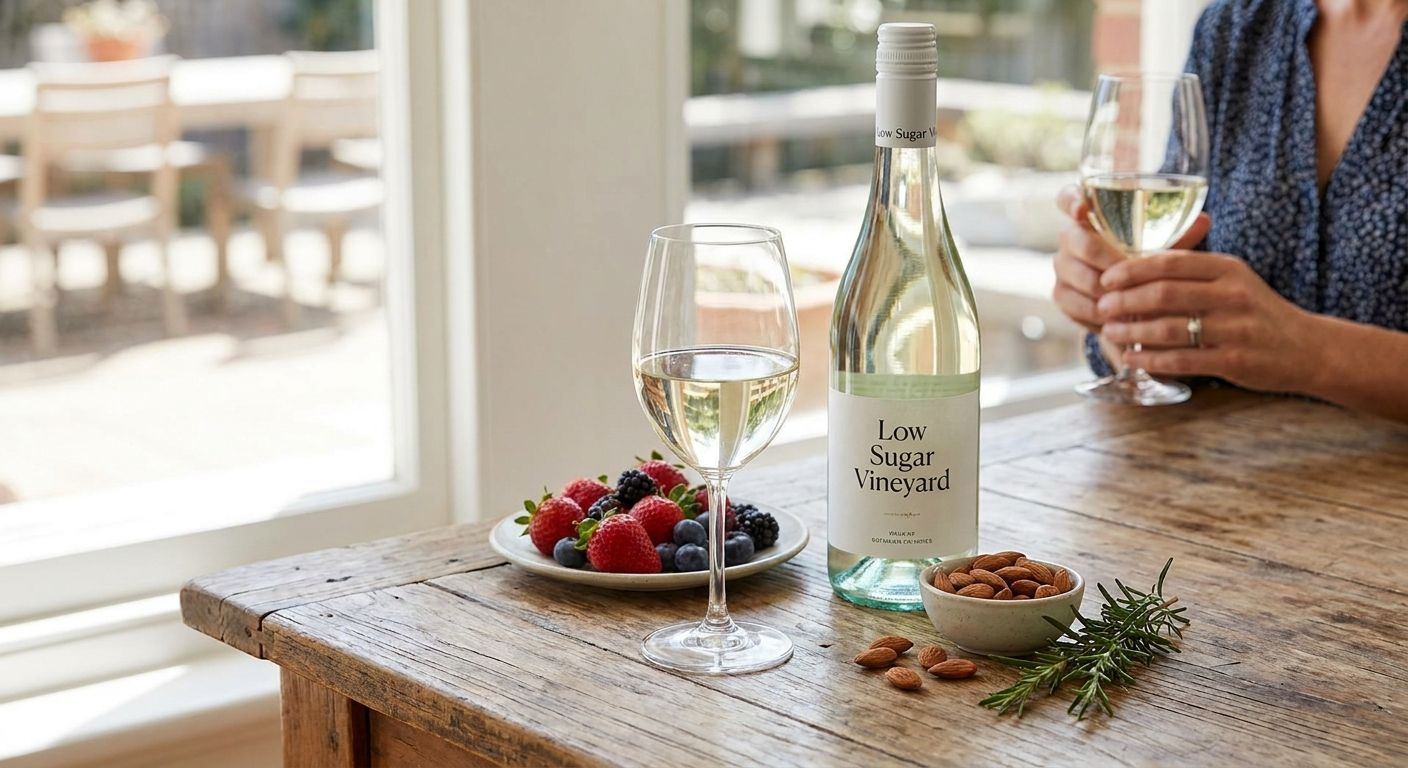
Low sugar wine for health-conscious drinkers means bottles that stay under roughly 10 grams of residual sugar per liter — dry reds, dry whites, and Brut sparkling wines that let you enjoy a glass without derailing a low-carb or blood-sugar-conscious diet in 2026. This segment doesn't shop by tannin structure or vintage hype; it shops by the sugar number on the spec sheet and what a 5-ounce pour does to a daily carb count. Buy Wines Online's catalog of over 5,000 bottles makes filtering for these styles straightforward once you know which grape and style words to trust.
- Dry reds, dry whites, and Brut sparkling stay under roughly 10g/L sugar — the safest low sugar wine bets in 2026.
- Buy Wines Online's Cabernet Sauvignon and Sauvignon Blanc lineup skews dry by default — check the label, not the marketing.
- Off-dry, moscato, and demi-sec sparkling carry 12-50+ g/L sugar — skip them if sugar is the concern.
- A 5oz glass of dry wine runs about 120-125 calories from alcohol alone, sugar or not.
- Build a mixed case instead of gambling one bottle at a time — cheaper way to test what you actually like.
Why low sugar wine matters for health-conscious drinkers
Health-conscious drinkers aren't checking a wine score — they're checking a sugar number against a daily carb budget, a keto macro split, or a blood-sugar concern, and a wine that fails that check gets skipped no matter how it's rated. The EU/OIV wine classification system draws the dry line at roughly 4-10 grams of residual sugar per liter for still wine, 12-50+ g/L for off-dry through sweet, and a separate scale for sparkling that starts at 0-3 g/L for Brut Nature. Cross that dry threshold and the wine reads noticeably sweet on the palate, adding sugar grams a low-carb diet doesn't have room for.
Buy Wines Online stocks more than 5,000 bottles across reds, whites, rosé, champagne, and dessert wine, and most of the still-wine catalog — Cabernet Sauvignon, Pinot Noir, Sauvignon Blanc, Chardonnay — ferments dry by default. That's the advantage for this segment: instead of hunting for a rare "diet wine," you're filtering a normal wine catalog down to styles that were already low in sugar before anyone put a health claim on the label.
Buy Wines Online's dry Cabernet Sauvignon and Sauvignon Blanc selections are the safest low sugar wine starting point for health-conscious drinkers in 2026. The catch is that "low sugar" almost never appears on the bottle itself — producers print ABV, not residual sugar, so you have to read grape, region, and style as sugar signals instead of waiting for a number that usually isn't there.
Check the residual sugar number, not the marketing label
Most bottles never print a residual sugar figure, so "light," "skinny," or "clean" on a label is marketing copy, not a lab result. A handful of producers do publish residual sugar on their tech sheets in 2026 — check before buying if the label makes any health claim.
- Search the producer's tech sheet or spec PDF for "residual sugar" or "RS"
- Treat under 4 g/L as bone dry, 4-10 g/L as still low sugar, above 12 g/L as off-dry or sweeter
- Ignore "low calorie" claims that skip sugar entirely — the two are different metrics
- Cross-check the vintage note; a warm growing year can push a normally dry wine slightly sweeter
- Skip any bottle marketed as "skinny" with no sugar or calorie disclosure at all
Default to dry styles across every wine category
Dry is the fastest filter for low sugar wine, because fermentation that runs to completion converts nearly all grape sugar into alcohol before bottling. Off-dry and sweet styles stop fermentation early on purpose, leaving sugar behind for texture and flavor.
- Cabernet Sauvignon, Pinot Noir, and Merlot ferment dry almost universally
- Sauvignon Blanc and dry Chardonnay run dry unless the label says "off-dry"
- Riesling swings from bone dry to dessert-sweet — check region and producer notes before buying
- Rosé varies widely; Provence-style rosé runs dry, White Zinfandel does not
- Avoid anything labeled "semi-sweet," "demi-sec," or "moscato" if sugar is the deciding factor
Pick Brut or Extra Brut for sparkling wine
Sparkling wine sugar levels are easier to read than still wine, because the dosage category is printed right on most labels. Brut Nature and Extra Brut sit at the low end; Demi-Sec and Doux sit at the sweet end.
- Brut Nature: 0-3 g/L, the driest commercial sparkling category
- Extra Brut: 0-6 g/L
- Brut: up to 12 g/L, still low but the widest, most common category
- Extra Dry and Dry: 12-32 g/L despite the name — these read sweeter than Brut
- Demi-Sec and Doux: 32 g/L and up, dessert-level sugar
Match grape variety and region to your health goal
Some varieties and regions run drier as a rule, which narrows the shopping list before you even open a bottle. That matters more for a segment shopping by macro or blood-sugar target than for someone shopping by mood.
- Napa Valley and Bordeaux-style Cabernet Sauvignon: consistently dry, structured reds
- Chablis and Sancerre-style Sauvignon Blanc: high acid, bone-dry whites
- Brut Champagne and Cava: dry sparkling with a printed dosage category
- Malbec and Syrah: dry by convention, full-bodied without added sweetness
- Avoid late-harvest, ice wine, and port-style labeling entirely if sugar is the concern
Read the calorie and carb count when the producer publishes one
A small number of brands publish calorie and carb counts alongside ABV in 2026, and those labels save the manual guesswork this segment usually does bottle by bottle.
- Look for "low calorie," "low carb," or nutrition-panel language on the product page
- Compare the carb count against your macro target before adding to cart, not after
- Remember alcohol itself carries calories — a dry wine at 14% ABV isn't calorie-free just because it's sugar-free
- Cross-check ABV; a higher-alcohol dry wine can carry more total calories than a lower-ABV off-dry wine
Build a case instead of guessing bottle by bottle
Testing one bottle at a time to find a preferred low sugar style is slow and gets expensive fast when half the bottles miss. Buy Wines Online's tasting sets group wines by style, which turns a slow bottle-by-bottle sugar hunt into one order instead of five separate ones.
- Start with a case split across dry reds, dry whites, and Brut sparkling
- Note which bottles you'd reorder before the case runs out, not after
- Treat a mixed case as a sugar-and-style audit, not just a gift purchase
- Compare per-bottle cost against buying five individual bottles blind


Low sugar wine options compared
| Option | Best for | Starting price | Key limitation |
|---|---|---|---|
| Dry Cabernet Sauvignon / red blends | Red drinkers cutting sugar without cutting body | Price varies by producer | No printed sugar number on most labels |
| Dry Sauvignon Blanc / Chardonnay | White drinkers wanting a crisp, low sugar pour | Price varies by producer | Off-dry bottlings from the same grape can slip through unlabeled |
| Brut / Extra Brut sparkling | Sparkling drinkers who want the driest printed dosage category | Price varies by producer | Extra Dry and Dry sparkling labels are sweeter than the name suggests |
| Low-calorie, low-carb labeled wine | Buyers who want sugar and calories disclosed on the label | Price varies by producer | Fewer brands publish this data than publish ABV |
| Mixed low sugar tasting case | Buyers testing dry reds, whites, and sparkling in one order | 15 Bottle Fall Wine Tasting Set at $86.95 | Set composition is curated, not sugar-labeled bottle by bottle |
Common mistakes health-conscious drinkers make
- Trusting "skinny" or "clean" marketing without a sugar number. Neither term is regulated — check the tech sheet instead.
- Assuming rosé and moscato are automatically low sugar because they're light in color. White Zinfandel and moscato rank among the sweeter styles on the shelf.
- Chasing zero sugar while ignoring ABV. A 14.5% ABV dry red still delivers roughly 120-125 calories per 5oz glass from alcohol alone.
- Buying one bottle to "test" a style. A single bottle that misses teaches less than a mixed case at a similar per-bottle cost.
- Confusing "low sugar" with "organic" or "sulfite-free." These are three separate label claims — a wine can be organic and still off-dry.
FAQ
What counts as a low sugar wine in 2026?
A low sugar wine has roughly 0-10 grams of residual sugar per liter under the EU/OIV dry classification. Most Cabernet Sauvignon, Pinot Noir, Sauvignon Blanc, and Brut sparkling wines fall in this range by default.
Is red wine lower in sugar than white wine?
Not automatically — sugar level depends on fermentation style, not color. A dry Cabernet Sauvignon and a dry Sauvignon Blanc both run low sugar, while a sweet Riesling or White Zinfandel carries far more sugar than either.
Does dry wine mean zero sugar?
No, dry wine still carries a small amount of residual sugar, typically under 10 grams per liter. Bone-dry wines sit closer to 0-4 g/L, but true zero sugar wine is rare.
Is champagne or Brut sparkling wine low in sugar?
Brut and Extra Brut sparkling wines are among the driest options available, with Extra Brut running 0-6 g/L and Brut up to 12 g/L. Extra Dry and Dry sparkling wines are actually sweeter than their names suggest, so check the dosage category, not just the word 'dry.'
How much sugar is in a 5-ounce glass of wine?
A dry wine at 0-10 g/L residual sugar carries roughly 1-2 grams of sugar per 5oz glass. A sweet dessert wine at 50+ g/L can carry several times that amount in the same pour.
Is low sugar wine the same as keto-friendly wine?
They overlap but aren't identical — keto-friendly wine also factors in total carbs and typically favors dry reds and whites under 4 grams of carbs per glass. Low sugar wine is one part of that filter, not the whole picture.
What wine should health-conscious drinkers avoid?
Skip late-harvest, ice wine, port-style, moscato, and demi-sec or doux sparkling wines if sugar is the concern. These styles stop fermentation early on purpose to leave sugar behind for sweetness.
Does Buy Wines Online sell low sugar wine options?
Buy Wines Online carries dry reds, dry whites, and Brut sparkling low sugar wine options across its catalog of over 5,000 bottles, along with mixed tasting sets for buyers who want to test several dry styles in one order.
One last thing
Cutting sugar doesn't cut calories the way most health-conscious drinkers assume. A dry wine with almost no residual sugar still delivers roughly 120-125 calories per 5oz glass in 2026, and that number comes from the alcohol itself — about 7 calories per gram, regardless of how dry the wine is. If the goal is fewer calories, not just less sugar, ABV matters as much as the sugar label does: a 12.5% ABV dry wine will consistently run lighter than a 15% ABV dry wine carrying the same sugar content.