
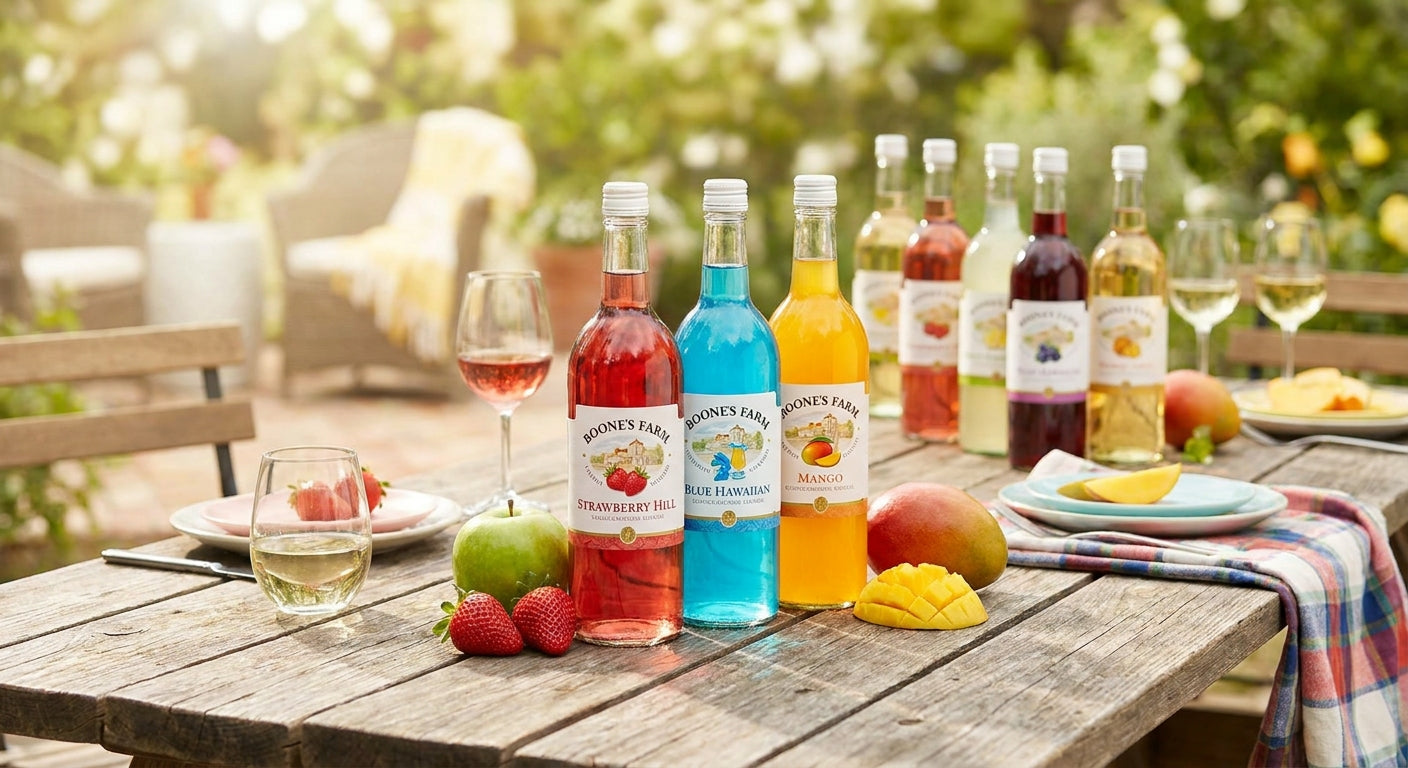
Boone's Farm has been the training-wheels wine for millions of Americans since 1961, and picking the right flavor from the lineup is easier once you know what actually separates Strawberry Hill from Sangria. This guide breaks down the flavor families, how to match one to your palate, and what to reach for once you're ready to trade the twist-off cap for something with a cork.
- Boone's Farm wine flavors split into three families: berry-sweet, citrus-tart, and sangria-spiced — pick by sweetness tolerance, not the label art.
- Strawberry Hill and Blue Hawaiian sit at the sweetest end; Snow Creek Berry and Sangria run drier and more balanced.
- Boone's Farm bottles run about 7.5% ABV, roughly half the alcohol of a standard 750ml table wine at 13-14%.
- Once the sweetness stops working for you, a 750ml rosé like Chateau d'Esclans Whispering Angel is the natural next step up in 2026.
Why this matters
Most people who search for Boone's Farm wine flavors aren't wine collectors — they're picking for a backyard party, a college dorm fridge, or a nostalgia buy. Getting the flavor wrong means a bottle that sits half-finished on the counter.
The flavor names don't tell you much on their own. "Fuzzy Navel" and "Sangria" sound like they could be equally sweet, but they land in different places on the sugar and tartness scale. Sorting flavors by actual taste profile, not marketing copy, is the fastest way to land on one you'll finish the bottle of.
What you'll need
- A sense of your sweetness tolerance (do you like soda-sweet drinks, or do you prefer something drier)
- A fridge or ice bucket — Boone's Farm and its flavored-wine cousins are meant to be served cold, around 45-50°F
- A backup bottle or two if you're buying for a group with mixed preferences
- A little patience to read past the label art, since flavor names don't always match intensity
The steps
1. Identify your sweetness baseline
Start by ranking how sweet you like your drinks on a rough 1-10 scale, with 1 being dry red wine and 10 being fruit punch. Boone's Farm flavors mostly cluster between 6 and 9 on that scale, so this step narrows the field fast.
If you land under a 5, none of the Boone's Farm lineup will satisfy you long-term — skip ahead to the "what to do next" section. If you land 6 or higher, keep going.
Common mistake: assuming all Boone's Farm flavors taste the same level of sweet. Strawberry Hill and Blue Hawaiian sit closer to a 9, while Sangria and Snow Creek Berry sit closer to a 6-7.
2. Match berry names to berry-sweet flavors
Any flavor with "Hill," "Berry," or "Melon" in the name (Strawberry Hill, Snow Creek Berry) leans into candied fruit sweetness with low acidity. These are the closest thing in the lineup to a fruit cocktail in bottle form.
These work best served over ice, which cuts the sugar intensity and stretches the bottle further at a party. Pour over ice in a tall glass rather than a wine glass — the extra dilution actually improves the drinking experience.
3. Reach for Sangria or Fuzzy Navel if you want less sugar
Sangria and Fuzzy Navel flavors carry more citrus and spice character, which reads as less cloying even though the sugar content is close to the berry flavors. If your sweetness baseline was a 6 or 7, start here before jumping to the sweeter end.
Sangria in particular mimics the fruit-and-wine-cooler style of a real sangria, so it plays well mixed with a splash of soda water or lemon-lime soda if you want to stretch it into a lower-proof spritz.
4. Check the ABV before you commit to a case
Boone's Farm flavors run about 7.5% ABV, roughly half the strength of a standard 750ml red or white table wine at 13-14%. That matters for portion planning: a 750ml bottle of Boone's Farm delivers noticeably less alcohol than the same size bottle of a Cabernet or Chardonnay.
If you're buying for a group event, plan on people finishing more bottles per person than they would with a full-strength wine — the lower ABV means less impact per glass.
5. Buy small before you buy a case
Boone's Farm bottles are inexpensive enough that buying two or three different flavors to sample costs less than a single bottle of most table wine. Grab one berry-sweet flavor, one citrus flavor, and one sangria-style flavor, then let taste settle the debate.
Common mistake: buying a full case of one flavor before tasting it. Flavor preference here is personal enough that a 2026 case commitment on an untested flavor often ends with half the bottles unopened.
6. Serve it cold, every time
Boone's Farm and similar flavored wines are built to be served at refrigerator temperature, not cellar temperature. Warm serving temperature amplifies the sugar and flattens whatever fruit character the flavor has.
If you're serving outdoors, an ice pack in a cooler keeps bottles at drinking temperature for hours longer than a warm patio table will.
7. Know when to graduate to real wine
Once a flavor stops feeling exciting — usually after a few bottles — that's the signal to step up to an actual 750ml varietal wine instead of a flavored one. The jump doesn't have to be intimidating or expensive; a lot of easy-drinking, fruit-forward wines cover similar ground with more depth.
Buywinesonline stocks over 5,000 bottles across red, white, rosé, sparkling, and dessert wine, including built-for-beginners picks that keep the fruit-forward character you liked without the sugar overload. A 15-bottle wine tasting set built as all-red, all-white, or mixed is one of the easiest ways to sample a range without guessing.
Troubleshooting
- The flavor tastes flatter than expected: it's likely been open too long or served too warm — Boone's Farm doesn't hold well past a day or two once opened, and warm serving kills the fruit aromatics.
- It's too sweet even on ice: switch families entirely — move from a berry flavor to Sangria or Fuzzy Navel rather than trying a different berry flavor.
- Guests have mixed preferences: buy two flavor families (one berry-sweet, one citrus/sangria) rather than one case of a single flavor.
- You've outgrown the sweetness but still want something easy: a fruit-forward rosé, like Chateau d'Esclans Whispering Angel Rosé, delivers real fruit character at a fraction of the sugar.
- You want bubbles instead of still wine: a Prosecco covers the same celebratory, low-commitment territory Boone's Farm does, just with more structure.


Tools and resources
- An ice bucket or cooler for proper serving temperature
- A 15-bottle wine tasting set for side-by-side comparisons once you're ready to move past flavored wine
- Buywinesonline's full catalog of over 5,000 bottles at buywinesonline.com for browsing by varietal, region, or price
- A notebook or phone note to track which flavors and wines you actually finished versus poured out
What to do next
Once you've settled on a Boone's Farm flavor family you like, the next move in 2026 is testing a real varietal wine that shares the same fruit-forward profile without the added sugar. If Cabernet is more your speed once you're past the flavored-wine phase, the Napa Valley Cabernet Sauvignon guide breaks down real Napa bottles under $50 with the same ranked, no-nonsense approach used here.
FAQ
What is the sweetest Boone's Farm wine flavor?
Strawberry Hill and Blue Hawaiian sit at the sweetest end of the lineup, both landing close to a 9 on a 10-point sweetness scale. They're best served over ice to cut the intensity.
What is the alcohol content of Boone's Farm wine?
Boone's Farm flavors run about 7.5% ABV, roughly half the strength of a standard 750ml table wine at 13-14%. That means less alcohol impact per glass than a typical bottle of Cabernet or Chardonnay.
Is Boone's Farm actually wine?
Yes, it's classified as a flavored wine product made by E&J Gallo, blending wine with added fruit flavoring and sugar. It's built for easy drinking rather than the tasting-note complexity of a varietal wine.
What's a good wine to try after Boone's Farm?
A fruit-forward rosé or Prosecco covers similar easy-drinking, low-commitment territory with more structure and less sugar. A 15-bottle tasting set is an efficient way to sample several styles at once.
How should Boone's Farm wine be served?
Serve it cold, around 45-50°F, ideally straight from the fridge or an ice bucket. Warm serving temperature amplifies the sugar and flattens the fruit character.
Does Boone's Farm flavor sweetness vary a lot between flavors?
Yes — berry-named flavors like Strawberry Hill run sweeter, while Sangria and Fuzzy Navel run drier with more citrus and spice character. Matching flavor family to your sweetness tolerance matters more than the label name.
How much does Boone's Farm wine typically cost?
Boone's Farm bottles are priced as an entry-level flavored wine, generally a fraction of the cost of a standard 750ml varietal wine. That low price point makes it cheap to sample multiple flavors before committing to a case.
One last thing
The real signal you've outgrown Boone's Farm isn't boredom with the flavor — it's reaching for ice less often. Once you start preferring a wine at cellar temperature over one drowned in ice cubes, that's the moment to move into varietal wine, and 2026's easiest entry points are fruit-forward rosés and Proseccos, not heavy reds.