
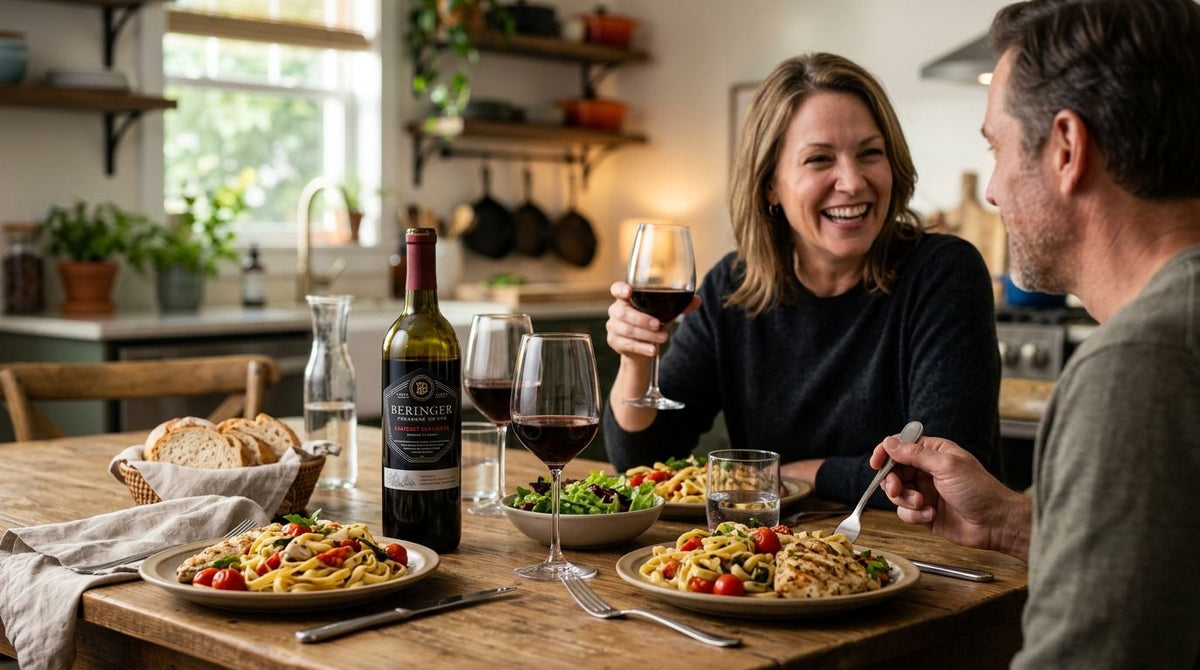
Weeknight Beringer wine means the everyday tier — Founders' Estate Cabernet, Main & Vine reds and whites — poured on a Tuesday with tacos or pasta, not the Private Reserve bottle saved for a birthday. A weeknight bottle needs to open fast, pair with whatever's already in the fridge, and skip the decanter entirely; that's a different job than a bottle bought for a dinner party or a gift.
- Beringer wine works for weeknight dinners at the everyday tier — Founders' Estate and Main & Vine, not Private Reserve.
- Chateau La Nerthe Les Cassagnes Côtes-du-Rhône-Villages 2023 ($26.95) sits in the same casual price bracket for a weeknight red.
- Stag's Leap Hands of Time Napa Chardonnay 2020 ($22.95) matches Beringer's fuller white style without the grocery-aisle hunt.
- Chill reds 10-15 minutes and whites 20-30 before a weeknight pour — no decanting required.
- Build a rotation with a mixed tasting set instead of restocking the same single bottle every week.
Why Beringer wine matters for weeknight dinners
Beringer Vineyards opened in St. Helena, Napa Valley, in 1876 and kept producing through Prohibition by making sacramental wine — one of the few Napa Valley wineries with that continuous run. That history is a big part of why the name reads as safe on a grocery shelf: no research required, a flavor most people already recognize, a price point built for repeat buying instead of a single splurge.
The tier matters more than the winery name here, and this is where most weeknight buyers go wrong. Founders' Estate and Main & Vine sit at the everyday-drinking price point Beringer is actually known for; Knights Valley and Private Reserve are built for a different night and a different budget entirely. Grabbing the wrong tier — a Private Reserve bottle over a plate of leftovers — is the single biggest reason a weeknight pour disappoints, not the producer, the tier.
For a wider look at what else belongs in that everyday-drinking price bracket beyond one label, the everyday California red wine guide covers the category in more depth. Heading into 2026, that tier logic holds regardless of which producer's name is on the label — grocery-shelf reds and whites are priced and blended for volume and consistency, not vintage-to-vintage variation, and Beringer built a business on exactly that model.
How to pick weeknight wine, step by step
The process is the same whether the bottle in hand says Beringer or something else entirely. Six steps cover it, from what's on the stove to what's in the fridge door.
Match the label to what's actually on the stove
Pairing rules for weeknight wine don't need tasting-note complexity — match weight to weight, not vintage to vintage.
- Cabernet Sauvignon and other structured reds: braises, burgers, mushroom-heavy pasta.
- Fuller Chardonnay: roast chicken, cream sauces, baked mac and cheese.
- White Zinfandel or a rosé-style pour: tacos, spicy takeout, sheet-pan dinners.
- A basic Merlot or red blend: pizza night, no decision required.
- Sauvignon Blanc or a lighter white: grilled fish, salads, anything finished with lemon.
For a fuller-bodied white in that same everyday register, Kendall-Jackson Vintners Reserve Chardonnay 2024 sits in the same style lane as Beringer's Chardonnay tiers.
Pick the right Beringer tier for a Tuesday, not a tasting
Each tier is built for a different occasion, and mismatching them is the fastest way to feel let down by a $12 bottle.
- Founders' Estate: the everyday tier, built for by-the-glass simplicity.
- Main & Vine: an entry tier meant for volume pouring, not nuance.
- Knights Valley: single-appellation, a step up — save it for a weekend dinner.
- Private Reserve: the flagship tier — skip it on a random Tuesday; it's wasted on leftovers.
If a specific tier is out of stock, or the goal is a Cabernet in the same casual price slot, Bonanza Cabernet Sauvignon Lot 9 fills it without the grocery-aisle hunt.
Set a hard price ceiling before you shop
Deciding the number in advance keeps a quick stop from turning into an upsell.
- Decide the ceiling before opening a browser tab or walking into a store.
- Treat anything above that number as a weekend bottle, not a Tuesday bottle.
- Buy two bottles of the same label instead of one of two different ones — consistency beats variety on a work night.
- Skip single-vineyard and reserve labels entirely; they're priced and made for a different occasion.
Chill it fast enough for a 6pm pour
Speed matters more than precision on a weeknight, and most home pours get the temperature backwards.
- Whites and rosé: 20-30 minutes in the freezer beats an hour sitting in the fridge.
- Reds for weeknight drinking still benefit from 10-15 minutes in the fridge — most home reds get served too warm, not too cold.
- A reusable ice pack in the fridge door speeds up both without watering the wine down the way an ice bucket can.
- Skip decanting entirely on a weeknight — it doesn't need it, and it's one more dish to wash before bed.
Build a rotation instead of restocking one bottle
A single go-to bottle runs out of goodwill by week three; a rotation doesn't.
- Keep two reds and one white in rotation so weeknight choice isn't a single point of failure.
- Rotate a mixed case instead of six bottles of the same label — variety keeps a Tuesday from feeling like a rerun.
- The 15 Bottle Fall Wine Tasting Set builds that rotation in one order instead of five separate store trips.
- Track what actually got finished versus what sat open for a week — that's the real signal for what to reorder.
Order ahead so weeknight wine isn't a last-minute grocery run
The manual version of this is a standing shopping list; the faster version is ordering it before the week starts.
- Set a standing order or a recurring reminder instead of grabbing whatever's at eye level at checkout.
- Ordering online means the label and vintage match what was actually researched, not whatever's left on a shelf.
- BuyWinesOnline's catalog runs past 5,000 wines, so the everyday-tier style Beringer built its reputation on shows up across other producers too — useful when one specific label is out of stock.
- Order roughly two weeks ahead if a specific vintage matters; weeknight convenience shouldn't mean settling for whatever's closest.
How the weeknight options compare
| Option | Best for | Starting price | Key limitation |
|---|---|---|---|
| Beringer Founders' Estate Cabernet | Grocery-aisle convenience, familiar label | Varies by retailer | Inconsistent vintage-to-vintage quality |
| Chateau La Nerthe Les Cassagnes Côtes-du-Rhône-Villages 2023 | Weeknight red with more structure than a jug wine | $26.95 | Benefits from 15 minutes of air before pouring |
| Stag's Leap Hands of Time Napa Chardonnay 2020 | Weeknight white for roast chicken or cream-sauce pasta | $22.95 | Richer style — not for someone chasing crisp and lean |
| 15 Bottle Fall Wine Tasting Set | Building a full rotation in a single 2026 order | $86.95 | Bigger upfront order than grabbing one bottle |
Verdict: Chateau La Nerthe Les Cassagnes Côtes-du-Rhône-Villages 2023 is the Buy for anyone who wants a step up from grocery-tier Beringer reds without leaving the weeknight price bracket. The tasting set is a Buy for households that go through two or more bottles a week; a single bottle of the Beringer everyday tier is a Hold if it's already sitting in the fridge.


Common mistakes weeknight wine drinkers make
- Buying whatever tier is at eye level in the store and judging an entire producer off one bad Tuesday bottle.
- Over-chilling a red meant to sit closer to room temperature — 15 minutes in the fridge, not overnight in it.
- Restocking the exact same single bottle every week until decision fatigue kills the whole habit by week three.
- Opening a Private Reserve-tier bottle on a random Tuesday and resenting it when it doesn't taste different over leftovers.
- Ignoring cork versus screw cap — a screw-capped weeknight red actually holds up better across two or three nights than most people assume.
FAQ
Is Beringer good for everyday drinking?
Beringer's everyday tiers — Founders' Estate and Main & Vine — are built for exactly that: casual, food-friendly pours meant for repeat weeknight buying. The Knights Valley and Private Reserve tiers are made for a different occasion and a different price point, so pick the tier before judging the brand.
What's the difference between Beringer Founders' Estate and Main & Vine?
Founders' Estate sits a notch above Main & Vine in structure and fruit concentration, though both are priced and blended for volume rather than vintage variation. Neither is meant to be cellared; both are built to be opened the week they're bought.
What food pairs with a weeknight Cabernet Sauvignon?
A structured red like Cabernet Sauvignon pairs with braises, burgers, and mushroom-heavy pasta on a weeknight. Skip delicate fish or light salads with it — save those for a Sauvignon Blanc or a crisp Chardonnay instead.
Do you need to decant a weeknight bottle?
No — everyday-tier reds and whites are made to drink right after opening, no decanting required. If a bottle genuinely needs 30-45 minutes of air to taste right, it's a weekend bottle, not a Tuesday one.
How long does an open bottle of weeknight wine last?
A resealed bottle in the fridge holds up for two to three days for whites and rosé, and slightly less for lighter reds. A screw cap seals better than a re-corked bottle over that stretch, which matters if the wine needs to last across a few weeknights.
What's a good pick if a specific Beringer tier is out of stock?
Chateau La Nerthe Les Cassagnes Côtes-du-Rhône-Villages 2023 and Stag's Leap Hands of Time Napa Chardonnay 2020 sit in the same everyday price bracket and both ship through a catalog of more than 5,000 wines.
How much should a weeknight bottle of wine cost in 2026?
Most everyday-tier reds and whites, Beringer included, land well under $30 a bottle in 2026, the bracket built for repeat weekday buying rather than a single occasion. Anything priced meaningfully above that is better saved for a weekend.
Is white Zinfandel a good weeknight wine?
Yes — a chilled, slightly sweet pour like white Zinfandel matches spicy takeout and taco night better than a dry red does, and it needs no decanting or special glassware. It's built for exactly the kind of casual, no-ceremony drinking a weeknight calls for.
One last thing
Beringer's home in St. Helena, the Rhine House mansion built in 1883, is a National Historic Landmark — the winery has been pouring since 1876, longer than almost anything else likely sitting on the same grocery shelf. That history doesn't change what belongs in a Tuesday-night glass heading into 2026: the everyday tier, chilled fast, matched to whatever's already on the stove, finished before the credits roll on whatever's streaming.