
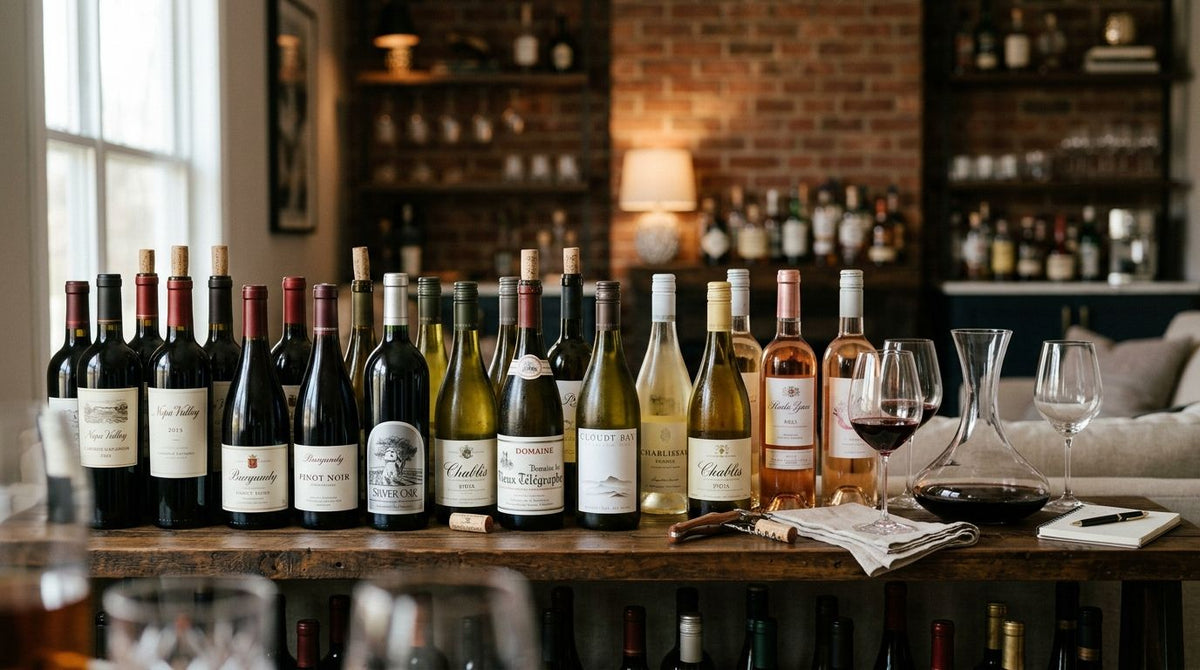
A home bar wine selection needs 12 to 20 bottles split across five core categories: an everyday red, an everyday white, a sparkling wine, one or two splurge reds for special occasions, and a dessert or fortified pour, built up over a few orders instead of bought all at once in 2026. The number that trips people up isn't the bottle count — it's storage, since a dozen bottles left upright near a stove or a sunny counter degrade faster than most people expect.
- How to build a home bar wine selection starts with a mixed case, not five separate bottle purchases — the 12-Bottle World Tour Tasting Set covers five styles in one order.
- Stock one everyday Cabernet Sauvignon under regular rotation, like Caymus Vineyards Cabernet Sauvignon 2023, for weeknight pours.
- Add a sparkling wine such as Veuve Clicquot Yellow Label Brut for toasts you can't schedule around.
- Scale from a 12-bottle starter to an 18- or 20-bottle set once you're hosting weekly in 2026.
Why this matters
Most home bars fail for the same reason: they start with 15-20 random bottles bought on impulse and end up with a third of them unopened six months later. The fix is starting with a mixed case built around the five categories that cover nearly every real drinking occasion, like the 12-Bottle World Tour Mixed Wine Tasting Set, then filling gaps as you learn what you actually reach for.
A five-category starter wastes fewer bottles than a scattershot approach, and it gives you an answer for every scenario — a Tuesday dinner, a client stopping by, or a holiday toast — without a last-minute store run in 2026.
How to build a home bar wine selection
- Cover the five categories first: everyday red, everyday white, sparkling, splurge red, dessert or fortified.
- Buy your first case as a mixed set, not five separate purchases — it forces variety and skips decision fatigue.
- Pick one "wow" bottle for guests who know wine, like Silver Oak Alexander Valley Cabernet Sauvignon 2021 or Caymus Special Selection Cabernet Sauvignon 2020.
- Restock the everyday red and white every four to six weeks in 2026 rather than all at once; keep the splurge bottles reserved instead of opened on a random Tuesday.
- Store bottles on their side, away from heat and light, and keep an ice pack on hand for warm-weather deliveries so wine arrives at the right temperature.
| Category | Example bottle | Best for |
|---|---|---|
| Everyday red | Caymus Vineyards Cabernet Sauvignon 2023 | Weeknight dinners |
| Everyday white | Rodney Strong Charlotte's Home Estate Sauvignon Blanc 2024 | Light meals, easy sipping |
| Sparkling | Veuve Clicquot Yellow Label Brut | Toasts and celebrations |
| Splurge red | Silver Oak Alexander Valley Cabernet Sauvignon 2021 | Dinner parties, gifting |
| Dessert or fortified | Port or late-harvest style | After-dinner pours |
The Starter Bar: 12 Bottles
A 12-bottle bar covers the five categories with two or three bottles each, and it's the fastest way to stop guessing at the store. The 12-Bottle World Tour Mixed Wine Tasting Set is built for exactly this — a spread of reds and whites from different regions in one order. Buy if this is your first real home bar in 2026.
The Everyday Bar: 15 Bottles
Once you're opening wine more than once a week, 15 bottles gives you rotation without waste. The 15-Bottle Fall Wine Tasting Set lets you choose all red, all white, or mixed, so the extra three bottles go toward whichever category you're actually draining faster. Buy if you host every other week.
The Serious Home Bar: 18 Bottles
At 18 bottles you're not just restocking — you're curating. The 18-Bottle Ultimate Sampler Wine Set adds room for a second splurge red and a proper dessert wine without crowding out the everyday bottles. Buy for a bar that hosts monthly dinners.
The Full Cellar Bar: 20 Bottles
Twenty bottles is where a home bar starts acting like a small cellar: multiple vintages, a couple of library-style reds, and enough sparkling wine that a toast never means a store run. The 20-Bottle International Wine Tasting Set pulls from rated selections across regions instead of one country, which suits a bar built for wine-curious guests. Buy once you're hosting weekly or gifting often.


Why bottle count varies
- How often you host: weekly entertainers need 18-20 bottles; monthly hosts do fine at 12-15.
- Storage space: a countertop rack tops out around 12 bottles before heat and light become a real problem.
- Budget rhythm: a mixed 12-bottle case spreads cost over one order instead of a dozen impulse buys.
- Gifting habits: if wine doubles as gifts, add 2-4 bottles you're comfortable giving away, not just drinking.
- Guest taste range: a bar serving both wine newcomers and collectors needs an easy Pinot Grigio and a serious Cabernet Sauvignon, which pushes count toward 18-20.
- Occasion mix: households that host both casual dinners and formal toasts need sparkling wine stocked separately from the everyday rotation.
How many bottles should a home bar have?
A home bar should have 12 to 20 bottles for most households, split across five categories instead of stacked in one style. Fewer than 12 means running out of variety fast; more than 20 without proper storage risks bottles sitting too long before they're poured.
Is a mixed tasting set better than buying bottles one at a time?
A mixed tasting set is better for a first home bar because it forces category coverage in one order instead of five separate decisions. Sets like the 15-Bottle Fall Wine Tasting Set or 18-Bottle Ultimate Sampler let you pick all red, all white, or mixed, so you're not stuck with a case of Cabernet Sauvignon and nothing to pour with fish.
Do I need a wine fridge for a home bar?
A wine fridge isn't required for a 12-bottle starter bar, but it becomes worth it past 15-18 bottles once temperature swings start affecting flavor faster than you can drink through the rack. Until then, a cool closet away from the stove and direct sun does the job in 2026.
FAQ
What's the best way to build a home bar wine selection in 2026?
Start with a 12-bottle mixed case covering everyday red, everyday white, sparkling, splurge red, and dessert or fortified wine, then restock the everyday bottles every four to six weeks. This beats buying random bottles one at a time.
How many bottles of wine should a home bar stock?
Most home bars run best at 12 to 20 bottles across five categories. Under 12 means limited variety; over 20 needs real storage to keep the wine in good shape.
Is a mixed tasting set better than buying bottles one at a time?
Yes, for a first home bar — a mixed set like the 12-Bottle World Tour Tasting Set forces category coverage in one order. Buying bottle by bottle usually skews toward one style and leaves gaps.
Do I need a wine fridge for a home bar?
Not for a 12-bottle starter bar, but it's worth it once you pass 15-18 bottles. A cool, dark closet works fine until the collection outgrows a rack.
What's a good splurge Cabernet Sauvignon for a home bar?
Silver Oak Alexander Valley Cabernet Sauvignon 2021 or Caymus Special Selection Cabernet Sauvignon 2020 both work as the one showpiece bottle in an 18- to 20-bottle bar. Reserve them for guests, not weeknights.
Should a home bar include sparkling wine?
Yes — sparkling wine like Veuve Clicquot Yellow Label Brut covers toasts and celebrations that can't be planned around a store run. Every bar past 12 bottles should have at least one bottle on hand.
What's the difference between an everyday wine and a special-occasion wine?
An everyday wine is priced and poured for regular rotation, like Sutter Home Cabernet Sauvignon or Sauvignon Blanc, while a special-occasion wine is a splurge red or aged selection reserved for guests. A well-built 2026 home bar keeps both stocked separately so the good bottles don't get opened by accident.
One last thing
The bottle most home bars skip is the everyday white, not the splurge red — people default to stocking reds and then have nothing to pour on a hot night in 2026 or alongside seafood. Add a Sauvignon Blanc or Pinot Grigio to the first case, even if red is your usual pour, and the bar actually gets used instead of admired.